
Does a swallow tattoo tell you how far someone has sailed, or where they hope to return? A swallow tattoo usually symbolizes safe return, homecoming, or loyalty, with roots in maritime tradition and the bird's migration. But the bird alone doesn't tell the whole story: its companions, pose, placement, and wearer's intentions all help shape its meaning.
Table of Contents
- What Does a Swallow Tattoo Mean?
- Where the Swallow Symbol Came From
- What the Swallow Count Really Stands For
- How Other Motifs Change the Meaning
- Does Placement Change the Message?
- Which Swallow Styles Suit Each Meaning?
- Try a Swallow Design Before You Commit
What Does a Swallow Tattoo Mean?
Say you're choosing a swallow after moving away from your hometown. To you, it might mean staying connected to family while building an independent life. Someone else could choose an almost identical bird to celebrate a relationship or mark getting through a difficult chapter. Neither interpretation cancels the other, because swallow tattoo meaning is built from inherited symbolism and personal choice together.
The historical starting point is more specific than a general love of freedom. The U.S. Navy's guide to sailor tattoos records the traditional convention of a swallow representing 5,000 nautical miles traveled. Read that number as a documented custom, evidence of what sailors observed and recorded. Modern wearers borrow it, adapt it, or set it aside entirely. Alongside the achievement symbolism, sailors associated the bird with sighting land and returning home.
Common Swallow Tattoo Meanings at a Glance
| Meaning | Where It Comes From | Who Often Chooses It |
|---|---|---|
| Safe return and homecoming | A swallow sighted at sea suggested land was near | People living far from home |
| Loyalty and fidelity | The bird's habit of returning to familiar places | Partners marking a commitment |
| Voyage milestone | The nautical-distance convention above | Sailors and long-distance travelers |
| Freedom and travel | Migration and open flight | People who value independence |
| Hope and endurance | Survival through hard voyages | People marking recovery or a difficult chapter |
The next two sections trace the maritime evidence behind these associations, including where the mileage convention sits among competing origin stories. The right-hand column lists possibilities only: you don't need to be a sailor, a frequent traveler, or part of a couple to connect with the image.
If you're comparing birds, avoid assuming they are interchangeable. Exploring hummingbird tattoo meaning can help you decide whether the swallow's emphasis on return fits your story better than another bird's symbolism.
Before interpreting a particular design, check these clues:
- Count the birds. A single swallow and a balanced pair can suggest different intentions.
- Check the companions. A ship, anchor, or dagger can change the emotional direction.
- Notice the placement. A chest composition carries a different historical context from a small wrist design.
That checklist narrows the question down to one: what does this swallow mean to this person?
Where the Swallow Symbol Came From
For a sailor nearing the end of a hard voyage, a land-associated bird meant more than a pleasant sight. It suggested familiar ground, people waiting ashore, and an approaching end to uncertainty. That experience is why the swallow became an image of reassurance, a small promise that the dangerous stretch was nearly over.
Migration added a second layer. The bird could leave familiar surroundings and later return, a pattern sailors could map onto their own departures and homecomings. A swallow works like a round-trip ticket: the departure matters less than the guarantee of coming back. Its seasonal return to familiar nesting places offered a natural metaphor for belonging across distance. The nautical compass is the other classic sailor image of finding the way home; see compass tattoo meaning.
History and Legend Aren't the Same Thing
One widely repeated origin story concerns seven sailors aboard a vessel called The Swallow. In the legend, the men took part in a mutiny and wore matching swallow tattoos to identify fellow conspirators. It is a memorable story.
That memorability is exactly the problem. In "Earning Your Ink," an article in the U.S. Naval Institute's Naval History magazine, the mutiny tale appears as legend, recounted alongside the homecoming association that carries the symbol's real weight. A story can belong to tattoo folklore without proving that every later swallow design descended from that single event.
The National Park Service's account of maritime tattoos documents the bird within sailor tattoo traditions. That historical convention provides firmer ground than claiming one dramatic origin for the entire symbol.
The swallow carried a sailor's hope home.
Loyalty grew from a related set of folk beliefs. Sailors linked the swallow's seasonal return to familiar nesting places with faithfulness, and maritime folklore held that the bird mated for life. Read as folk tradition, those beliefs explain why a single small shape could carry devotion. They describe what the symbol came to stand for in sailor culture.
A Symbol With Overlapping Purposes
A sailor never had to choose between love, luck, experience, and survival. The same tattoo could express pride in a completed voyage while keeping home and a partner in mind. One image carried several messages at once, which suited men whose work routinely took them far from familiar surroundings.
That overlap is why attempts to identify one original meaning often fall short. Ask what a swallow "really means" and you will get a sincere answer about homecoming, a second about loyalty, and a third about luck, all drawn from the same tradition.
The maritime inheritance comes down to three connected ideas:
- Returning safely, with the hope of reaching shore again.
- Staying faithful, despite separation and distance.
- Surviving hardship and staying connected to home, even when home felt far away.
Keep all three in view, and the swallow stops looking like a code to crack. It reads as a record of what the sea asked of people and what they hoped to come back to.
What the Swallow Count Really Stands For
Multiple swallows are where the symbolism starts to behave like a tally. Each additional bird could mark accumulated travel, giving the design an achievement function alongside its association with good luck.
The U.S. Naval Institute's account of earning sailor tattoos describes the older convention of one swallow for every 5,000 nautical miles sailed, while noting modern retellings that use 10,000 nautical miles per swallow because contemporary ships travel farther and faster. The traditional distances are set out below, with approximate land-distance conversions calculated from those nautical-mile figures.
Swallow Count and the Distance It Traditionally Marks
| Swallows | Traditional Reading | Approximate Distance | Modern Retelling |
|---|---|---|---|
| One swallow | 5,000 nautical miles | About 5,753 statute miles or 9,260 km | Some modern retellings use 10,000 nautical miles |
| Two swallows | 10,000 nautical miles | About 11,507 statute miles or 18,520 km | 20,000 nautical miles in the doubled retelling |
The final column needs careful reading. The doubled milestone describes how the pair works inside a counting convention. Accounts vary on the starting distance, and no formally enforced system ever governed who could wear which bird.
The older mileage figure is the more commonly cited convention. The existence of changing retellings is itself a reason to read the tattoo loosely: a swallow count signals that the wearer values the idea of earned distance, whatever the exact arithmetic behind it.
Why the Milestone Mattered
Distance at sea represented work completed under demanding conditions. Storms, illness, accidents, and the possibility of death gave a successful voyage significance beyond its length.
Within that setting, an additional swallow could communicate accumulated experience and another successful return. The achievement was enduring the journey.
That background explains why the image can still suit perseverance, even when a modern wearer hasn't sailed. Someone finishing a demanding period of life may connect with the idea of earned experience without claiming a naval biography. Partners might choose matching birds because they maintained a relationship across distance, and reading those tattoos as proof of sea travel would miss the intention completely.
Practical rule: Treat the mileage as a documented historical tradition. The number belongs to sailor custom, and nobody could verify an exact distance by looking at someone's skin.
If you're planning your own design, you can acknowledge the tradition while stating your meaning plainly: a completed journey, a difficult chapter survived, or a promise to return. That honesty serves you better than borrowing a mileage claim that doesn't describe your life, and it keeps the symbol's history intact for the people it records.
How Other Motifs Change the Meaning
Traditional sailor tattoos worked as a visual code, but the bird wasn't the only clue. The subject, pose, surrounding objects, and arrangement helped narrow the reading.
Historical scholarship published by the Australian National University connects the swallow with hopes of returning safely to land and records a more sorrowful variation: a dagger through the swallow's heart could signify lost love. That's a substantial shift from an uncomplicated image of homecoming.
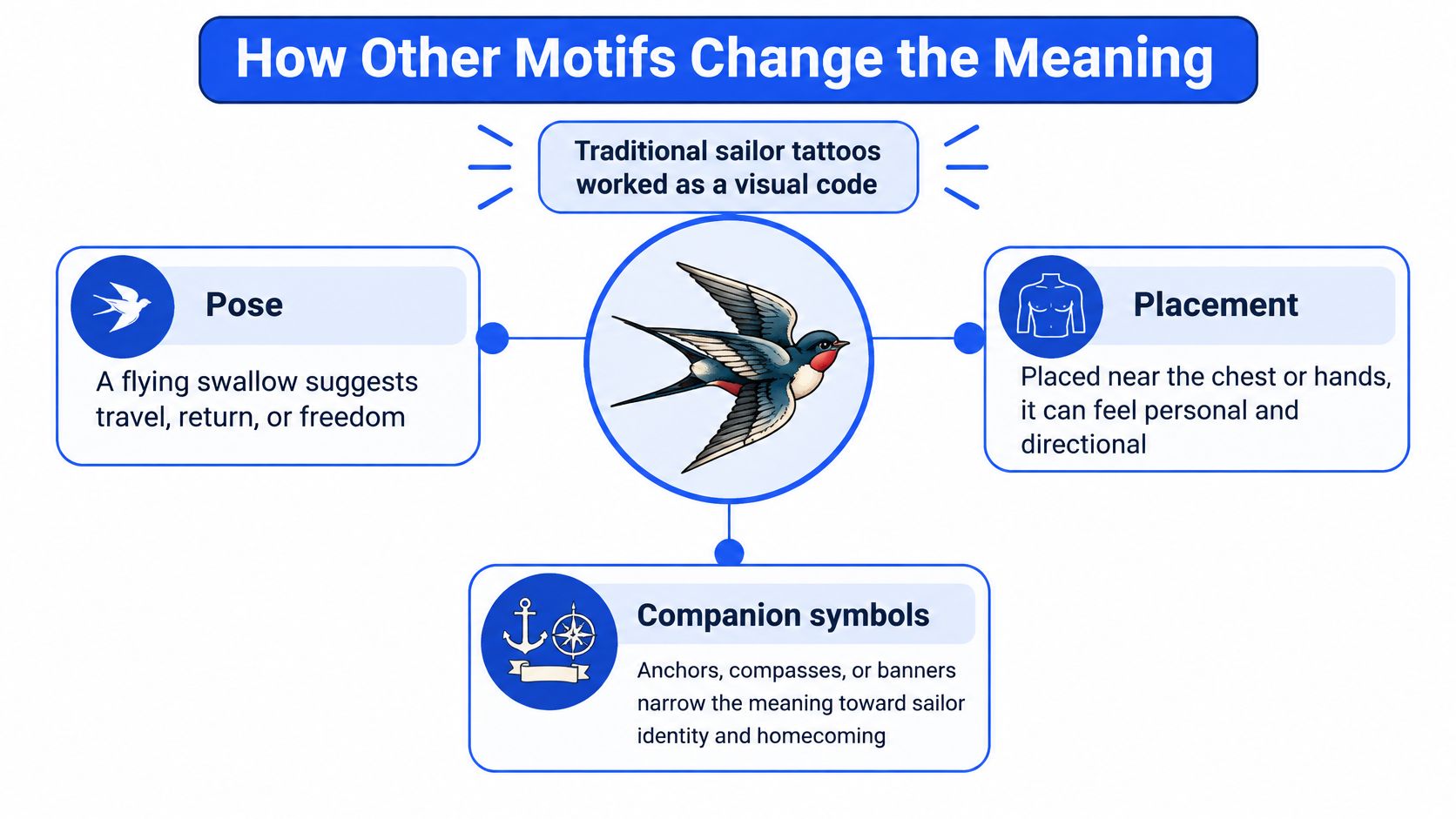
How Added Elements Shift a Swallow's Meaning
| Added Element or Pose | Shift in Meaning | Everyday Reading |
|---|---|---|
| Dagger through the bird | Lost love, grief, or memorial | Remembering someone who has died |
| Anchor | Stability and safe harbor | Steady home life or a settled period |
| Name or date | Personal loyalty or remembrance | A partner, child, or milestone date |
| Flying bird | Travel, speed, and autonomy | Wanderlust or a move to a new city |
| Perched bird | Home, fidelity, and permanence | Rooted commitment to a place or person |
| Pair of birds | Partnership or a doubled journey | A couple or a two-trip record |
A dagger changes the emotional tone. The historical lost-love association can support a modern memorial interpretation, but it doesn't prove that the wearer has experienced a particular loss. Ask rather than assume.
An anchor directs attention toward steadiness. Combined with the swallow, it can express a balance between leaving and having somewhere dependable to return to. It's a useful choice when home matters more to your story than travel itself.
A name or date makes the reference more personal. A bird carrying a partner's name may communicate commitment, while a date may mark a departure, reunion, birth, or remembrance. The lettering can clarify what the bird alone leaves open.
Pose Changes the Story Too
A flying swallow emphasizes motion. Open wings and a clear direction of travel can suit independence, a move, or a continuing journey.
A perched bird offers a quieter alternative. It can suggest arrival, staying, or building a life somewhere. That doesn't make it less hopeful, just less focused on movement.
A pair introduces a relationship between the birds. They might face each other to suggest connection, or travel together to express a shared direction. The nautical counting tradition is only one possible reading.
When comparing symbols of personal change, butterfly tattoo meaning offers another useful reference. Choose the image that expresses your intended story, rather than adding motifs because they're all described as meaningful.
Read the Combination, Not Just the Parts
Consider a small wrist swallow beside a compass. A wearer could use that combination as a reminder to pursue a travel goal or find a personal direction.
A chest swallow with an anchor reads closer to a maritime tribute. The bird, nautical companion, and placement reinforce the same theme rather than introducing unrelated ideas.
Even the dagger's reading changes with the composition. Beside a perched swallow, it might emphasize a home or relationship disrupted by loss; with a flying bird, it might suggest departure and separation. Those are possible interpretations, not historical rules for every arrangement.
The wearer's story remains decisive. Visual clues help you understand a design, but they don't give you permission to invent someone's biography.
Does Placement Change the Message?
The chest has the clearest connection to traditional mileage swallows. Sailor tradition placed the birds there, so a chest design with recognizable nautical imagery is the easiest to read as a deliberate maritime reference.
A chest swallow may or may not record a voyage; the wearer's intent decides. Someone might pick the spot because the design sits close to the heart, fits beneath a collarbone, or stays easy to keep covered.
Visible Reminders and Quieter Placements
On the wrist, ankle, or forearm, a swallow usually reads as a bird in motion: travel, loyalty, or freedom, with no mileage implied. These placements rarely function as a literal nautical logbook on their own.
A wrist design works as a reminder you see constantly. An ankle placement feels more discreet, depending on clothing and footwear. The forearm gives the bird room for a readable silhouette or a companion motif, while the shoulder and upper arm can hold a larger composition with spread wings, a banner, or an anchor.
Plan the Relationship Between Paired Birds
A swallow on each shoulder creates balance across the body. Birds on opposite wrists or ankles can mark departure and return, and partners can choose corresponding spots without wearing identical compositions.
Position shapes the story a pair tells. Two swallows side by side on one forearm stay together permanently. One per wrist only meets when the wearer brings their hands together, which suits a theme of reunion or a bond across distance. Pick positions that match the relationship you want the birds to show.
Before applying a test design, use this checklist:
- Daily visibility: Do you want to see the swallow regularly, or notice it only at certain moments?
- Privacy: Should clothing cover it easily for work or personal preference?
- Detail: Is there enough space for the wing shape, flowers, lettering, or companion symbol?
- Body position: Does the bird still look right when your arm hangs naturally or your wrist turns?
Our guide to placement spots for temporary tattoos can help you compare locations before choosing one.
Placement is one clue among several. The wearer's story decides what it means.
A discreet ankle swallow can carry a profound memorial meaning. A large chest pair may be chosen mainly for how it looks. Weigh the intended message, the available space, and everyday visibility together before you settle on a spot.
Which Swallow Styles Suit Each Meaning?
Start with the feeling you want, then choose the drawing style. Style influences how viewers read a swallow, but it doesn't lock the bird into a single interpretation.
Traditional American-style swallows use bold outlines and may include red or blue accents. They suit a classic sailor reference, especially when the intended meaning is a sailing milestone or homecoming.
Fine-line birds can feel quieter and more intimate, making them a possible fit for loyalty, a memory, or a private travel goal. Illustrated and watercolor-style treatments can emphasize freedom and self-expression instead of a historical reference.
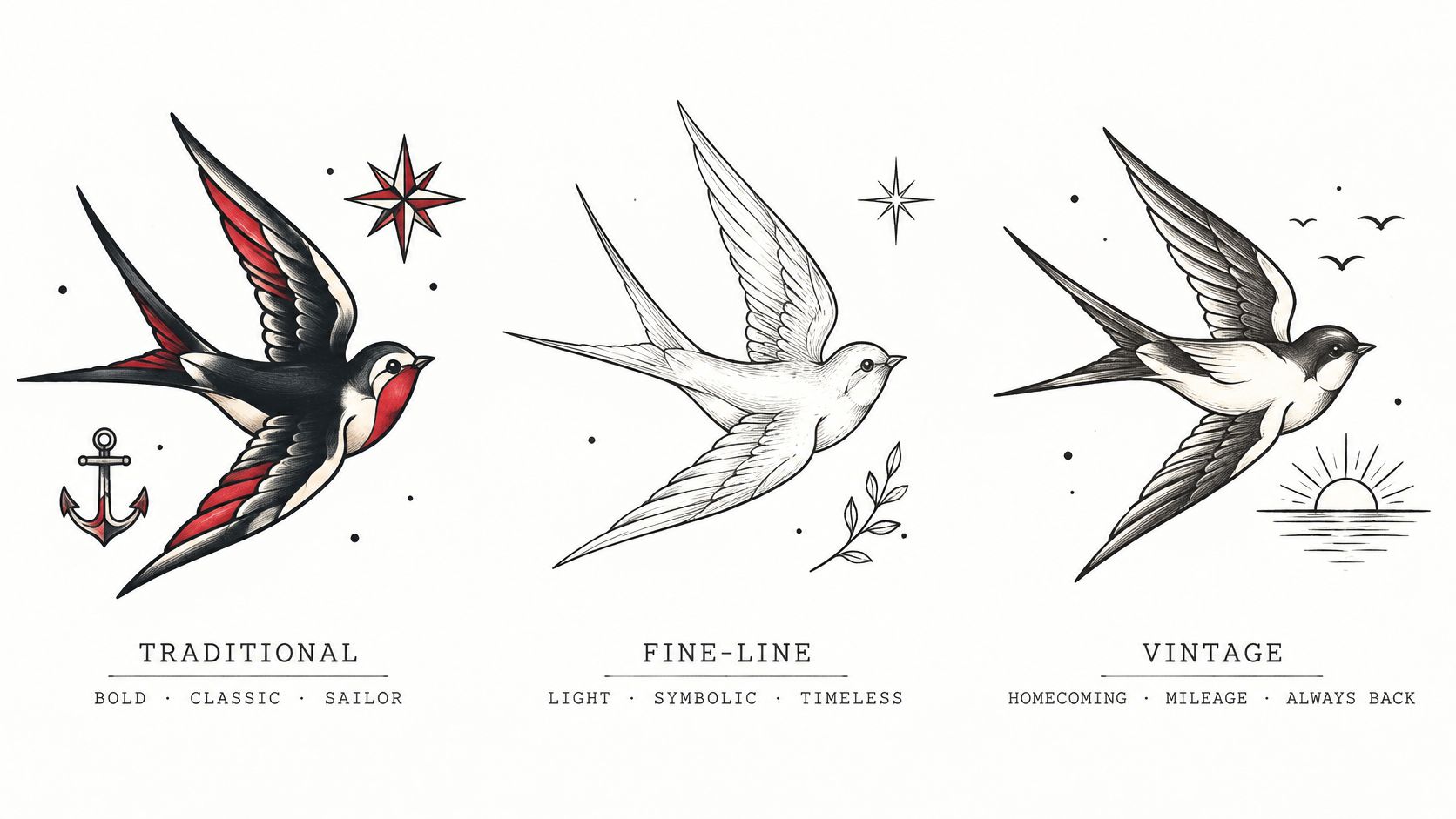
Match the Treatment to Your Intention
- A traditional swallow can suit a sailing milestone or tribute to maritime heritage.
- A fine-line pair can express partnership without making the design visually heavy.
- A floral swallow can combine return with a personal idea of growth or renewal.
For Japanese-style swallow designs, waves or blossoms can help you express change and seasonal passage. Browse the Japanese art collection for that broader visual direction rather than assuming every piece carries identical symbolism.
For a floral approach, compare the vertical swallow flowers design with other floral designs. You can also browse the full catalog to compare compositions and decide whether the bird or its surrounding details should take priority.
Try a Swallow Design Before You Commit
A meaningful tattoo still needs to feel right on your body. Liking a drawing is one thing. Liking its size, direction, and placement on your skin is another, and testing gives you room to tell the two apart.
Make the Decision in Practical Steps
- Write your meaning in a sentence. For example, you might want a reminder that you can build a new life without losing your connection to home.
- Choose supporting motifs. Keep only the details that strengthen that intention.
- Pick a placement. Consider how often you want to see it and whether you want others to notice it.
- Test before booking an artist. Look at the design with everyday clothing and in relaxed body positions, not just while posing.
At Just Tattoos, we offer semi-permanent tattoos made with plant-based ink and applied at home with no needles, for US customers. The ink develops in about 24 hours, from faint to a deep blue-black that reads like a real tattoo, so judge the placement after it develops rather than on day one. Because the ink absorbs into the skin instead of sitting on top like a sticker, the trial also shows you the matte finish a settled tattoo has.
Most designs last 7–10 days, depending on skin and placement. Follow our step-by-step temporary tattoo application guide for a clean transfer, and consider a patch test if you have sensitive skin. A patch test is a sensible first check.
Give Yourself Room to Choose
A trial run answers questions a mirror cannot. Does the bird's flight direction still read clearly when your arm rests at your side? Does the size hold its own on the forearm, or does the same drawing sit better near the collarbone? Wear it through a normal week of sleeves, showers, and workouts, and notice which version of it you keep glancing at.
You can use the trial to assess a permanent concept, coordinate with a friend for a trip, or explore a different look. You don't have to turn every design you enjoy into a lifelong commitment.
Visit Just Tattoos to find a design that fits your story of travel, loyalty, or finding your way home.