
A dragon tattoo has no single meaning: East Asian designs usually signal water, wisdom, and protection, while many Western designs signal courage, danger, or a battle overcome. The popular advice that every dragon means strength misses the details that can turn a guardian into an attacker.
The creature's anatomy and setting matter as much as its name. Wings, a pearl, a calm coil, or a burst of fire can lead viewers toward very different stories. Choose the tradition first, then check whether the picture expresses what you want to wear.
Table of Contents
- What Does a Dragon Tattoo Mean?
- What Does a Chinese Dragon Stand For?
- What Does a Japanese Dragon Tattoo Mean?
- What Does a Western Dragon Tattoo Mean?
- How Do Color Pose and Claws Change Meaning?
- Where Do Dragon Tattoos Usually Go?
- Is a Dragon Tattoo Respectful to Wear?
- Try the Design Before You Commit
What Does a Dragon Tattoo Mean?
Ask five people what a dragon tattoo means and you will hear five confident answers. Most of them will be wrong for the design in front of you, because the word dragon is the least informative part of the picture. A dragon tattoo draws its meaning from the tradition the artwork borrows from, and East Asian and European designs often place the same raw power in very different relationships with people.
Dragon tattoo meanings by tradition
| Tradition | Core meaning | Typical visuals | Common intent |
|---|---|---|---|
| Chinese | Rain, water, prosperity, imperial authority | Long serpentine body, no wings, clouds, flaming pearl, claw count | Protection, good fortune, status |
| Japanese | Water, wisdom, protection, resilience | Scaled body, claws, waves or clouds, expressive face | Guardianship, courage, personal strength |
| Western medieval | Danger, a foe, or evil opposed | Wings, fire, horns, a knight or treasure | Conquest, defiance, overcoming fear |
| Guardian dragon | Keeper of knowledge or treasure | Coiled body, hoard, watchful pose | Protection, secrecy, stewardship |
| Modern fantasy | A personal myth assembled from mixed sources | Mixed wings, fire, and magic motifs | Independence, story, identity |
Treat these rows as broad symbolic readings that shift with each artist and wearer. Guardian dragons cross categories, and modern fantasy artists often combine features that never belonged to a single historical tradition. The common-intent column describes ways a wearer might use the imagery within each tradition's loose boundaries.
Separate the creature from its role
A dragon can be the protector, the threat, or the survivor of a struggle. Look at what it is doing before deciding what it means.
A creature sheltering something fragile sends a different message from one breathing fire at a fleeing figure. Both designs can share wings, horns, and claws, yet the relationship between the dragon and its surroundings flips the reading from menace to guardianship.
Practical rule: Describe the action in the design before choosing a symbolic label. A dragon guarding, searching, resting, or attacking tells a clearer story than a dragon alone.
Someone who wants a reminder of patience might choose a composed river dragon. Someone marking a difficult challenge overcome might prefer a dramatic confrontation scene. Each design carries its own specific story.
When features send mixed signals
Viewers read a dragon's features before they ever learn your intent. A winged, fire-breathing creature reads as aggression first, and it will not communicate imperial good fortune on its own. A long serpent moving through clouds reads as calm and auspicious, and it will not look like a monster a hero must defeat.
Mixing traditions is allowed. A hybrid design just needs a clear personal explanation, because without one, a viewer will notice the aggressive features first even when protection was your starting point.
What Does a Chinese Dragon Stand For?
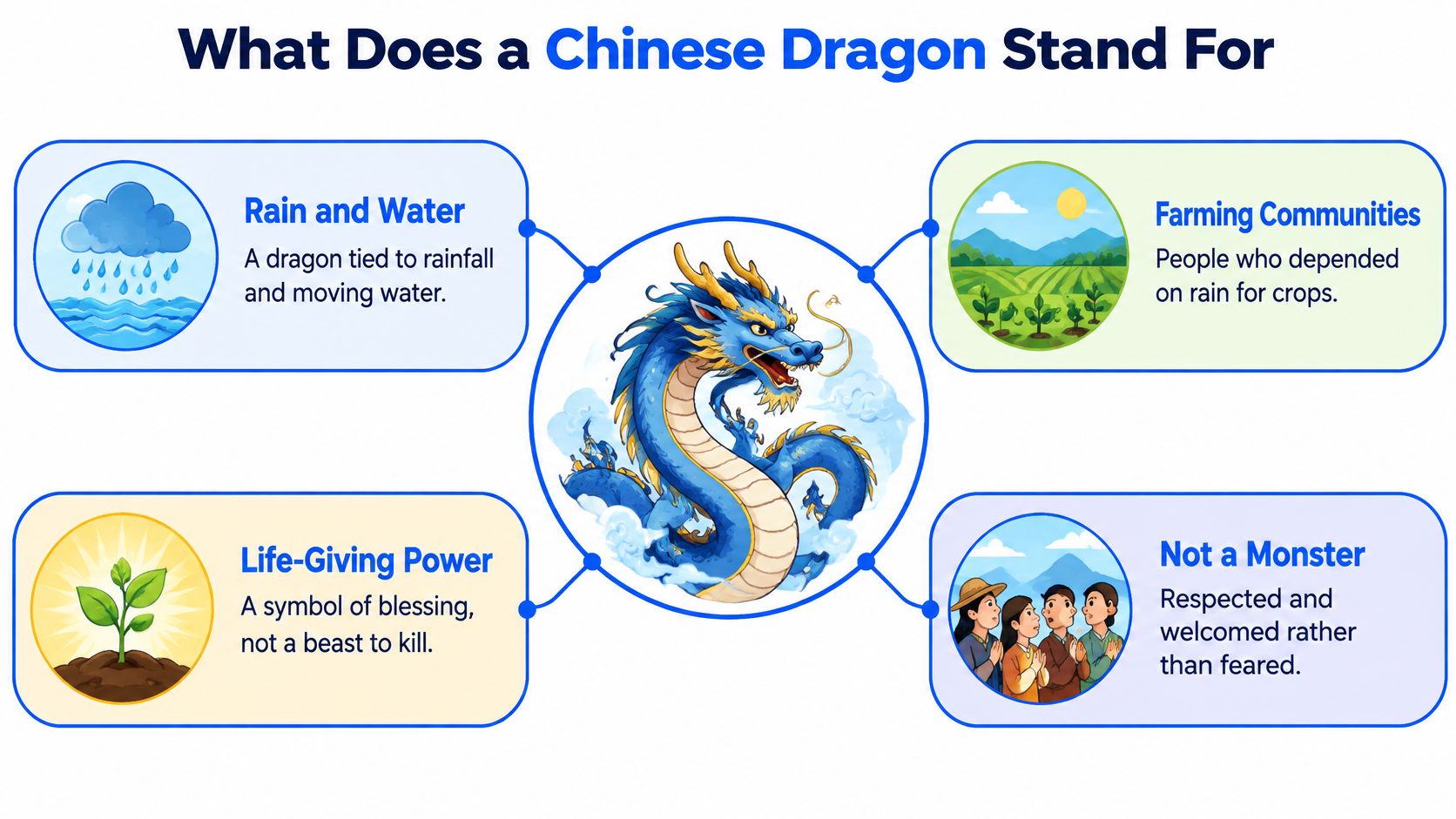
A Chinese dragon works less like a monster outside a castle and more like a river in storm season: formidable, but something people depend on. Power over water means the ability to sustain crops and livelihoods, which is a very different kind of strength from the ability to frighten.
The Shanghai Municipal Education Commission's cultural overview connects Chinese dragons with rainfall, agriculture, the East, and imperial power, and identifies the dragon as the only mythical creature among the 12 Chinese zodiac animals. Those connections explain why a Chinese dragon tattoo can suggest prosperity, protection, or authority rather than aggression.
Start with water, then add wisdom
The Smithsonian's National Museum of Asian Art describes Chinese dragons as divine rulers of moving water that could rise into clouds, control weather, and bring life-giving rain. It also explains the flaming pearl associated with dragons as a symbol of wisdom, enlightenment, or the pursuit of higher understanding.
That pearl changes the tattoo's emphasis. A dragon reaching toward it reads as strength guided by understanding, a creature in pursuit of insight. Pose and direction do the heavy lifting here: the same dragon can look protective or aggressive depending on where its body leans and where its gaze lands.
Say you want a design to mark becoming more thoughtful under pressure. A dragon extending toward a pearl supports that story more clearly than a dragon baring its teeth with no surrounding imagery. A coiled, watchful posture suggests guarded patience, while a lunging posture tilts the same creature toward menace.
Read the whole scene
When reviewing a Chinese-inspired design, look for a coherent relationship between its main elements:
- The body: A long, serpentine form establishes the creature's flowing shape.
- The environment: Water and clouds give the dragon somewhere meaningful to move.
- The focal object: A pearl can make the pursuit of understanding central to the composition.
- The expression: An attentive face supports a calmer mood; an attacking one tilts the design toward aggression.
These clues work together. Give the pearl a job in the scene, something the dragon reaches for, chases, or guards, and it becomes part of the story instead of a filler shape.
If you're weighing aquatic imagery, the guide to koi fish tattoo meaning can help you distinguish the story you want from the broader appeal of water-themed art. Two creatures can share the same river and still tell very different stories.
What Does a Japanese Dragon Tattoo Mean?
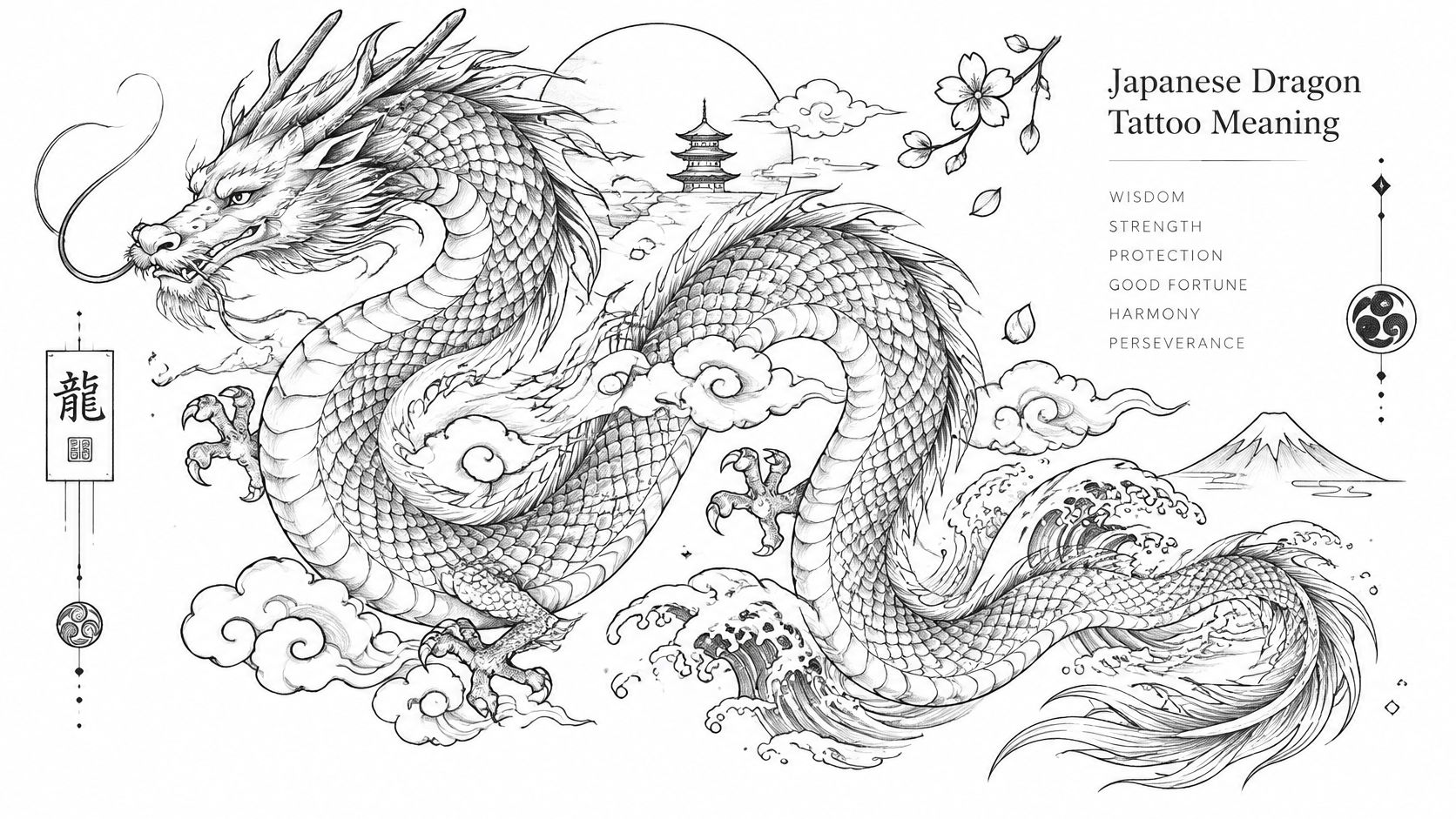
A Japanese dragon tattoo often expresses protective strength, wisdom, courage, and resilience. Its details belong to a specific tradition shaped in Japan, with its own gods, water imagery, and print-era designs. In East Asian art the dragon is often paired with the tiger, which carries its own set of readings covered in our tiger tattoo meaning guide.
The Seattle Asian Art Museum's account of Japanese dragon tattoos describes imagery familiar in Japan as traveling from China through the Korean Peninsula before taking on local stories and artistic forms, and places the development of Japanese tattoo imagery in the Edo period, 1615–1868, when tattooing interacted closely with illustrated-print culture.
Understand the water connection
Japan Search's dragon gallery describes influences from Japanese snake gods, Indian Naga, and Chinese dragons. It also explains that people prayed to dragon gods, or Ryujin, for rain needed for rice cultivation.
That background supports associations with water, weather, fertility, and protection. A fierce face can express a protector's force; the clue is whether the body guards the scene or tears through it.
- Look for continuity: A long body moving through waves or clouds creates a connected scene.
- Read the face: An alert expression can communicate vigilance without an attacking pose.
- Keep the context: Treat the setting as part of the meaning, not optional filler.
Study the water-and-cloud compositions associated with Japanese-style artwork before settling on a silhouette. Judge what the strength appears to serve: rain, harvest, a boundary, or the wearer's own discipline.
Make the protective intention visible inside the picture. Waves that carry the dragon forward, clouds that frame a watchful head, and claws held ready without striking can keep the design on the guardian side; a dragon shown breaking the setting apart pushes toward aggression.
What Does a Western Dragon Tattoo Mean?
A Western dragon tattoo can represent danger confronted, independence, conquest, or something fiercely protected. Its role matters more than the assumption that every winged dragon is evil.
The historical study hosted by the Rockwell Center for American Visual Studies traces the Greek and Latin terms drakōn and draco to large or supernatural serpents, with later European forms incorporating influences from sea monsters and winged demons. It also discusses dragons as both destructive forces and guardians of knowledge or treasure.
That background helps explain the tension in Western imagery. The dragon can be the obstacle a hero faces, but it can also be the being entrusted with something valuable.
Read who holds the power
Consider these different compositions:
- A dragon slain beneath a sword: A wearer might use this as a personal image of victory over fear. The dragon represents the challenge rather than the wearer.
- A dragon hoarding gold: This can suggest intimidating power or a dangerous attachment to possessions. The treasure makes the confrontation part of the story.
- A watchful dragon curled around a keep: The creature becomes a defender. Its strength protects a boundary rather than breaking through one.
These are interpretive examples, not fixed medieval definitions. A modern wearer can choose a personal meaning, but the visible action should help another person understand it.
A guardian and an aggressor can have the same teeth. What they protect or threaten makes the difference.
Give a personal interpretation something visible
If your intended word is resilience, decide how the artwork expresses endurance. A dragon holding its ground creates a different impression from one burning everything around it.
If your word is guardian, include a protected place, object, or figure. If your word is conquest, decide whether the dragon is the victor or the defeated opponent. Leaving that relationship unresolved can make your explanation harder to read.
People drawn to surviving hardship may also compare phoenix tattoo meaning. The practical distinction is whether your chosen image centers on a struggle, a protected treasure, or renewal.
Western and fantasy dragons are useful choices when you want a visual language of conflict, independence, or defended boundaries. They're less direct choices for a story centered on rainfall or imperial harmony, unless you're deliberately creating a hybrid.
You don't need to erase the creature's menace to make it protective. You need to show where that menace is directed.
How Do Color Pose and Claws Change Meaning?
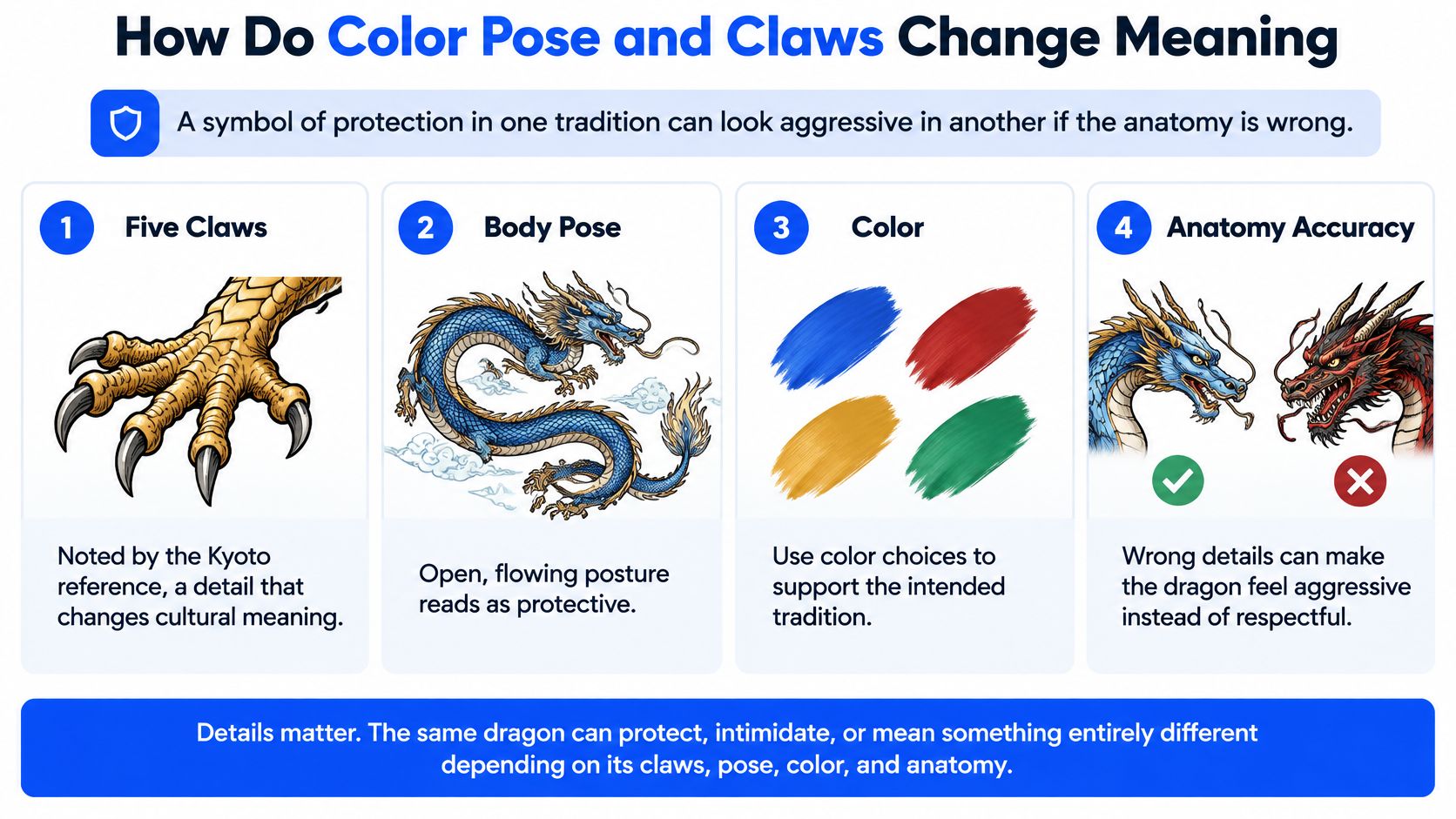
A dragon coiled calmly around a pearl and the same dragon mid-lunge with jaws open can share every scale and still tell opposite stories. Before choosing colors, inspect the feet, wings, surrounding objects, and body position, because each one can tip the design toward protection or attack.
Two details from the Chinese tradition matter here because they carry straight into your reading of a design: a five-clawed dragon points to imperial rank, and a flaming pearl shifts the message toward wisdom and the search for insight. The Kyoto National Museum's dragon exhibition overview records that the five-clawed form was, for a period, reserved for the emperor's use, which is why claw count still reads as a claim about authority.
Design features that shift a dragon tattoo meaning
| Feature | Often reads as | Meaning it can add | Watch-out |
|---|---|---|---|
| Five claws | Imperial Chinese | Authority and court rank | Historically tied to the emperor, beyond generic bravery |
| Flaming pearl | Chinese | Wisdom, enlightenment, a search for insight | Strength alone is no longer the whole message |
| Wings | Western or fantasy | Otherworldly power or battle | Can cancel a wingless water-dragon reading |
| Fire breath | Western | Ferocity and danger | Fights a luck or harmony message |
| Clouds or waves | East Asian | Rain, weather, protection | Nearby fire mixes different stories |
| Calm coil | East Asian control | Mastery and balance | A lunging pose reads as an attack |
| Black line work | Any style | Keeps a fierce pose from reading as cartoonish | Drops the festive signal red or gold can carry |
| Red or gold accents | Often festive East Asian color | Vitality or fortune | Color is a hint, and impressions vary by context |
Use the table as a design-reading checklist. Pose and palette describe the impression a viewer is likely to get, and an individual artist can always assign a meaning of their own.
Check action before atmosphere
Start with claws and any object the dragon touches, since those details can introduce specific historical or symbolic associations. Then weigh wings and fire, which can pull an otherwise flowing composition toward a Western or fantasy reading.
Trace the body from head to tail. A relaxed coil suggests power held in reserve; a forward lunge with exposed teeth reads closer to attack. That difference matters most when you explain the drawing to an artist, because "fierce" and "threatening" call for different lines.
A quick test: cover the background with your hand. If the dragon alone looks aggressive, soft clouds around it will struggle to change the impression.
- For watchfulness: Choose a stable body and a clear subject under guard.
- For confrontation: Keep the direction, tension, and target of the attack visible.
- For pursuit: Give the dragon an object of attention rather than decoration.
Use color as support, not proof
Black and gray reads restrained and serious across several styles. Red or gold may echo festive East Asian palettes, and neither shade settles the meaning by itself.
Red can look celebratory or dangerous depending on what the body is doing. Gold can suggest prosperity or warm the palette. Let the pose establish the message first, then check whether the palette reinforces it.
For winged storybook creatures, explore fantasy designs with a clear intention: personal myth, luck, or conflict. Adding wings to a cloud dragon can be a deliberate hybrid. Doing it because an unrelated reference looked attractive is how a protective symbol ends up reading as a threat.
If the long, coiled body is the part that draws you, comparing snake tattoo meaning can help separate your interest in that shape from your interest in dragon symbolism.
Where Do Dragon Tattoos Usually Go?
Placement frames the story; it isn't a luck chart. Choose a body area that can hold the dragon's shape without losing the details that matter to you.
A long East Asian body needs a route. A compact winged creature needs enough width for its silhouette, especially if the wings are essential to recognizing it.
Placement and dragon shape pairings
| Placement | Dragon shape it holds | Example style |
|---|---|---|
| Spine, rib, calf, or shoulder-to-forearm wrap | Long East Asian body with clouds or waves | Japanese illustrative |
| Upper arm, thigh, chest, or shoulder blade | Compact Western or fantasy dragon with wings | Bold blackwork |
| Wrist, ankle, or finger | Single head or tiny coil | Fine black line |
| Sleeve | Dragon joined to waves or blossoms | Full color when red, gold, or painted scales matter |
Fit the drawing to the available space
For a calf or spine placement, check whether the head, body, and tail follow a comfortable line. Avoid choosing a broad composition and squeezing it narrow just to make it fit.
On an upper arm or shoulder blade, assess the wings at their widest point. If the outer edges disappear around the body's curve, the dragon may look different from the flat reference.
Small placements need a simpler brief. A single head or tiny coil can remain recognizable, while a full scene with claws, pearl, clouds, and scales may become visually crowded.
Scale check: Identify the detail that carries your meaning. If you can't distinguish it at the intended size, simplify the drawing or choose a larger placement.
Let style serve the story
Japanese illustrative work can give water and clouds enough structure to feel integrated. Fine black line can suit a quiet guardian, while bold blackwork can emphasize the outline of a fierce Western creature.
Full color makes sense when painted scales or particular accents are central to the composition. It shouldn't compensate for an unclear pose or a missing focal point.
A sleeve gives an artist room to join a dragon with waves or blossoms. It also gives you more room to mix conflicting references, so keep the visual story deliberate. A knight-slaying scene combined with imperial features needs more explanation than either composition on its own.
Compare dimensions and silhouettes across the full design range before deciding on a location. Assess the design with your arm relaxed, your body moving, and your usual clothing on, rather than judging only a carefully posed view.
Is a Dragon Tattoo Respectful to Wear?
A dragon tattoo can be a thoughtful choice. The respectful test is direct: know which tradition you're borrowing from, and understand the details you're borrowing with it.
Meanings shift across regions and eras, so a concrete check beats hunting for one universal rule. Ask the artist which reference book, museum collection, or school of drawing shaped the design. The answer tells you whether your dragon has a traceable lineage or is a loose collage of striking parts.
Check the reference, not just the label
- Name the tradition: If your reference is Chinese or Japanese, describe it accurately rather than calling it a generic religious symbol.
- Understand specific details: A pearl, spread wings, or court-associated features each carry their own weight. Decide whether those associations belong in your story, since bared claws and a coiled pose can turn a guardian into a threat.
- Ask about the lineage: Find out whether the artist can name the period, region, or collection behind the body shape, the setting, and any culturally specific objects.
An artist who can answer those questions gives you more than a picture that looks Asian. You get a dragon whose parts point in the same direction.
Keep your explanation modest
You can say a river dragon represents steady patience to you without claiming patience is its universal traditional meaning. That distinction leaves room for personal connection without rewriting a culture around your tattoo.
Avoid claiming ritual authority or spiritual status the design doesn't establish. Show the homework instead: name the tradition, name the feature, state your reason plainly. "A river dragon reminding me to stay steady under pressure" is clearer, and more convincing, than a long list of borrowed symbolic claims.
Try the Design Before You Commit
A dragon that reads as calm guardianship on a phone screen can read as open aggression once it sits across your forearm. Scale, angle, and the direction of the claws all shift when flat artwork wraps around a moving body. That gap between screen and skin is exactly what a test run is for.
Just Tattoos offers 300+ artist-made designs in semi-permanent, plant-based ink you apply at home with no needles. The catalog includes a fantasy collection plus 42 full-color designs such as koi, phoenixes, sunflowers, and cherry blossoms, so you can trial both the pose and the palette before booking any permanent appointment.
Give the design time to develop
Black-ink designs develop over roughly 24 hours, moving from faint to a deep blue-black that reads like real tattoo ink, and most designs stay visible for 7–10 days depending on skin and placement. Judge the piece on day two, not minute two. A coiled tail that looks subtle while the ink is still settling may dominate the whole composition once the full shade arrives.
Because the ink absorbs into the outer layer of skin, the trial piece wears like healed work through showers and gym sessions, with no shiny film or peeling sticker edges. If you have sensitive skin, a patch test is a sensible first step, though it is no guarantee against a reaction.
- Assess the silhouette: Check that the head, wings, and tail still read clearly at your chosen size and placement.
- Test the message: Ask someone what they see before you explain your intention. If they say "attack" and you meant "protection," the open jaws or spread claws may be doing the talking.
- Compare your routine: Watch the placement through a week of sleeves, bags, and movement to see whether it still feels like yours.
Our guide to temporary tattoos for men walks through similar placement thinking, and the same shape-and-scale checks apply regardless of gender.
Know the order details
Just Tattoos ships from Tucker, Georgia, to all 50 states, with orders leaving within 1–3 business days. Shipping is $4.99 flat, free on orders of $35 or more. For a winged dragon built around a personal story, the fantasy collection is a practical starting point: wear it for the full week and see whether the meaning you intend is the one people read.
Just Tattoos offers realistic-looking, plant-based semi-permanent tattoos you can apply at home without needles. Visit Just Tattoos to compare dragon-inspired and fantasy artwork, then choose a design whose pose and details express the meaning you want to wear.