
A hummingbird tattoo most commonly symbolizes joy, resilience, freedom, and renewal, with roots in Aztec associations of rebirth and warrior memory, and its exact meaning shifts with color, flight direction, and your own story. If most lists call this bird delicate, why did older traditions link it to warriors? That question matters, because the strongest designs don't copy a generic definition. They choose one specific reason the bird fits your life.
Table of Contents
- What Does a Hummingbird Tattoo Mean
- The Aztec Roots of Hummingbird Symbolism
- Why Hummingbirds Symbolize Resilience and Freedom
- How Color and Companion Motifs Change the Meaning
- Placement Ideas and Style Variations
- Cultural Respect and Common Misreadings
- Try It Before You Commit
What Does a Hummingbird Tattoo Mean
What can a small bird say through a tattoo? For many wearers, a hummingbird represents joy, resilience, freedom, love, or remembrance. The meaning depends on the wearer: a songlike, jewel-toned bird may celebrate happiness, while a quiet blackwork bird may honor someone they have lost.
Read the meaning in three layers. The public reading is what a stranger sees at a glance. The cultural history is what a tradition documents. The personal layer is usually the one that matters most years later.
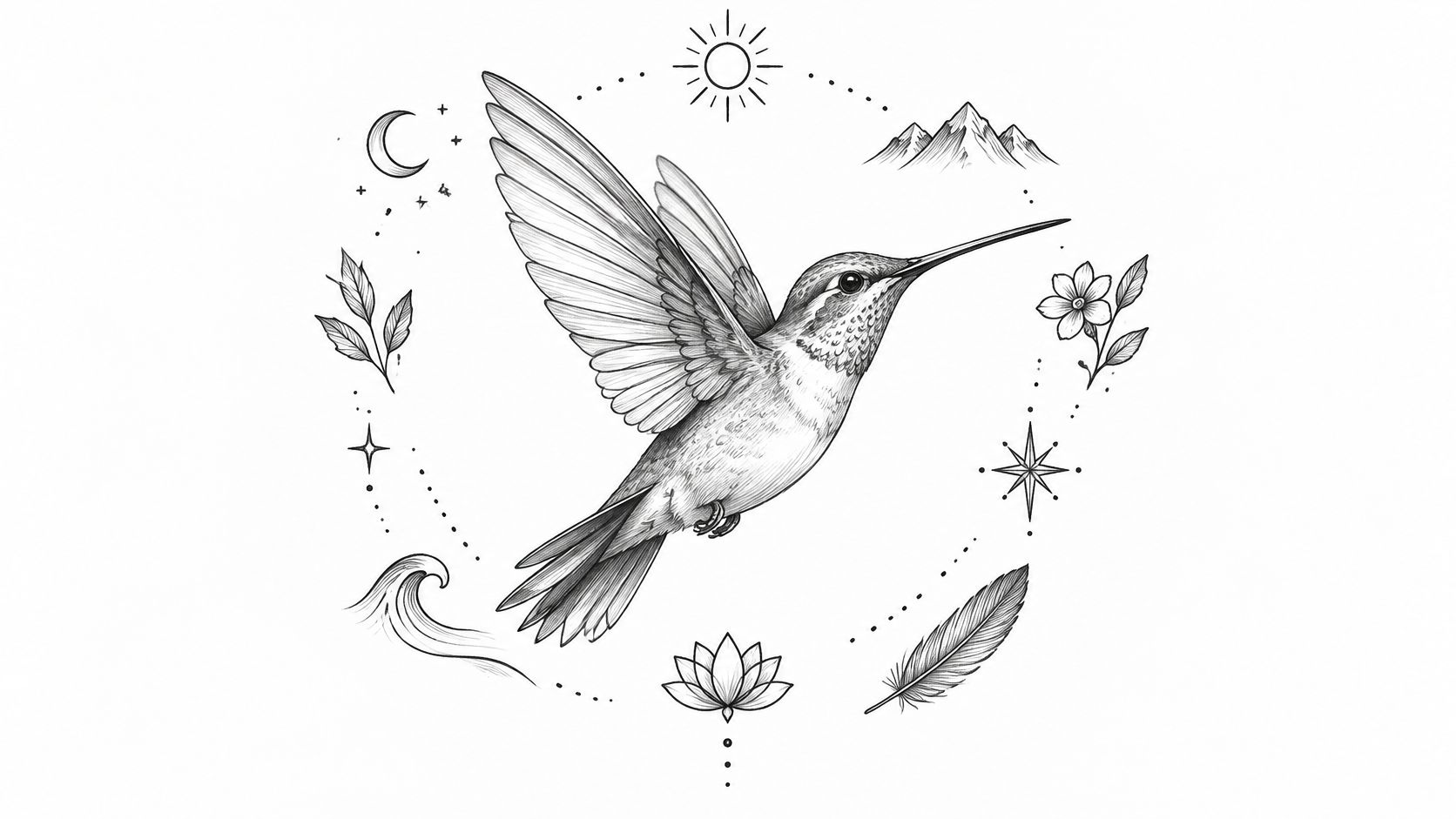
Five Common Readings at a Glance
- Joy: A darting bird among bright flowers can suggest curiosity and appreciation for small pleasures.
- Resilience: A bird pressing onward may mark survival after illness, grief, or a difficult transition. A single feather carries a related idea of freedom; see feather tattoo meaning.
- Freedom: Open wings and surrounding space can express independence.
- Love: Paired birds or a hummingbird beside a meaningful flower may represent devotion or connection, which also makes it a thoughtful pick from our temporary tattoo gift ideas.
- Remembrance: Initials, dates, or a loved one's favorite bloom can give the design a personal memorial meaning.
Small and quick, the hummingbird can carry a fierce meaning. Historical context, covered below, supports a reading beyond delicacy. You can choose which part of the bird's story matters to you, then use details such as color, flight direction, and companion motifs to make that choice visible.
The Aztec Roots of Hummingbird Symbolism
The hummingbird's seasonal return gave it a place in Mexica, often called Aztec, ideas about renewal. People observed the birds disappearing during the winter dry season and returning in spring, a cycle they understood through the language of death and rebirth.
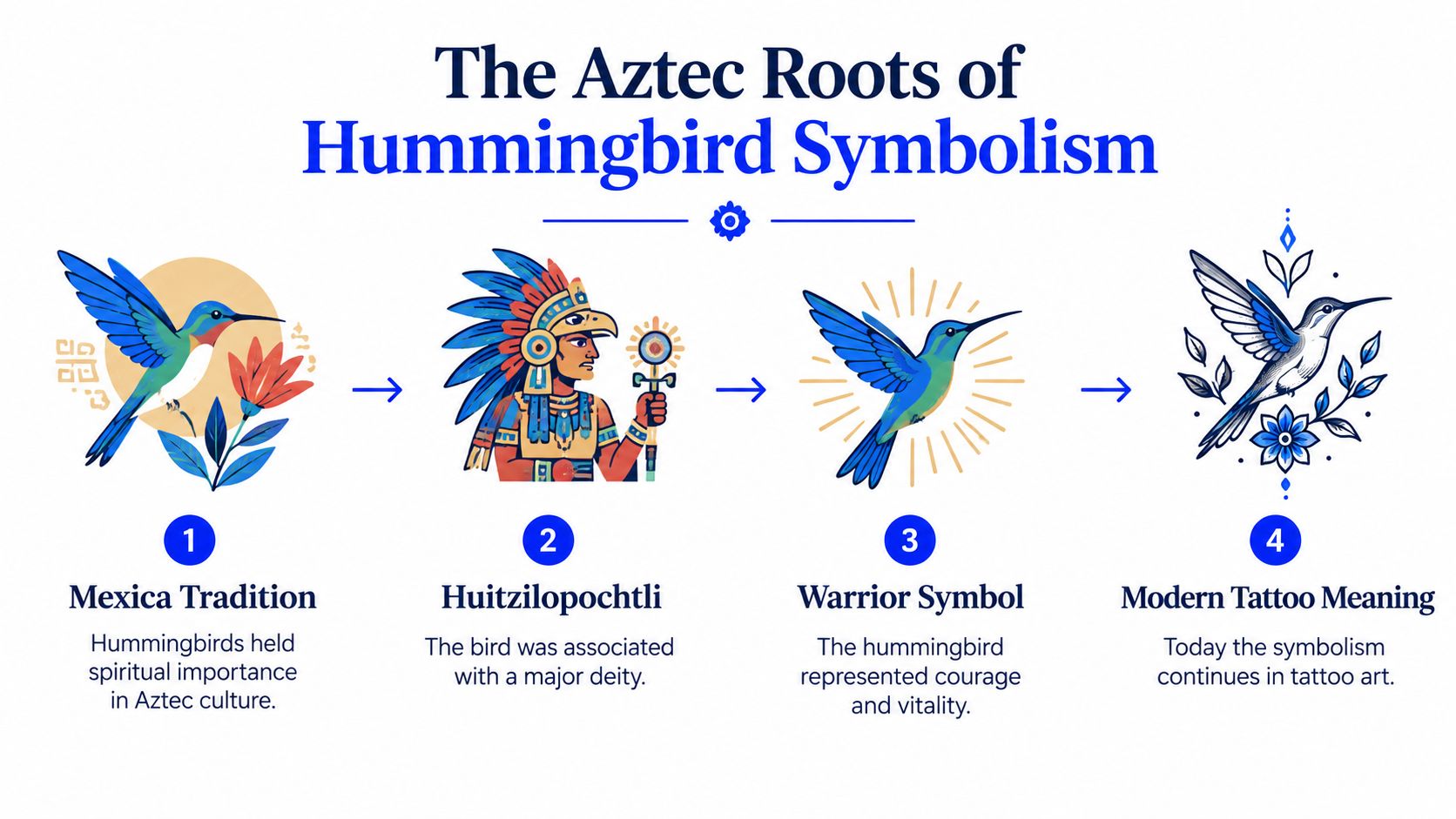
The bird was also associated with Huitzilopochtli, a major deity connected with war and the sun. Scholars who study Mexica religion read the name as “hummingbird of the south” or “left-handed hummingbird,” though the precise translation remains debated.
The Mexicolore account and the Natural History Museum of Los Angeles County's learning resource on Aztec hummingbird symbolism both describe a belief that warriors who died in battle could return as hummingbirds. The museum resource also discusses the bird's association with rebirth and renewal in Central and South American cultures.
That seasonal story can give a tattoo a personal connection to recovery, a major transition, or remembrance. For a memorial design, the cycle may suggest continuity alongside grief.
Rebirth here doesn't mean pretending a hard chapter never happened. It means showing that life continues after it.
A bird flying forward and one hovering can express different ideas: progress or steadiness. Present the Aztec associations as dated, specific history, and let the wearer decide whether to build on them.
Why Hummingbirds Symbolize Resilience and Freedom
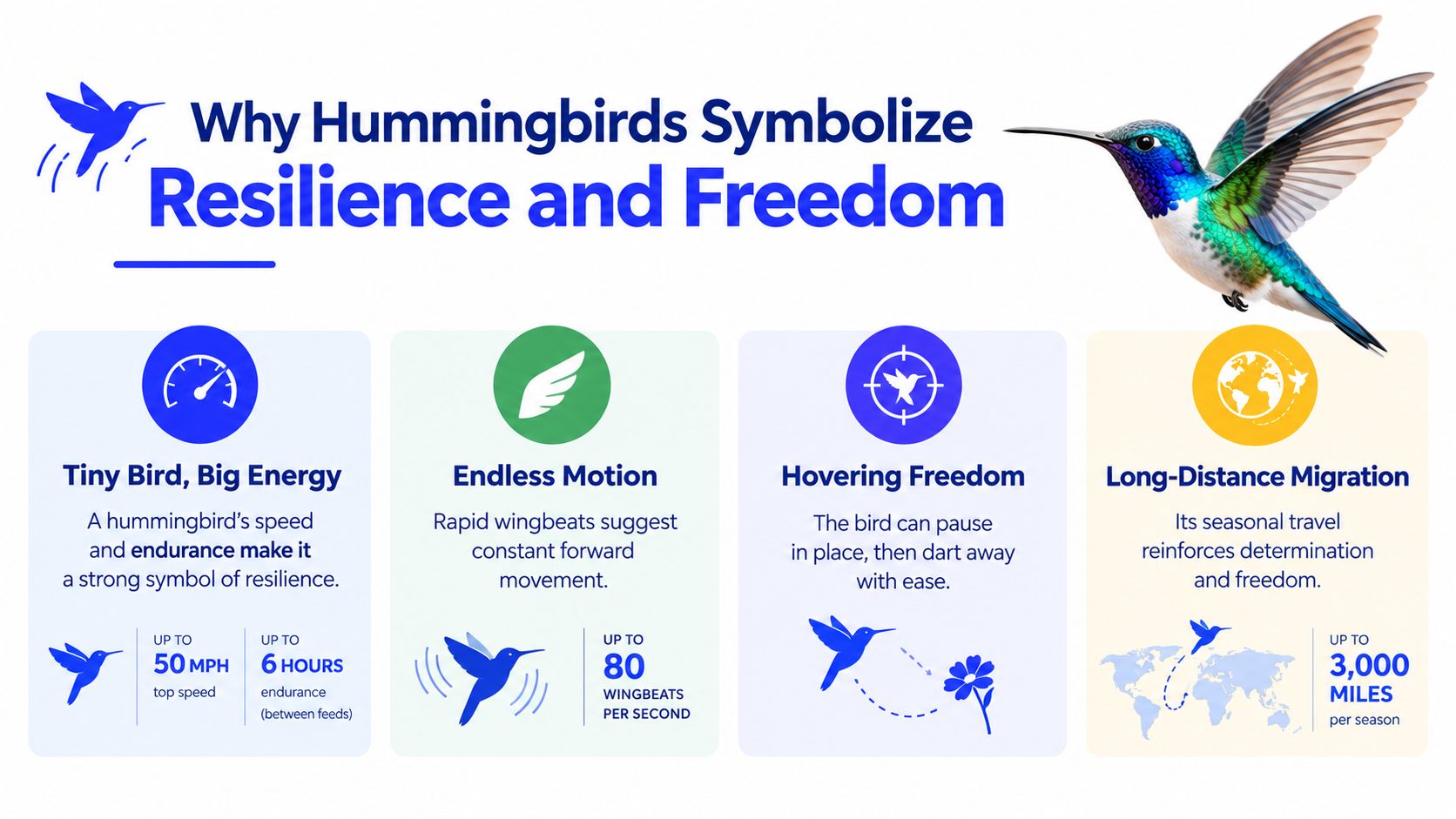
A hummingbird's small size makes its endurance especially striking. The Smithsonian's National Museum of Natural History account of hummingbird migration reports that the rufous hummingbird migrates approximately 3,900 miles, equivalent to about 78.4 million body lengths. That scale offers a biological parallel for a tattoo about persisting through a difficult period. Whether it fits a wearer's story depends on the person, not on a universal meaning.
Flight as a Symbolic Engine
- Sustained flight: The Smithsonian's National Zoo guide to hummingbirds notes that ruby-throated hummingbirds can fly roughly 18 to 20 hours straight across the Gulf of Mexico, relying on stored fat and favorable winds. For a tattoo, that long effort can suggest endurance.
- Energy: The same guide describes hummingbirds' unusually high energy demands. A forward-flight design can pair that biological intensity with a personal idea of determination.
- Hovering: Eindhoven University of Technology's explanation of how hummingbirds hum reports wing movement of about 40 beats per second during hovering. The ability to hold position and change direction can suggest agility or composure.
Hovering offers a different image from a long migration: staying steady while remaining ready to move. That interpretation is personal shorthand, not a survey result about tattoo owners. For another example of animal symbolism shaped around persistence, this guide to koi fish tattoo meaning explores a distinct visual tradition.
For a hummingbird, freedom can mean sustained effort. The bird keeps working to stay airborne, giving the image a sense of motion shaped by energy and control.
How Color and Companion Motifs Change the Meaning
Two hummingbird tattoos can use the same outline and say opposite things. Color is usually the quickest signal. Black and grey often reads quieter and more reflective, suited to remembrance or inner strength. Jewel tones push toward vitality, joy, and visibility. Watercolor washes can suggest lightness and impermanence because edges dissolve instead of holding a hard boundary.
Flight direction is grammar. A bird angled upward generally reads as aspiration or recovery. A bird moving across the body emphasizes transition or travel. A bird facing you can feel private, chosen for your own view rather than for strangers. That orientation choice matters more than many people expect.
Matching Hummingbird Tattoo Intent to Design Choices
| Intended Meaning | Color Direction | Flight Direction | Companion Motifs |
|---|---|---|---|
| Joy | Bright jewel tones | Darting forward | Flowers, nectar |
| Recovery | Fresh color or soft shading | Angled upward | New leaves, open space |
| Remembrance | Black and grey | Hovering or gentle forward | Initials, date, favored flower |
| Freedom | Light, airy color | Open wings, outward | Negative space, no frame |
| Travel | Natural or muted color | Lateral movement | Map line, horizon, flowers |
Companion motifs can clarify or accidentally contradict your intent. Flowers add nourishment and connection to nature. Open negative space supports freedom, while a tight geometric border may make an uncaged bird look enclosed. Ethnographic context in research on animal themed tattoos shows wearers using animal images to claim desired traits or mark bonds, including a hummingbird tied to lightness and resistance to being caged in. Compare that trait based logic with butterfly tattoo meaning and transformation symbolism. Before you add anything, ask what work it does. If it doesn't sharpen your sentence, leave it out.
Placement Ideas and Style Variations
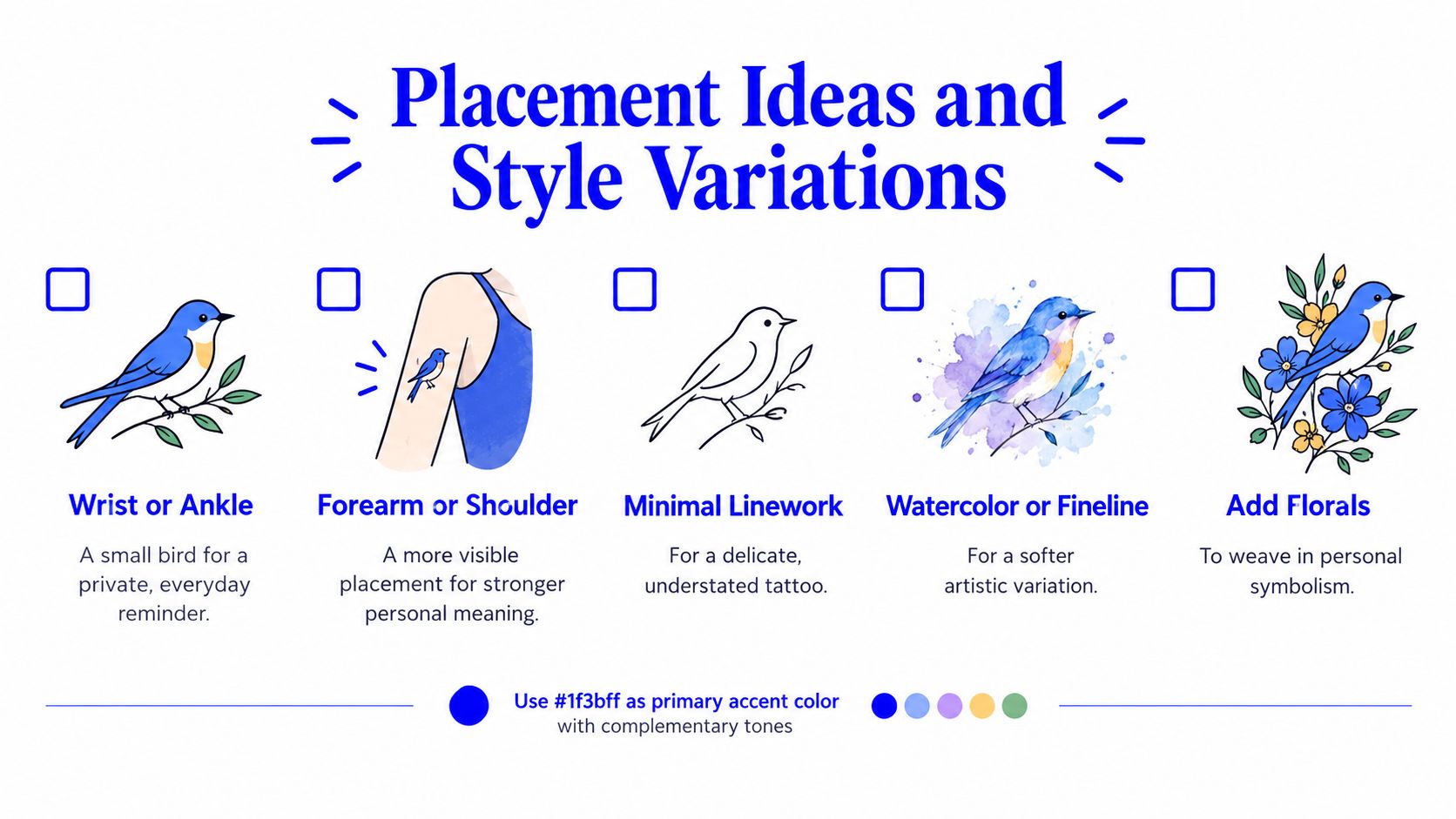
A hummingbird's small silhouette can sit neatly on the wrist or ankle, where a fine-line design stays easy to notice in daily life. Those spots suit a compact bird with few details. A collarbone or shoulder offers more room for color and a longer wing shape, while clothing can cover the tattoo when you prefer.
Choosing Scale and Style Together
- Upper arm or thigh: These broader areas can hold a bird in flight, detailed feathers, or surrounding flowers.
- Shoulder blade: Its open surface gives a hovering bird room, keeping the wing position clear.
- Japanese-influenced composition: Pairing the bird with blossoms creates a flowing scene that reads as one image, not a sticker placed on the skin.
- Watercolor: Bright washes suggest motion, while a clear silhouette keeps the bird recognizable.
- Minimal outline: A simple contour works well when the symbol matters more than feather detail.
Scale check: If the bird's pose is hard to distinguish from arm's length, the design may need fewer details or a larger placement.
Before booking, sketch the design at actual size on your skin with a marker, then check whether the bird is still readable from arm's length. Bend your wrist, raise your arm, or turn slightly to see how the image shifts with your body. A good placement gives the wings and flight path enough room to stay legible.
Cultural Respect and Common Misreadings
A common misreading sounds confident: "Native American tribes believe the hummingbird means one thing." That single sentence flattens many nations, languages, and histories into a poster slogan. A safer habit is to ask which tradition is being named, then spell it the way the source does, such as Mexica for the Mexica people, rather than reaching for a broad label that merges several cultures under one phrase. If a source will not name the group, treat the meaning as unverified decoration.
You can reference an Aztec meaning without belonging to that culture, as long as you name the tradition and do not claim it as your identity. Say you are drawn to the recorded association with rebirth or warrior memory; say your grandmother loved the garden hummingbird if that is the true source. The distinction works like a citation in conversation: context honors where an idea came from, while a personal story explains why it landed on your skin.
Keep the modern reading honest too. Joy, stamina, attention to small sweetness, and return after hardship can stand on their own without being announced as universal. A memorial can name your person, habit, or shared place; specificity reads stronger than borrowed sacred language. Renewal overlaps with phoenix tattoo meaning and renewal symbolism, yet the birds carry different motion: a phoenix climbs out of wreckage, while a hummingbird comes back, hovers, feeds, and continues.
Try It Before You Commit
Test the design in real life before permanent ink. A semi-permanent version lets you check scale, orientation, and whether the flight direction reads the way you intended on your wrist, shoulder, or ankle. You'll also learn whether you like seeing it every day.
Our detailed botanical hummingbird temporary tattoo uses plant based ink, needs no needles, and is applied at home. It develops in about 24 hours and generally remains visible for 7–10 days, depending on skin and placement. If your skin is sensitive, do a patch test first.
Browse all Just Tattoos designs to compare bird sizes and companion motifs. We offer 300+ artist made designs, categorized by style including floral, color, fine line, celestial, animals, Japanese, blackwork, and words. If application questions come up, this guide to making temporary tattoos at home covers the process. Pick a meaning, test the placement, then decide.
Try a hummingbird on your wrist, collarbone, or ankle first and see whether its direction and color say what you mean. Just Tattoos offers plant based, needle free semi permanent designs you can apply at home and wear while you decide. Choose the version that feels like your story, not someone else's list.