
If a butterfly tattoo means transformation, does that mean everyone wearing one is telling the same story? Butterfly tattoo meaning commonly centers on change, renewal, freedom, and the soul, but there's no single definition that fits every wearer. Your design can celebrate a turning point, remember someone you love, or capture something you find beautiful.
The useful question isn't just what butterflies symbolize. It's whether you want other people to recognize your message or whether you'd rather keep its meaning your own.
Table of Contents
- What Does a Butterfly Tattoo Mean
- The Ancient Roots of Butterfly Symbolism
- Why Metamorphosis Makes the Butterfly a Symbol of Change
- How Color and Design Change the Meaning
- Personal Meanings and Cultural Context
- Choosing a Placement That Matches Your Meaning
- Try It Before You Commit
- Frequently Asked Questions About Butterfly Tattoos
What Does a Butterfly Tattoo Mean
Consider two people choosing the same butterfly outline. One might connect it with leaving an unhappy chapter behind. Another might associate it with a relative who loved watching butterflies in the garden. Those are hypothetical examples, but they show why matching artwork doesn't necessarily mean matching stories.
A helpful way to understand butterfly symbolism is to separate what people commonly associate with the image from what you personally bring to it. The familiar associations give you a starting point, not a rulebook.
Shared symbolism and your own story
You might choose a butterfly to express:
- Transformation: A change in how you live, see yourself, or understand your past.
- Renewal: The feeling that you're beginning again without pretending your earlier experiences disappeared.
- Freedom: Permission to make your own choices or stop identifying with an old expectation.
- Remembrance: An ongoing connection with someone whose absence matters to you.
- Beauty: Appreciation for the shape, movement, or pattern, without a deeper explanation.
These meanings can overlap. A memorial design could also represent your own changing relationship with grief. A celebratory tattoo might acknowledge both excitement and uncertainty.
You don't have to turn your life into a neat before-and-after story to choose a butterfly.
Does a tattoo need an explanation?
No. Liking the artwork is a complete reason to wear it. Personal significance can develop later, remain private, or never become more complicated than enjoying the design.
It also helps to distinguish the meaning you intend from the meaning someone else might notice. You can influence that interpretation through the artwork, but you can't completely control it.
If you're comparing symbols, exploring snake tattoo meaning can help you ask a more useful design question: which image feels closest to the experience you want to express? Choose the symbol that fits your story, rather than reshaping your story to fit a definition.
The Ancient Roots of Butterfly Symbolism
How does a small, short-lived insect end up standing for the human soul? In ancient Greek, the word psychē carried both meanings at once, and the goddess Psyche was commonly shown with butterfly wings. The earliest known depiction of winged Psyche dates to the 5th century BC and is held by the British Museum, as described in this historical account of butterflies in art.
That double meaning solved an artistic problem. A body is easy to paint. A soul is not. Giving Psyche wings let Greek artists make an invisible inner life visible, which helps explain why the motif can feel spiritually significant even when the finished tattoo looks delicate or simple.
A symbol that traveled from art to the grave
Historical art also placed butterflies on tombs, where the image suggested the soul leaving the body. Within that tradition, death was treated as a passage rather than only an ending.
Here is where the history becomes practical. Say you are choosing a memorial piece for a parent. That gravesite tradition gives the design two layers at once: an acknowledgment of absence and an expression of continued attachment, spiritual hope, or love that has not ended. You could share that meaning openly or keep it entirely private, and the symbol works either way.
One distinction trips people up. Knowing where an association comes from is different from claiming everyone uses it the same way. Greek symbolism shaped centuries of Western art, yet it never created a universal definition that binds every culture, family, or individual wearer.
Culture supplied one layer of meaning. Nature supplied another.
An ancient gravesite and a modern wrist can share an image without sharing a worldview. The history is yours to borrow from, not a definition you are required to repeat.
Why Metamorphosis Makes the Butterfly a Symbol of Change
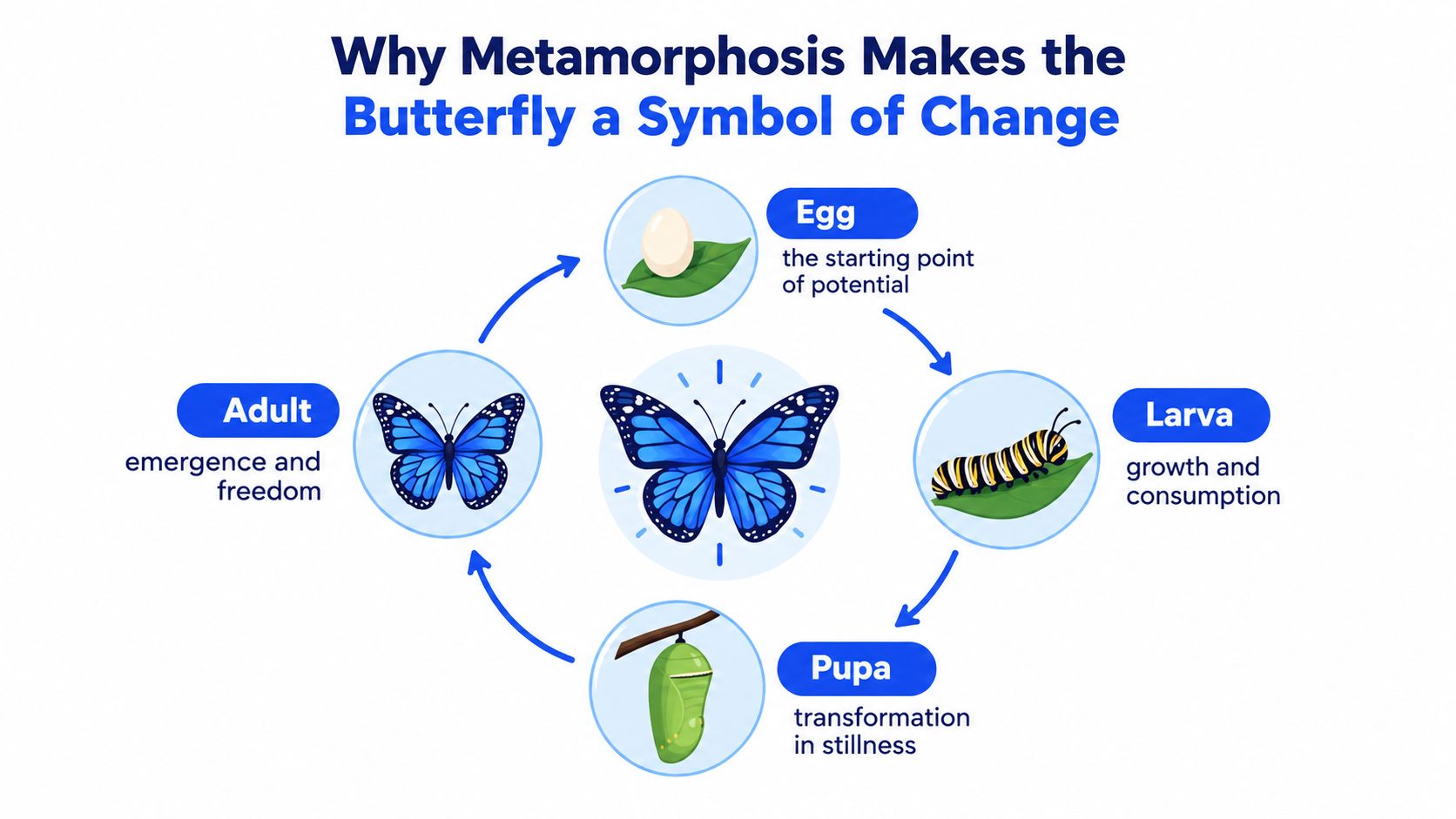
A butterfly doesn't become an adult by gradually enlarging the same body shape. It undergoes complete metamorphosis, progressing through egg, larva, pupa, and adult stages. The chrysalis marks a dramatic reorganization rather than ordinary growth, which gives transformation symbolism a concrete basis in the Smithsonian Gardens explanation of butterfly development.
That distinction matters. Growth might mean becoming more confident in a familiar role. Transformation can mean changing the role itself, reconsidering an identity, or learning to live differently.
Which moment of change do you want to show?
You don't have to depict the finished butterfly if your experience feels unfinished. Different compositions let you emphasize different parts of a personal transition.
| Design choice | A possible personal interpretation |
|---|---|
| Fully opened wings | Readiness to participate in life differently |
| Partially unfolding wings | Progress without claiming the process is complete |
| A chrysalis beside a butterfly | Recognition of both private effort and visible change |
| A split-stage composition | Connection between an earlier self and an emerging identity |
These are design readings, not biological facts or fixed cultural definitions. Their value is that they help you choose deliberately.
A useful distinction: You can honor a process without announcing that you've reached its endpoint.
A metaphor doesn't have to become a demand
The butterfly's life cycle can offer an image for reinvention, but it shouldn't become a standard you have to meet. People don't move through difficult experiences in a tidy sequence, and a tattoo doesn't require you to feel permanently renewed.
For example, someone changing careers might prefer unfolding wings because they're still learning what comes next. Someone reflecting on a completed transition might prefer an open-wing composition. Neither choice says that uncertainty or setbacks are failures.
Once you've chosen the moment you want to represent, visual treatment can refine the mood. The following comparison offers possible creative associations, not a universal dictionary of color or cultural meaning.
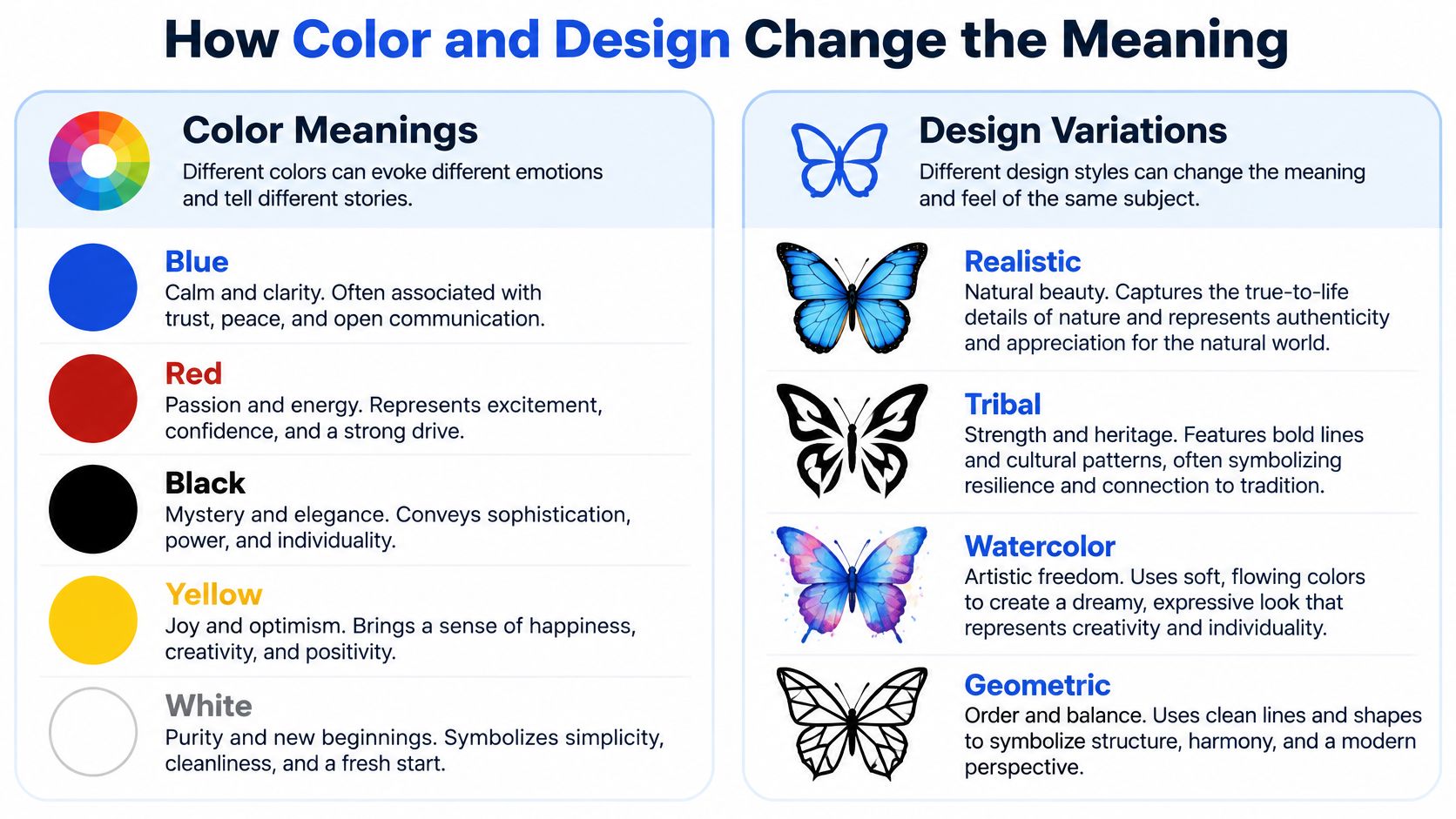
Treat those associations as prompts. A color that reminds you of someone's favorite clothing may matter more than any generalized interpretation attached to it.
How Color and Design Change the Meaning
Compare a butterfly drawn with spare, delicate lines with one built from dense black shapes. You might read the first as quiet or vulnerable and the second as assertive. That's an interpretation of the visual treatment, not evidence that the wearers have different personalities.
Color and pattern modify the message, but they don't determine it. The most useful comparison is between how a design looks and how you want it to feel.
Compare the visual choices
| Visual treatment | A mood you might choose it for | A question to ask yourself |
|---|---|---|
| Fine linework and open space | Understatement, tenderness, restraint | Do I want something quiet? |
| Bold outlines and strong contrast | Confidence, defiance, emphasis | Am I comfortable with a more noticeable design? |
| Realistic wing details | Appreciation of nature | Is the butterfly itself the main attraction? |
| Geometric structure | Deliberateness, order | Do I prefer a constructed rather than organic appearance? |
| Loose, painterly effects | Expressiveness, fluidity | Does a less controlled look suit my story? |
None of these treatments requires a particular life experience. A bold butterfly can be joyful, and a delicate one can represent determination. Butterflies are also a popular present; see our temporary tattoo gift ideas.
Symmetry, direction, and cultural care
Real butterfly wings exhibit bilateral symmetry. That structure supports centered compositions on the sternum, nape, spine, upper back, or chest; an angled or asymmetrical composition can suggest motion and suit directional placements such as the forearm, ribs, shoulder, or ankle, as discussed in this exploration of butterfly-wing symbolism and design.
Use that distinction to compare stillness with movement. Do you prefer a butterfly that appears settled and balanced, or one that looks as though it's passing through?
Be more cautious with labels that imply cultural belonging. A style described as tribal doesn't automatically communicate your heritage or carry a single shared meaning. If a pattern references a specific tradition, understand that context rather than treating the label as a shortcut for strength.
Personal Meanings and Cultural Context
Two people can wear nearly identical butterfly tattoos and mean entirely different things by them. Tattoo wearers often describe their ink in terms of grief, recovery, faith, family, and personal growth, so the wearer's history and social surroundings shape what the image carries.
A butterfly honoring a family member could sit alongside an initial, a meaningful date, or a flower tied to that person. It could also stay unaccompanied because the connection belongs to you. Both choices are equally honest. A visible design behaves like a book title: anyone can read the cover, while the chapters stay yours.
| What you want | What that suggests |
|---|---|
| Viewers grasp the general intention | Add a legible element: a name, a date, a paired symbol |
| The meaning stays yours | Keep the butterfly unaccompanied |
| The artwork invites different readings | Leave the design open to interpretation |
If a floral pairing interests you, reading about lotus flower tattoo meaning can help you judge whether a second symbol sharpens your story or simply crowds it.
Recovery doesn't have a required emblem
A butterfly can hold your understanding of survival, body reclamation, or identity. It proves nothing about trauma, a diagnosis, or a recovery path.
That gap protects everyone involved. You remain free to load the image with significance, and a stranger cannot fairly treat it as evidence about your health or history.
You can share the artwork without sharing the experience behind it.
Before settling on a highly visible design, rehearse your answer to curiosity. "It's personal, but I love the design" closes the topic without inviting a longer conversation. You owe nobody a disclosure because they noticed your tattoo.
Choosing a Placement That Matches Your Meaning
Start with access, not anatomy: who do you want to see the tattoo, and when? That question can be more useful than choosing a location because it looks appealing in a photograph.
A private memorial, an everyday reminder, and an expressive accessory may call for different placements. None has a mandatory location, but each gives you a practical priority.
Work through visibility and everyday use
- Decide how much conversation you welcome. A wrist, hand, or neck placement may be noticeable in ordinary interactions. If you don't want regular questions, consider a location your usual clothing covers.
- Check your own view. If you want to see the design yourself, compare an accessible location with one you'd usually need a mirror to view.
- Consider your routine. Look at the placement with work clothes, casual outfits, and whatever you wear for activities you enjoy.
- Test the actual footprint. Use the design's listed dimensions rather than guessing from an enlarged product image.
A butterfly that looks balanced on a screen might feel too broad or too small on your chosen area. Leave enough space for the wing outline to remain readable instead of choosing detail for its own sake.
Judge it while your body moves
Use a mirror to compare relaxed and bent positions. Turn your arm, sit down, or move your shoulder, depending on the location. You're checking whether you still like the composition during normal movement, not searching for a body position that keeps it looking perfect.
For more location-specific considerations, consult this guide to the best placement spots for temporary tattoos. Use it to narrow your options rather than treating any location as the correct choice.
Finally, separate liking a placement from liking the attention it attracts. A design can look right and still feel more public than you expected. A temporary trial gives you room to notice that difference before making a lasting decision.
Try It Before You Commit
What if you could live with your butterfly for a week before deciding it belongs on your skin forever?
A semi-permanent trial gives you exactly that. Applied at home with needle-free, plant-based ink, the design develops in about 24 hours and typically lasts 7–10 days, depending on skin and placement. Think of it as a dress rehearsal: same costume, lower stakes. Follow the step-by-step temporary tattoo application guide so the artwork develops evenly and you give yourself a fair test.
The first day or two mostly tells you about novelty, so notice when the design catches your eye and whether that glance feels like recognition or distraction. The more revealing questions tend to appear midweek. Does the butterfly still feel like something you chose, or something you felt expected to choose? When someone asks about it, are you glad to explain, or do you wish it were more private? That answer matters, because it separates wanting a recognizable message from preferring symbolism only you need to decode.
By the final days, you will know how the design sits inside your actual routine rather than your imagination. Some people finish the trial eager to discuss permanent artwork with an artist. Others discover a week was enough, and that enjoying body art never required an appointment at all.
When you are ready to experiment, compare the butterfly designs with the mood and level of detail you have settled on, or browse the full tattoo collection if you suspect your butterfly might want company. One honest caution: temporary does not mean risk-free. If your skin runs sensitive, a small patch test first is a sensible precaution.
Frequently Asked Questions About Butterfly Tattoos
Can a butterfly tattoo mean something other than transformation?
Yes. It can represent remembrance, spiritual connection, freedom, or appreciation of nature. It can also be decorative, without a personal story attached.
Is a butterfly a healthy symbol for recovery?
It can be a meaningful personal reminder, but it isn't treatment or proof that recovery is complete. Choose it because it supports your own understanding of your experience, not because you feel required to demonstrate progress.
What if someone interprets my tattoo differently?
You can explain your intention, offer a brief answer, or keep it private. Someone else's interpretation doesn't replace your meaning, and you don't have to disclose sensitive information to correct their assumptions.
Does a butterfly tattoo indicate a specific identity or diagnosis?
No. The image alone doesn't establish someone's gender, medical history, or life experiences. It's better to let the wearer decide what, if anything, they want to share.
How does a semi-permanent trial differ from permanent ink?
Permanent tattooing deposits pigment into the dermis, while the semi-permanent option discussed here uses needle-free application and fades. The trial helps you evaluate appearance and comfort, but it doesn't reproduce the procedure or lasting commitment of permanent tattooing.
Just Tattoos offers realistic-looking semi-permanent tattoos made with plant-based ink for needle-free application at home, available in the US only. Visit Just Tattoos to choose a butterfly design and test whether its style, placement, and personal meaning feel right for you.
Crafted with the Outrank tool