
Cherry blossom tattoos most often mean the impermanence of life, renewal and new beginnings, and appreciating beauty while it lasts. The design and your personal story decide which meaning comes forward.
If the flower can represent both a fresh start and a farewell, what makes a particular tattoo feel hopeful rather than sad? The answer is usually in the details: unopened buds, drifting petals, the shape of a branch, and the place you choose to wear it.
Table of Contents
- What Does a Cherry Blossom Tattoo Mean?
- Why Do Cherry Blossoms Stand for Impermanence?
- Is It Respectful to Wear a Cherry Blossom Tattoo?
- How Do Petals, Buds and Color Change the Meaning?
- Which Meaning Fits Your Personal Story?
- Does Permanence Change What the Design Says?
- Try It Before You Commit
What Does a Cherry Blossom Tattoo Mean?
A cherry blossom tattoo isn't a fixed code. It can mark a turning point, preserve a shared memory, or remind you to pay attention to the life you're living now.
The most useful distinction is between what the flower represents historically and what you want your tattoo to express personally. Those meanings can support each other without being identical.
Core cherry blossom tattoo meanings and their origins
| Meaning | Where It Comes From | Often Chosen For |
|---|---|---|
| Impermanence | Short bloom, then petals fall | Reflecting on change or loss |
| Renewal | Spring return and fresh starts in Japan | Recovery or a new chapter |
| Beauty in the present | Hanami viewing of peak bloom | Appreciating the moment |
| Friendship | Shared hanami gatherings and Japan's historic gift of cherry trees to the US | Friends, family and matching designs |
| Acceptance of mortality | Buddhist ideas of impermanence and historical imagery of brief life | Remembrance and acceptance |
Treat the final column as a starting point, not a profile of everyone who wears the flower. Someone celebrating recovery might focus on renewal, while another person could choose the same blossom to acknowledge how much their life has changed.
Choose the message before the motif
Start with your reason for wanting the tattoo. Are you celebrating something that began, remembering something that ended, or trying to stay present while life changes?
If you're comparing flowers, exploring lotus flower tattoo meaning can help you decide whether another motif better matches your intention. A flower's appearance may attract you first, but its underlying story should feel right, too.
Practical rule: Choose the meaning you could explain comfortably in a sentence, then select the visual details that support it.
You don't need to fit every association into the artwork. A clear, personal message usually gives you a better design brief than a long list of symbolic possibilities.
Why Do Cherry Blossoms Stand for Impermanence?
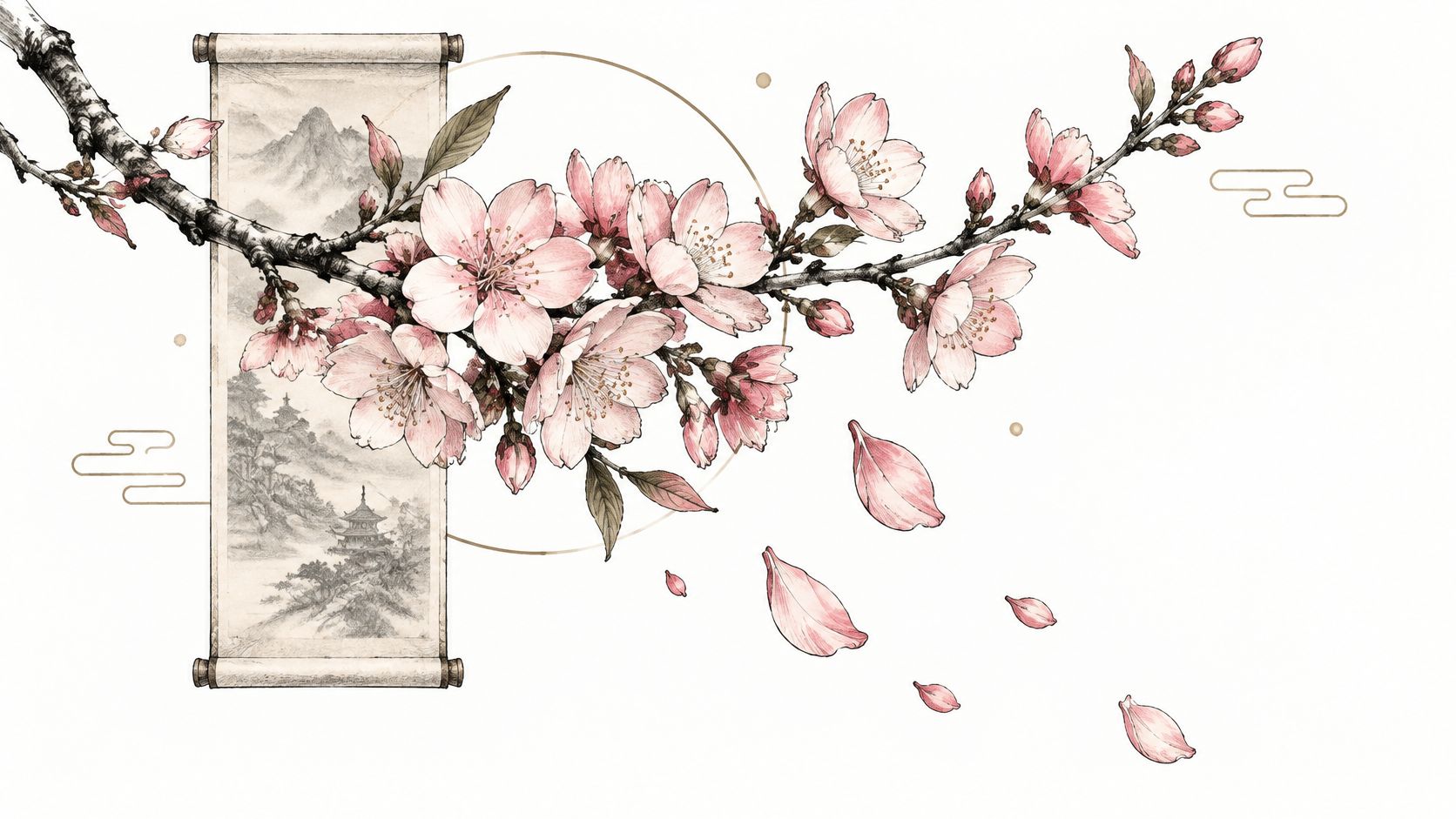
A cherry blossom's short bloom makes the passage of time visible. At peak bloom, the flowers are vivid; soon after, their petals fall. The Library of Congress's account of cherry blossoms in Japanese cultural history describes this brief flowering as a metaphor for life's ephemeral beauty and explains how flower viewing, first associated with plum blossoms, became closely tied to cherry blossoms during the Heian Period, 794–1185. The association grew through cultural attention to the flower, rather than from a fixed tattoo meaning.
Why transience isn't only sad
Falling petals can suggest an ending, while the return of blossoms each spring can suggest a fresh start. Together, those details let a cherry blossom design hold both change and continuity.
The blooming season has also been associated with new beginnings in Japan. That association can make the flower a fitting choice for someone marking graduation, recovery, or relocation, when a familiar chapter gives way to another.
The Japanese idea of mono no aware offers a way to understand the feeling behind this symbolism: a bittersweet awareness that beauty passes. A falling petal can carry that tenderness without turning every ending into a tragedy.
You can acknowledge that an experience won't last without deciding that it was less valuable.
Historical currents, not a single rule
Buddhist ideas about temporary existence and samurai ideals concerning honor, courage, and life's brevity also appear in the flower's historical associations. These currents do not make every cherry blossom tattoo a symbol of a warrior or death.
Design choices shape the message, too. A single falling petal may emphasize a moment passing; a branch with blossoms at different stages can suggest change unfolding over time. For a contemporary wearer, the meaning might be accepting a change they could not prevent, appreciating a relationship while it is present, or paying closer attention to ordinary moments.
Limited time can make beauty and affection more vivid.
Is It Respectful to Wear a Cherry Blossom Tattoo?
The historical sources don't establish a universal rule against wearing sakura imagery if you aren't Japanese. Knowing its roots and being honest about your intent is more useful than treating cultural respect as a simple permission slip.
The Japan Mint's cultural account describes sakura as Japan's unofficial national flower, notes its rise over plum blossoms approximately after the eighth century, and traces hanami's expansion from Heian aristocrats to the wider public during the Azuchi Momoyama and Edo periods, 1568–1868. The same account records Japan's gift of 3,000 cherry trees to the United States in 1912, a friendship gesture that helped make the flower internationally recognizable, particularly in Washington, D.C.
That history gives the image cultural specificity without reducing it to a single interpretation. Friendship, public celebration, national identity, and personal appreciation can coexist.
How to approach the imagery thoughtfully
- Acknowledge the origin. If Japanese art inspired your tattoo, say so rather than presenting its symbolism as culturally anonymous.
- Separate appreciation from identity. Enjoying a motif doesn't mean claiming Japanese heritage or authority over its traditions.
- Research companion elements. A floral branch and a composition with warriors, banners, or other historical imagery don't necessarily communicate the same thing.
When browsing Japanese-inspired designs, look for a composition whose meaning you can explain, rather than assembling unfamiliar symbols because they look striking. If you're considering fish alongside the flowers, understanding koi fish tattoo meaning can help you evaluate that additional reference.
A cherry blossom tattoo doesn't automatically declare samurai values, an interest in death, or a particular cultural identity. Your intent matters, but viewers also interpret what they can see. Know the history, choose deliberately, and be ready to explain your reference.
How Do Petals, Buds and Color Change the Meaning?
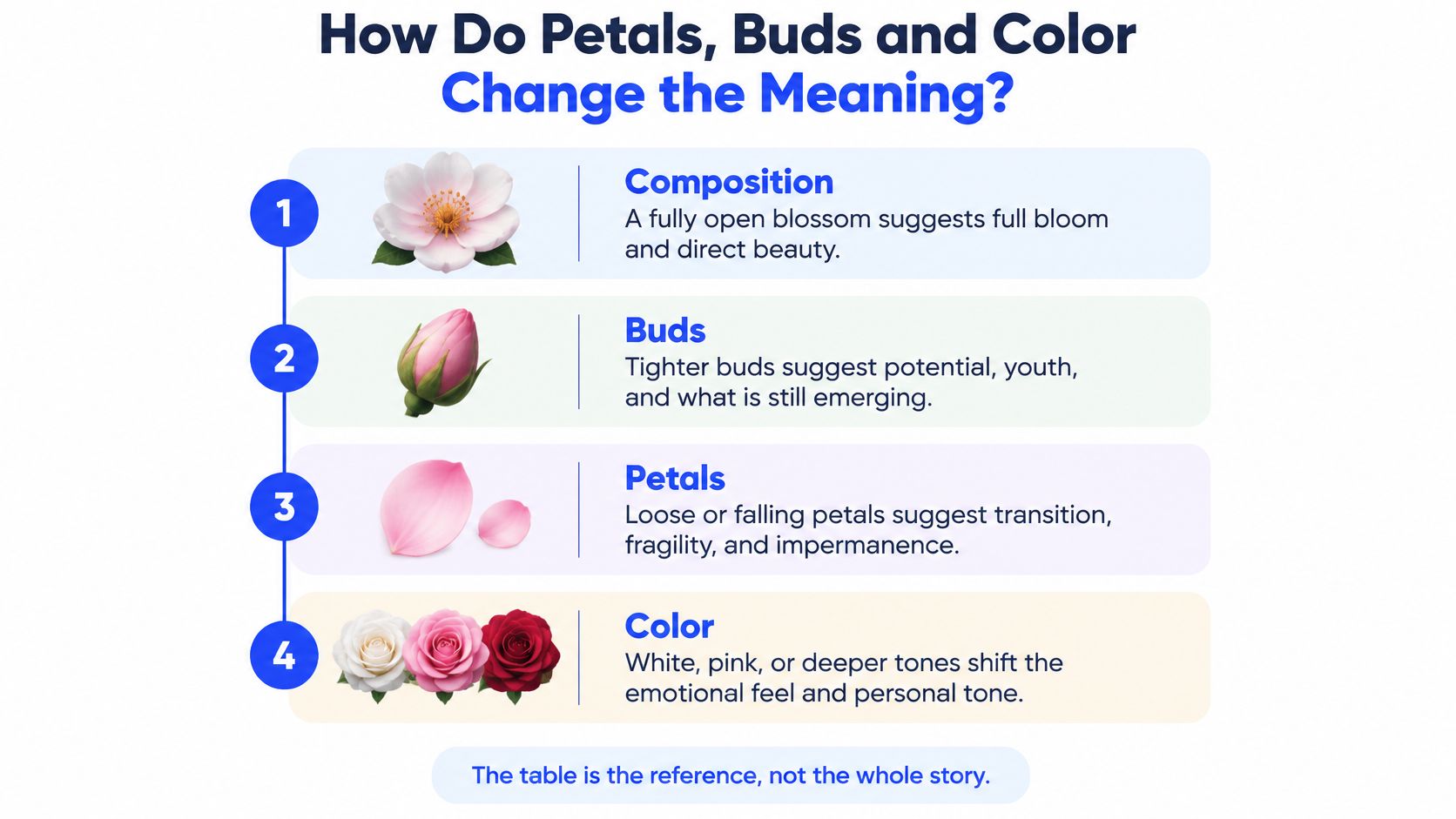
Design choices change the emotional message, not just the decoration. A blossom shown at its fullest and a branch losing its flowers can share a subject while telling very different stories.
Composition and placement
A fully open blossom directs attention to beauty at its peak. Scattered petals introduce absence and movement, while a branch containing buds, flowers, and falling petals can suggest an entire life cycle.
Petal count isn't a numerical code. Instead, density changes emphasis: a few loose petals can suggest gentle release, while a heavy fall may make loss the dominant impression.
The same principle applies to placement. A flowing branch along the ribs, shoulder, or forearm gives the eye a path to follow; a compact wrist or ankle blossom can function as a recurring personal reminder. These are design readings, not universal body-location meanings.
Design choices and the reading each one suggests
| Design Choice | Usual Reading | Typical Placement |
|---|---|---|
| Single open blossom | Renewal or a private memory | Small wrist or ankle piece |
| Closed buds on a branch | Potential and a new beginning | Curved branch along the forearm or shoulder |
| Full branch with buds, blooms and falling petals | A complete life-cycle story | Larger piece across the shoulder or back |
| Sparse falling petals | Change and acceptance | Scattered petals across the ribs or forearm |
| Heavy falling canopy | More explicit loss or mourning | Dense falling petals over a larger area |
| Blossoms with a phoenix, sun or waves | Transformation and renewal | Mid-size composition with a second motif |
| Blossoms with a name or date | A personal story | Small text beside a single blossom |
| Soft pink tones | Gentleness and femininity | Any placement where softness suits the design |
Style, color and companion imagery
Choose the style before the palette. Fine-line work can feel restrained, realism draws attention to the flower's physical detail, and traditional Japanese composition places the blossoms within a more culturally specific visual setting.
Soft pink can feel gentle; bold black linework can feel graphic or stark. Neither color nor style determines who can wear the design, and femininity is an optional association, not a restriction. Compare floral designs by their shapes and visual weight, not just their colors.
A phoenix, waves, or an emerging sun can support an intended transformation story. A name, date, or short phrase makes the personal reference more explicit. If a butterfly appeals to you, consider butterfly tattoo meaning before deciding whether it adds something necessary.
The medium matters, too. The FDA's tattoo-removal guidance explains that needle tattoos place ink in the dermis, the second layer of skin, where it mostly remains for a person's lifetime.
Before choosing a final design:
- Name the message. Decide which feeling should lead.
- Match the composition. Keep the details that express it.
- Test the result. Check whether the artwork communicates what you intended.
Which Meaning Fits Your Personal Story?
Cherry blossoms don't have to tell an exclusively individual story. The Smithsonian's National Museum of Asian Art describes sakura through both impermanence and the pleasure of spending time together admiring the flowers.
That communal layer makes clusters and branches suitable for family, friendship, and shared memories. The fleeting event matters partly because people experience it together.
A beginning you chose
Say you're moving away after graduation. You want to acknowledge the life you're leaving without making the tattoo feel like a farewell to everything familiar.
A branch with buds and open blooms, extending along the forearm, could express anticipation with continuity. Its direction gives the composition a sense of moving forward, while the mix of stages leaves room for both what you've learned and what you haven't experienced yet.
Recovery may call for a different emphasis. New buds growing outward from a branch on the shoulder could communicate cautious hope, without requiring a dramatic before-and-after narrative or implying that every difficulty is over.
A connection you want to carry
For siblings living far apart, matching branches could express companionship without needing identical placement. One person might choose an ankle and the other a forearm, preserving the shared motif while making each piece personally comfortable.
Remembrance asks a more delicate question: do you want the design to emphasize the loss, the relationship, or the life you continue to live?
A soft, sparse arrangement near the shoulder could keep the mood affectionate and reflective. If hope is your priority, retain open flowers or buds rather than making a dense canopy of falling petals the central feature.
A useful test: Finish the sentence, “I want this tattoo to remind me that…” before choosing the artwork.
Your answer might be that you can begin again, that distance doesn't erase closeness, or that someone mattered even though they couldn't stay. You don't owe strangers the full story, but knowing it yourself helps you make consistent choices.
A cherry blossom tattoo meaning chosen on purpose is more useful than one borrowed from a generic list. The symbol supplies possibilities; your experience supplies the reason.
Does Permanence Change What the Design Says?
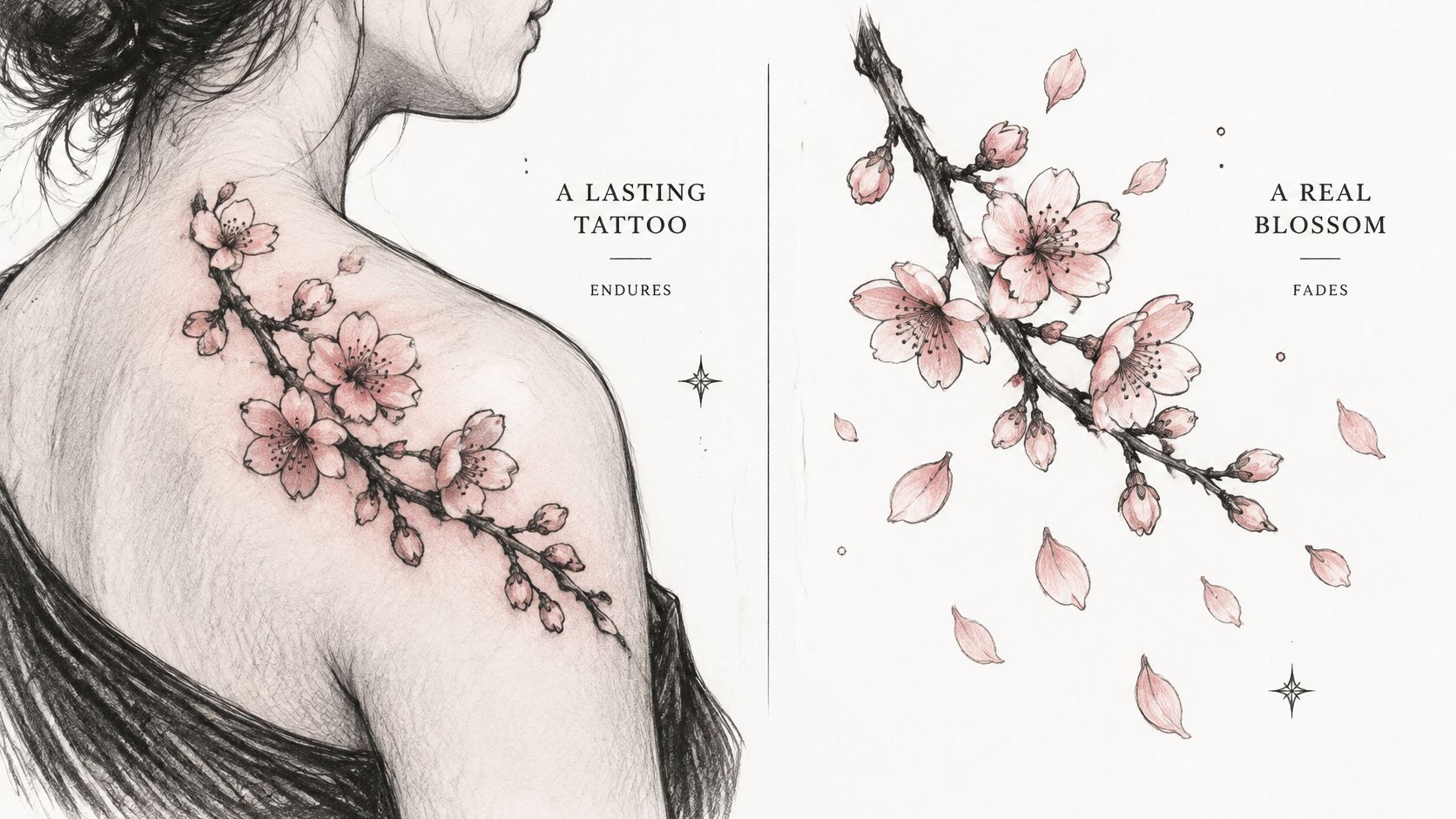
Yes. Preserving a fleeting flower in permanent ink creates a deliberate contrast: a lasting mark can hold the memory of something that couldn't last.
That contrast may strengthen a memorial or commitment. It can also feel unnecessary if the design represents a chapter you're still working through, rather than a statement you want to carry indefinitely.
A season or a lasting commitment
If you're exploring a recent change, a temporary version gives you space to notice your reaction during ordinary life. You might love the symbolism but discover that you don't want a visible reminder at work, or that a large branch feels more emotionally prominent than you expected.
If the tattoo represents a lifelong commitment, permanence may be part of the point. The mark doesn't need to reproduce the flower's brief existence; it can express your decision to remember it.
- Choose flexibility when you're still deciding what the experience means or how publicly you want to express it.
- Consider permanence deliberately when keeping the reminder is itself part of your intention.
Neither choice makes the meaning more sincere. Temporary artwork isn't a lesser form of reflection, and permanent ink doesn't require a dramatic justification.
Separate the decisions: first decide whether the symbol fits, then whether the placement fits, and finally whether permanence adds something you really want. Ask yourself: does this meaning need to last for life?
Try It Before You Commit
A 2.76 x 2.76 inch design can look quite different on a wrist than on a shoulder. Before settling on a permanent placement, check how much space the blossom takes up, whether its details remain easy to see, and how it sits beside a watch, sleeve, or other imagery.
Make the test useful
Try the design in the location you have in mind, then notice how often it catches your eye during everyday routines. A wrist is easy to see; a shoulder may be easier to keep private. Consider whether the artwork feels balanced in that setting, rather than judging the flower on its own.
Just Tattoos offers temporary cherry blossom designs, including full-color options. The ink develops over about 24 hours. Follow the step-by-step temporary tattoo application guide before applying one.
The design remains visible for 7–10 days, depending on skin and placement, then gradually fades as skin renews. Browse the cherry blossom collection to compare designs, and use the trial to see how the size and placement work in daily life before choosing permanent ink.