
A skull tattoo usually means mortality and impermanence, the old memento mori idea of remembering that life ends, not danger. People who choose one are marking time, loss, survival, or a decision to stop wasting days, and the symbols around the skull decide which of those a stranger notices first.
So why does the same emblem read as a memorial on one person and a threat on another? Because a tattoo is a sentence, and the skull is only the noun. Everything else in the composition is the verb, and that part is fully under your control.
Table of Contents
- What Does a Skull Tattoo Mean
- Where Does Skull Tattoo Meaning Come From
- How Do Paired Symbols Change a Skull Tattoo
- Does Placement Change How a Skull Reads
- Which Styles Shift Skull Tattoo Meaning
- Try It Before You Commit
What Does a Skull Tattoo Mean
Start with the oldest and most dependable reading. The National Museum of Ireland explains that memento mori translates as "remember you must die" and lists the objects that carry the idea alongside the skull: skeletons, coffins, hourglasses, wilting flowers, dead animals, candles, and even soap bubbles. The museum traces that symbolism across ancient art and several observances, including Ireland's Samhain, Mexico's Día de los Muertos, Japan's Buddhist Bon festival, the Taoist Hungry Ghost Festival, and Christian Lent. Built on that tradition, a skull tattoo can express awareness of impermanence, remembrance of someone who died, or a straightforward reminder to value limited time.
That's your baseline. From there, read the design like a short sentence and let each added object adjust the meaning.
| Motif | Start with this reading | What most often shifts it |
|---|---|---|
| Plain skull | Mortality, remembrance, impermanence | Added flowers, words, or a stated personal story |
| Skull and crossbones | Warning, piracy, or death's triumph over life | An hourglass or candle softens it toward passing time |
| Skull and rose | Death beside beauty and life's fragility | Thorns, color, or a dagger can add pain or defiance |
| Skull with hourglass or candle | Time running out, a vanitas reminder to use life well | Weapons or harsh lettering make it more threatening |
| Winged skull | Soul, spiritual passage, or the death's-head tradition | Aggressive blackwork can override the gentler reading |
| Anatomical skull | Reason, knowledge, or a realistic study of the body | Medical props versus decorative styling |
| Sugar skull or calavera | Remembrance and tribute, especially at Día de los Muertos | Treating ornate folk detail as generic edgy decoration |
| Flaming or weapon skull | Defiance, danger, or power | A memorial name or date pulls it back toward grief |
Read the middle column first, then the right-hand column as the adjustment. A bare skull leans toward remembrance, acceptance, and living with more urgency. Crossed bones push it toward warning. A rose sets beauty beside fragility. An hourglass or a spent candle turns it into a clock. Wings move it toward the soul and passage. An anatomical skull shifts the emphasis to reason, knowledge, or a straight study of the body.
Working rule: the skull supplies mortality. The symbols around it decide whether the finished piece reads as grief, tribute, rebellion, philosophy, or a reminder to enjoy the day.
The bottom two rows are where most confusion starts. A plain skull with ornament is still a skull, but a sugar skull is a specific cultural form with its own rules, and a flaming skull with a knife through it is closer to a warning sign than a meditation.
Here's the part people miss. A private meaning, such as surviving a brutal year or quitting something that was killing you, is completely valid and worth inking. It just isn't the symbol's universal meaning, and strangers won't infer it from bone alone. If you want the story to travel, let the design speak it: a date, a name, a flower from a funeral, a line of script, a birth month blossom.
Where Does Skull Tattoo Meaning Come From
Skull imagery has carried different meanings in different centuries, so no single fixed definition covers it. Radio France Internationale's account of a skull-themed exhibition, described on the Swiss National Museum blog, links early Roman use to both stoic preparation for death and the carpe diem idea of enjoying life because death is unavoidable. The same account notes that skull imagery returned to prominence in Jesuit art during the sixteenth century, and that in the twentieth century skull designs became tied to rebellion and broken taboos, particularly through 1960s pop culture.
Put those three moments side by side and the pattern is clear. The skull has been philosophical, religious, and countercultural in turn, and each era left a layer behind.
Why death became a picture everyone knew
In medieval Europe, plague, famine, and war made mortality a daily fact rather than a distant idea. The "dance of death" tradition put skeletons into church art, prints, and performances to show death claiming people across every social class, as Britannica's account of memento mori describes. The Virginia Department of Historic Resources ties skull-and-bone imagery in funerary art and vanitas traditions to roughly the 13th through 18th centuries, periods shaped by recurrent famine, warfare, and epidemics, and reads the surrounding props the way a designer should. Wings can suggest the soul or spiritual passage, while crossed bones or stark black-and-white styling amplify warning and mortality.
Vanitas painting tightened the formula. Beauty is temporary. Another hour of daylight doesn't fix that.
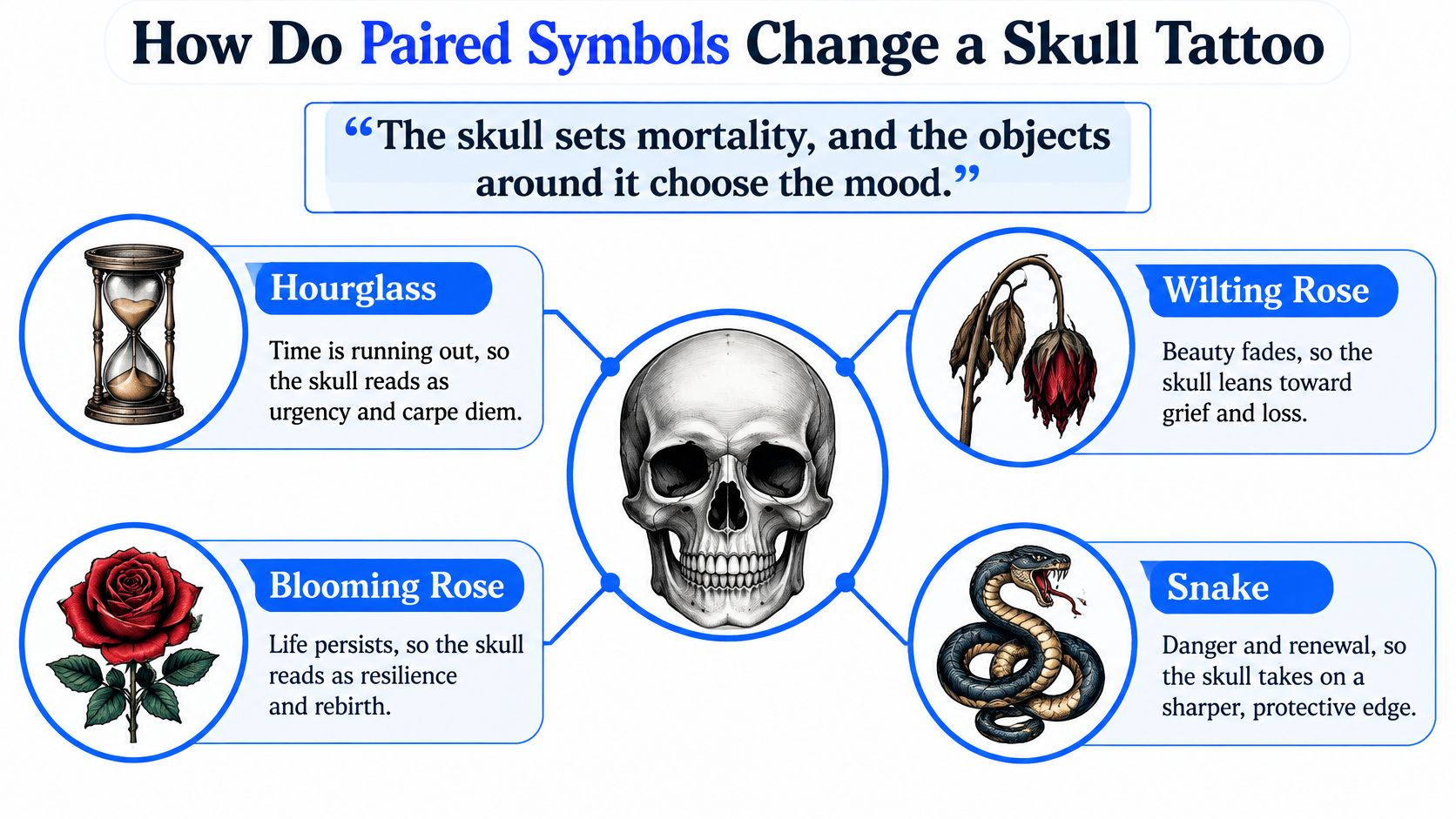
The pairing rule is easier to see than to read in a paragraph, so here it is as a map.
The symbol was never only European
Japanese Buddhist visual culture used skulls and skeletons to express life's transience and the afterlife. Tibetan kapala imagery treats the skull as a ritual object tied to impermanence, inside a spiritual system with its own rules about use and depiction. Mexican calavera imagery frames decorated skulls through remembrance and tribute at Día de los Muertos. At sea, the skull and crossbones worked as a warning emblem first and an outlaw flag second.
Designs built on transience rarely stay grim for long. The phoenix tattoo meaning takes the same awareness of an ending and pushes it toward renewal instead of loss, which is why skulls and firebirds show up in the same conversations.
| Tradition | Core idea | Design cue to respect |
|---|---|---|
| European memento mori | Remember death, life and status are temporary | Skull with hourglass, candle, or wilting flower |
| Dance of death | Death reaches every social class | Skeletons shown across ranks, not one outlaw figure |
| Pirate skull and crossbones | Warning, maritime threat, or resistance | Crossed bones under a stark skull |
| Japanese Buddhist imagery | Transience and the afterlife | Skeleton or skull in a Buddhist visual context |
| Mexican calavera | Remembrance and tribute at Día de los Muertos | Ornate sugar skull, flowers, names, bright pattern |
| Twentieth-century pop skull | Rebellion and broken taboos | Bold graphic skull without a memorial or festival cue |
One modern tattoo can stack two or three of these layers at once, and that's exactly where misreading begins. A colorful skull with flowers may be read as a calavera by one viewer, a summer design by a second, and a borrowed costume by a third.
How Do Paired Symbols Change a Skull Tattoo
The skull sets mortality, and the objects around it choose the mood.
The clearest test case is the skull and crossbones. The Science Museum Group describes it as the traditional symbol of piracy while also recording broader meanings, including the triumph of death over life and the memento mori job of reminding the living about life's fragility. Crossed bones make the design more specific than a bare skull. They push it toward outlaw identity, maritime adventure, warning, or a direct confrontation with mortality.
Softer objects pull the other way. The same catalog record notes that an hourglass or extinguished candle reinforces the passage of time, while weapons or dark flames create a more aggressive impression. That's the dial you're turning, not a new symbol.
A rose is the most common softener, and it does something precise: it sets death next to beauty and makes the fragility the whole point. If that's the register you want, browse rose designs before you shop skulls, because the flower is doing half the talking. The breakdown of rose tattoo meaning shows how petal count, thorns, and color change the read of an identical bloom.
Here's how the pairing logic looks when you map it.
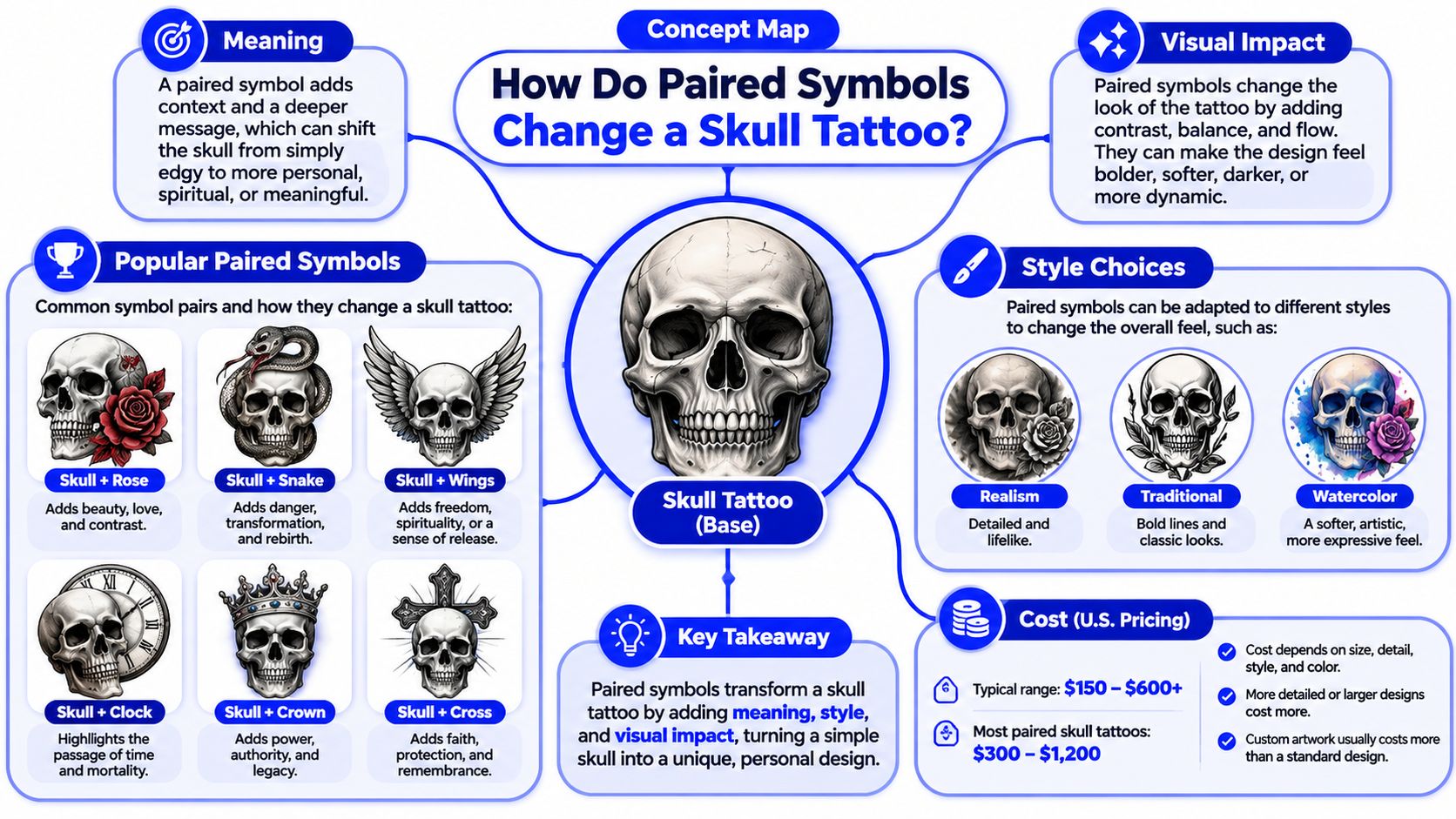
A skull with roses and a dagger holds both halves at once. The rose says beauty fades. The dagger says someone is willing to cut. Before you commit, decide which half people will notice first, because that's the half they'll ask about. The skull, roses, and dagger temporary tattoo shows that tension assembled on skin.
A sugar-skull pattern is not a European rose skull. The ornament, the flowers, and the space for names come out of a specific remembrance tradition, and treating that detail as generic mood decoration reads as borrowed to the people who grew up with it.
Run this three-part check before you book anything:
- Name the extra symbols. Rose, hourglass, wings, bones, dagger, flames, script.
- State the mood each one adds. Grief, urgency, soul, warning, defiance, tribute.
- Ask whether that's the story you mean. If two of the three answers surprise you, the design isn't finished yet.
Does Placement Change How a Skull Reads
Placement decides whether your tattoo is private or public, and that changes the reading more than expected. A chest, rib, or upper-back piece is easy to cover on a workday and usually reads as a personal reminder, seen only by people you choose. A forearm or calf sits in the middle: visible in warm weather, hidden under a sleeve, easy to explain when someone asks.
Hands, fingers, necks, and faces flip the math. The skull becomes the first thing many people see, which makes warning and rebellion readings louder and a quiet memorial much harder to frame. A design people already treat as ominous, such as a spider tattoo, gets louder again in those same visible spots.
Size works with placement rather than separately. A small anatomical skull on an inner wrist reads as a private memento. The identical artwork blown up across an upper arm or thigh reads as a statement, and a stranger will assume you want it noticed. If you're considering a wide composition, test the scale first with the large-format 16 by 8 inch option before you give up that much skin.
Audience check: before choosing a visible spot, ask three people who don't share your taste, one of them older than you, what the design says to them. Their answer is data.
Think about family dinners, workplace dress codes, and the photos that live on the internet forever. A trial wear shows you comfort and early reactions, but it can't predict every hiring manager or every cultural response, so treat it as one input rather than a guarantee.
Pick the spot that matches how often you're willing to explain the tattoo. If the answer is never, choose a coverable placement and let the design be for you.
Which Styles Shift Skull Tattoo Meaning
Style is a mood dial on the same symbol, not a new symbol. Fine line and small dotwork keep a skull quiet and contemplative, closer to a sketchbook memento than a warning, and they suit wrists, behind the ear, and other modest placements. Black and grey realism, with deep shadow and anatomical detail, reads serious, memorial, or studious. Heavy blackwork and bold traditional outlines feel graphic and defiant, especially with thick brows and empty eye sockets.
The flat, repeatable graphic skull has a long print history behind it. The Science Museum describes 18th- and 19th-century snuff boxes printed with several skulls, where the repetition made death a social leveller regardless of wealth, beauty, or status. That poster-like clarity is exactly why a bold traditional skull still lands before you've had time to think about it.
What color does to a skull
Color changes the channel the design broadcasts on. A bright floral calavera reads festive and commemorative. Red flames or a dark dagger read hotter and more aggressive. The safest approach is to ask what the color is doing, not just whether you like it: color that supports a tradition reads as respect, and color used as decoration on top of a tradition reads as costume.
Japanese-inspired composition changes the frame entirely. Wind bars, waves, and open background flow tie a skull to transience and passing time rather than to pirate graphics, which is why the same bone can look meditative in one layout and menacing in another.
A few styles carry meaning by default. A realistic portrait skull of a person or a pet is a memorial first, whatever else surrounds it. Script clarifies a tribute quickly, though aggressive lettering can cancel a gentle rose sitting right beside it.
Style doesn't erase culture, either. A colorful skull is not automatically a calavera unless its ornament says so, and a skull in Buddhist surroundings isn't a Halloween graphic. Choose the style that matches the row you picked in the first table, then confirm it on skin rather than from a flash sheet on a screen.
Try It Before You Commit
If the motif, the tradition, the style, and the placement all agree, a short trial is the sensible last step. If a sugar skull or another specific tradition still feels borrowed rather than understood, pause and read more before any needle touches you. Borrowed symbolism is the one problem a good design can't fix.
Just Tattoos sells semi-permanent tattoos that look real, made with plant-based ink and applied at home without needles. Designs develop in about 24 hours and most designs last 7–10 days, depending on skin and placement, which is long enough to live with a decision and short enough to walk it back. The catalog runs to more than 300 artist-made designs, and developed pieces settle into a realistic dark blue-black shade that mimics healed tattoo ink.
Use a trial wear for the questions permanence makes expensive. Wear a skull on the exact spot you're considering before you book an artist. Test a larger composition across a thigh or upper arm for a weekend to see how much surface you want covered. See a memorial design on your own body before you make it forever. Browse the full range at Just Tattoos collections to compare skulls, roses, snakes, and traditional-style artwork side by side.
If you're working through the decision properly, read how to try a tattoo before you get it and keep the step-by-step application guide open while you apply. Do a patch test first if your skin is sensitive.
Wear the reading you chose for the full week. Book permanent work only if you still want that exact message at the end of it.
Just Tattoos makes semi-permanent tattoos with plant-based ink that you apply at home without needles, which turns a skull design from a guess into a test you can run. Try the skull and roses piece on your forearm for a week, or wear a large-format sheet to see how a full statement feels on your own body before you commit to ink. Visit Just Tattoos to find the design that says what you mean.