
A phoenix tattoo most commonly symbolizes rebirth, resilience, and rising from a difficult chapter, but its meaning shifts with cultural tradition, design details, and the wearer's intent. It can mark survival, honor a loss, express a fresh start, or just celebrate a striking mythical bird.
The popular advice that “a phoenix always means rebirth” leaves out important nuance. Western phoenix imagery often centers on fire, ashes, and renewal, while Chinese fenghuang and Japanese hō-ō designs can carry different associations. Even two Western-style phoenixes can tell different stories: one rising with open wings may suggest forward movement, while one surrounded by ash may focus on what the wearer has endured.
A useful way to choose is to look through three lenses: the myth behind the bird, the cultural tradition reflected in the imagery, and the visual choices that shape its message. Together, they can help you decide what you want your tattoo to communicate, and what you'd rather keep personal.
Table of Contents
- What Does a Phoenix Tattoo Mean
- Where Does the Phoenix Myth Come From
- How Does Culture Change Phoenix Tattoo Meaning
- How Do Design Choices Change the Message
- Where Should You Place a Phoenix Tattoo
- Is a Phoenix Tattoo Right for Your Story
- How Can You Try a Phoenix Tattoo Before Committing
What Does a Phoenix Tattoo Mean
A phoenix tattoo often represents rebirth, resilience, and coming back after hardship, but it doesn't have one fixed definition. Western tradition commonly connects the bird with destruction followed by renewal and, later, Christian resurrection imagery. Japanese hō-ō imagery, by contrast, is associated with nobility, peace, moral virtue, and the beginning of a new era. (Phoenix imagery across traditions)
That difference matters if you're choosing a design to represent a personal experience. Someone marking recovery might want the bird in upward flight, while someone honoring a loss might prefer a quieter, more reflective composition. Another wearer may choose a phoenix for its flowing feathers and dramatic silhouette, without tying it to a painful chapter at all.
A symbol you can tune
Think of the phoenix less as a dictionary definition and more as a visual language. The myth supplies a recognizable starting point, but the wearer and the design add the emphasis. A solitary bird rising from flames tends to suggest surviving a difficult period; a bird with ornamental plumage or paired imagery can point toward a different cultural framework.
Before you choose, consider three questions:
- What story matters most? Recovery, grief, a transition, spiritual renewal, or visual appeal can all lead to different concepts.
- Which tradition are you drawing from? A Greek or Roman-inspired firebird, a Chinese fenghuang, and a Japanese hō-ō aren't interchangeable images. In Chinese art the fenghuang is often paired with the dragon, so it helps to read our dragon tattoo meaning guide if you want both.
- How public should the meaning be? A bold, visible design can invite questions; a more private placement can keep the story close to you.
The phoenix's broad familiarity makes it easy to recognize, but not everyone will interpret it the same way. That's not a flaw. It gives you room to choose a design that feels honest to your life rather than trying to fit a universal rule.
Where Does the Phoenix Myth Come From
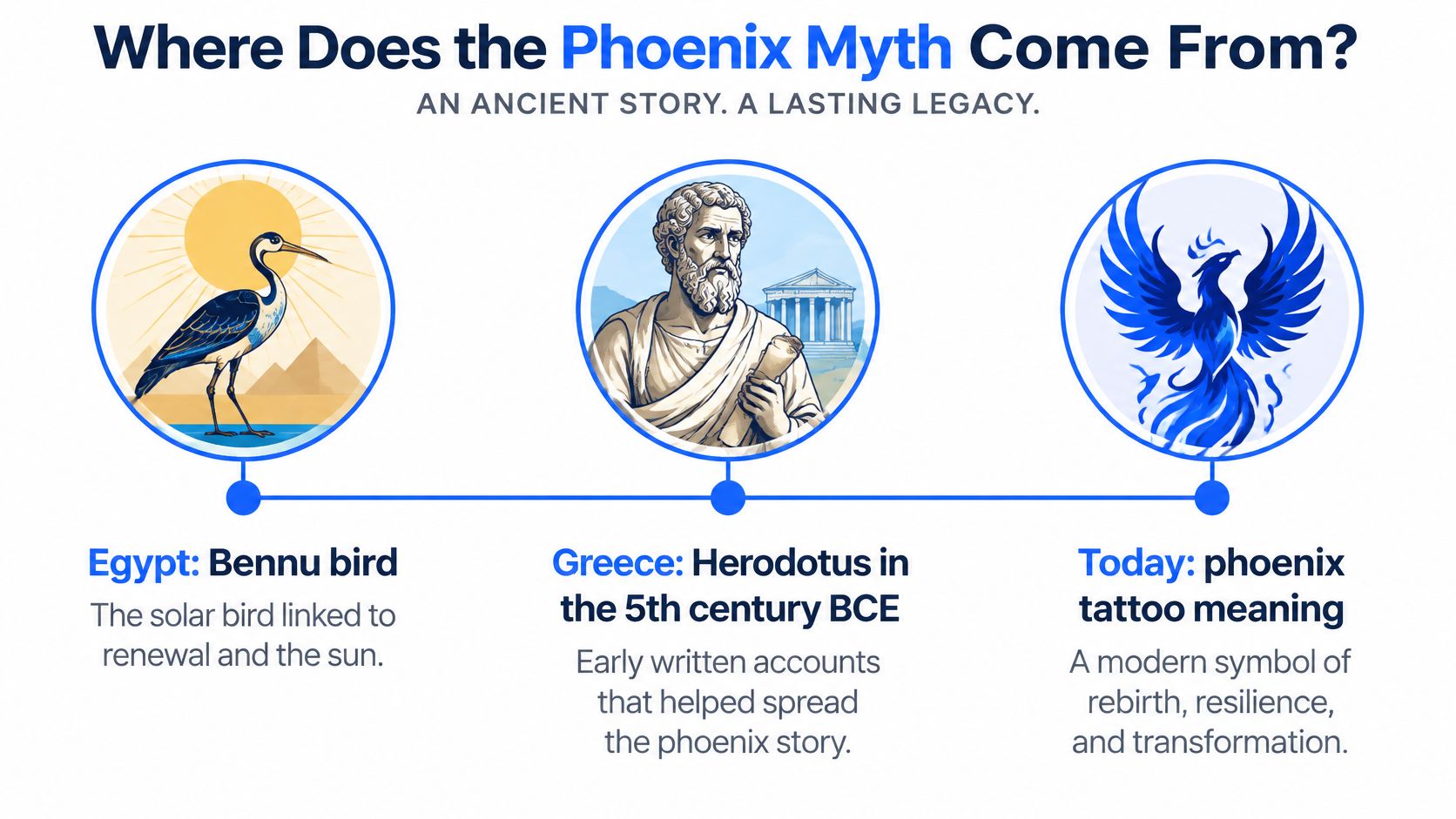
The phoenix's story has roots in ancient traditions, including Egypt's solar Bennu bird, and later Greek and Roman retellings. Those layers help explain why the tattoo can suggest renewal, endurance, and continuity, rather than just a fresh start. (Britannica's account of the phoenix)
From solar bird to written story
In Egyptian tradition, the Bennu was associated with the sun. Greek accounts carried the phoenix motif into another literary world: Herodotus discussed the bird in the 5th century BCE, and Pliny the Elder described it in his 1st-century CE Natural History. The story changed as it traveled, but its central image remained powerful: a long-lived bird dies, often in fire, and returns to life. If a single plume speaks to you more than the whole bird, our feather tattoo meaning guide covers that smaller symbol.
That sequence gives the phoenix tattoo its familiar visual shorthand. Fire signals an ending; the bird's endurance bridges the loss; the rise signals renewal. A wearer doesn't need to depict every stage for the meaning to come through. Ash beneath a wing or a body angled upward can suggest the whole cycle in a compact design.
From personal renewal to collective endurance
Roman audiences also used the phoenix as a political symbol of renewal and the enduring Roman Empire. Later Roman and early Christian traditions added associations with immortality and resurrection. These are historical meanings, not rules every wearer has to adopt, but they help explain why phoenix imagery can carry both personal and collective significance. (The phoenix in Greek and Roman sources)
For a tattoo, the bird's repeated return makes the story feel cyclical rather than final. It can represent getting through one upheaval, while also recognizing that life involves change more than once. That's why the image can fit a recovery milestone, a new chapter after grief, or a reminder that the wearer is still becoming.
How Does Culture Change Phoenix Tattoo Meaning
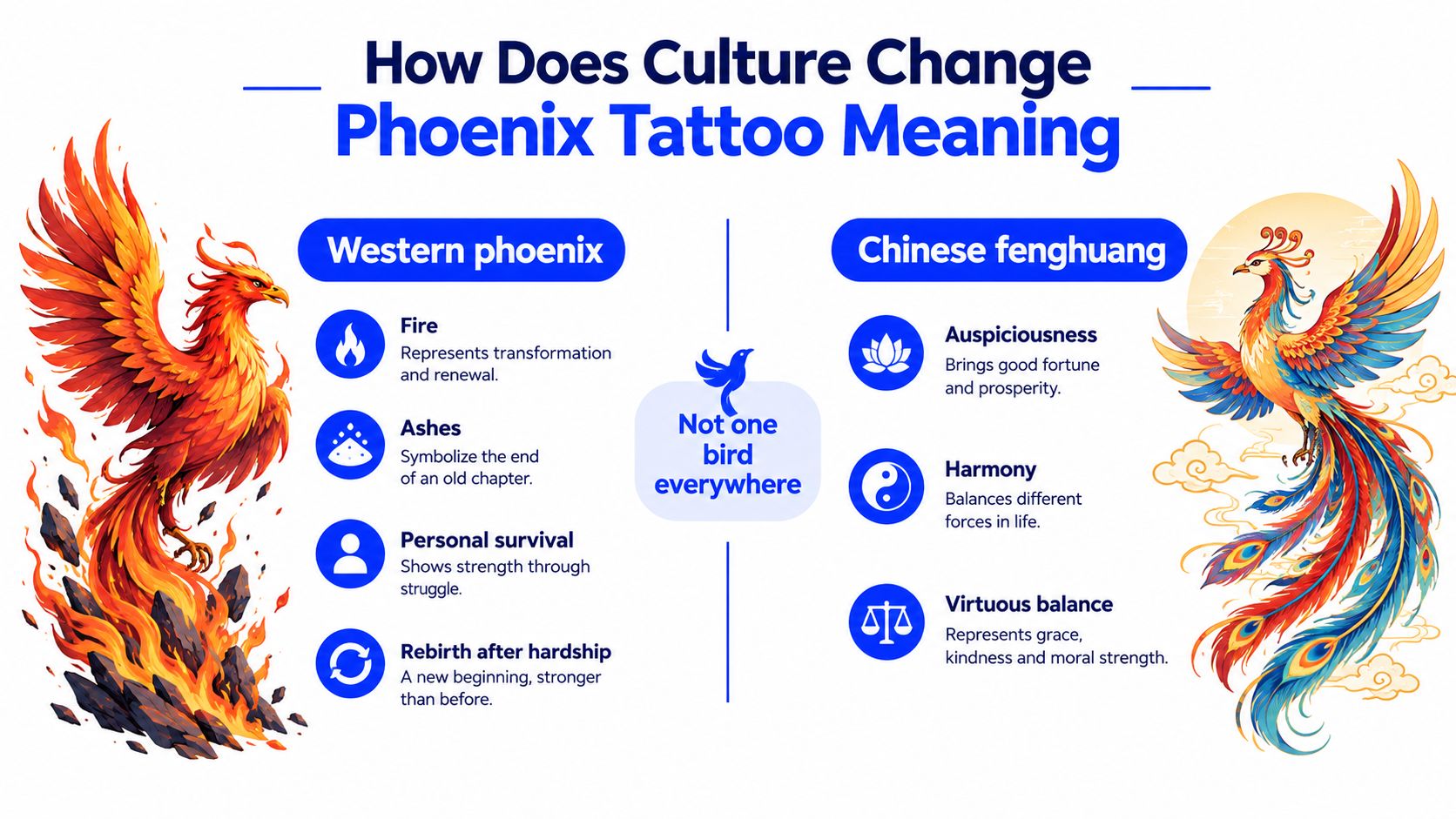
A phoenix isn't the same bird everywhere. Western imagery often leans on fire, ashes, and personal renewal, while Chinese-associated fenghuang imagery can signal auspiciousness, harmony, authority, and favorable order. Japanese hō-ō designs carry associations including nobility, peace, moral virtue, and the start of a new era. (The Metropolitan Museum of Art on phoenix imagery across cultures)
Look at the visual language
A lone bird wrapped in flames or rising from ash strongly cues the Western story of survival through destruction. A design with paired birds, elaborate ornamental plumage, or visual conventions associated with East Asian art may suggest a different set of ideas. Those details don't automatically define the meaning, but they give you clues about the tradition the artist is referencing.
Persian artists also adapted Chinese phoenix imagery into a distinctly Persian bird. The motif appears in Egyptian, Greek, Arabic, and Christian interpretive traditions, so it's misleading to treat one version as the origin of every phoenix image. If you're drawn to a culturally specific design, name that reference clearly when discussing it with an artist instead of describing everything as a generic “rebirth phoenix.”
Practical rule: Decide whether you want the image to signal personal survival, peace, spiritual renewal, or something else before selecting the pose and decorative details.
That precision can matter with other symbolic tattoo subjects, too. A koi fish tattoo's symbolism also depends on the visual tradition and the story a wearer wants to tell. The clearest phoenix design is the one whose imagery and intended meaning fit together, rather than a collection of cultural cues chosen without a plan.
How Do Design Choices Change the Message
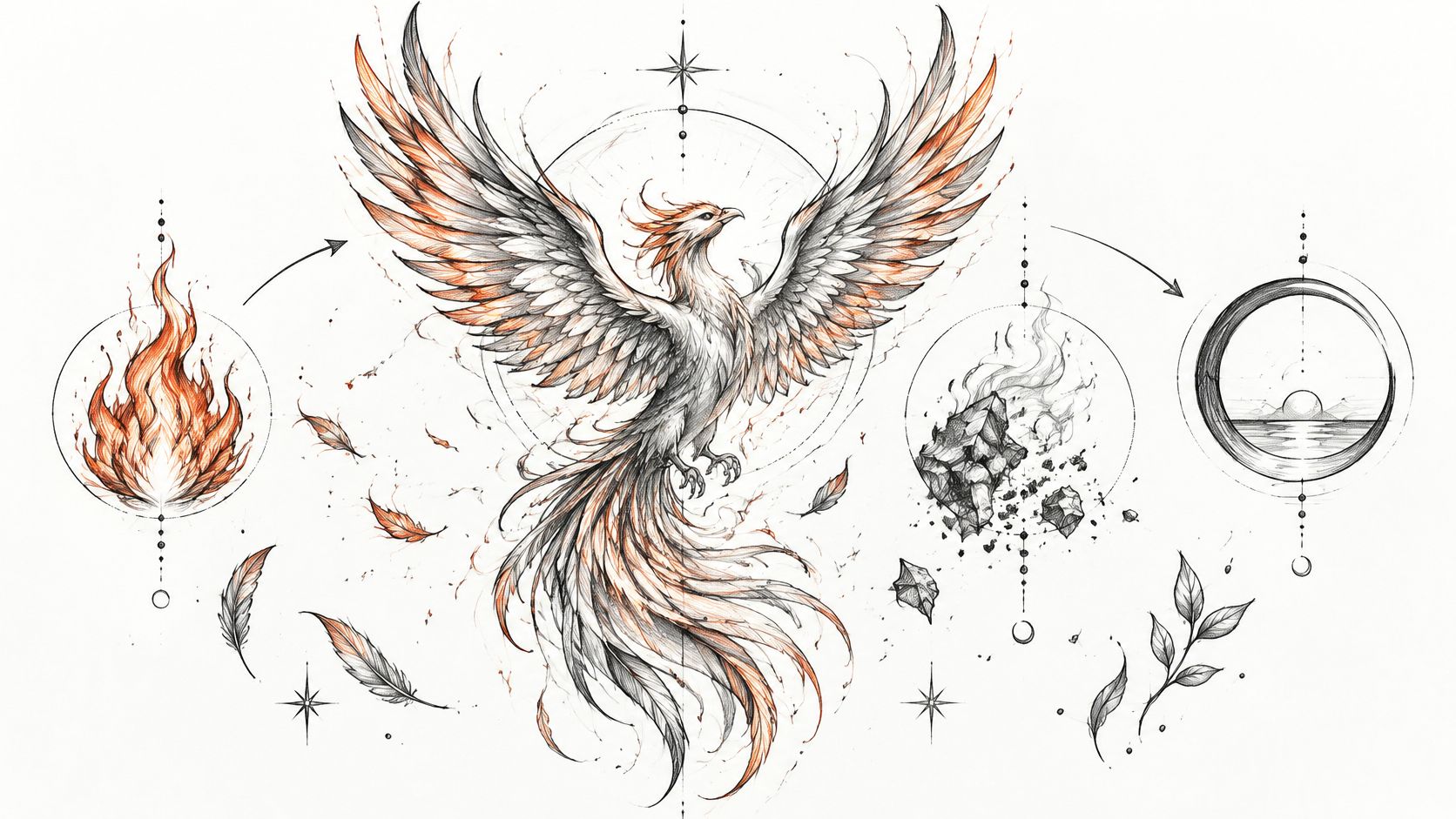
Read a phoenix tattoo like a sentence. Pose, flames, ash, palette, and companion symbols each add emphasis, so two designs of the same bird can communicate very different feelings.
Start with pose and direction
An upward flight pose, open wings, or rising body emphasizes motion and recovery. Flames or ash at the base bring attention to what came before, while a composition that moves from a downward angle into an upward one can show transition rather than a clean break. The bird's direction helps the viewer read the story before noticing smaller details.
Palette shifts the mood, too. Red and orange make fire and intensity prominent. Black fine-line work can feel restrained or personal, while blue and purple fantasy palettes can give the image a more otherworldly tone. These aren't fixed meanings; they're visual choices that influence how the design feels.
Add personal details with a reason
A date, initials, flower, or rising sun can connect the image to a particular person or chapter. If you add a motif, decide what it contributes: a flower may soften a fierce composition, while a date can preserve a specific milestone. Paired birds or highly ornamental tails may shift the visual reference toward East Asian imagery, so make sure those details match the tradition you intend. For what a rising or setting sun adds on its own, see our sun tattoo meaning guide.
A useful artist brief names the story first, then the image. “I want a phoenix that suggests a recovery still in progress” gives clearer direction than “make it dramatic.”
Scale affects whether the idea stays legible. Fine flame-to-feather transitions and detailed plumage need enough room to read clearly; when the design is small, simplifying the silhouette can work better than squeezing in every element. If you're comparing related transformation motifs, a butterfly tattoo meaning guide can also help you clarify whether you want a phoenix's fire-and-renewal story or a different kind of change.
Where Should You Place a Phoenix Tattoo
Choose placement around the design's movement and level of detail, not just convenience. Spread wings and layered flames need room, while a compact silhouette can suit a smaller area. Visibility matters as well: a forearm can make the story easy to share, while a less visible spot can keep it intimate.
Match the canvas to the design
The back, chest, thigh, or a sleeve can accommodate a large phoenix with detailed wings, feathers, and flame-to-ash transitions. A wrist, ankle, or area behind the ear is better suited to a simplified bird or fine-line outline. The smaller the canvas, the more selective you'll need to be about detail.
| Placement | Best Size Range | Style That Works Best | Meaning It Suits |
|---|---|---|---|
| Back | Large | Detailed, flowing wings and flames | A full personal transformation |
| Chest | Medium to large | Blackwork or layered color | A close-to-the-heart milestone |
| Thigh | Medium to large | Watercolor or fantasy color | A personal story with room for detail |
| Shoulder | Medium | Flowing wings or Japanese-inspired composition | Strength, renewal, or an evolving chapter |
| Forearm | Small to medium | Fine-line or clear silhouette | A visible reminder of resilience |
| Wrist or ankle | Small | Simplified fine-line design | A discreet personal symbol |
| Sleeve | Large | Connected imagery and layered composition | A longer story told through several motifs |
Let style support the story
Blackwork makes shape and contrast the focus. Watercolor gives a design a looser, more painterly feel; fine-line favors a lighter, more delicate outline. Japanese-inspired compositions rely on their own visual language and should be chosen with care if that cultural reference is important to you. Fantasy color offers room for imaginative palettes and dramatic transitions.
Visibility can change how often the tattoo becomes part of a conversation. A forearm or shoulder design can serve as a public marker, while a placement usually covered by clothing can hold a memorial or recovery symbol more privately. Neither choice is more meaningful than the other. Pick the location that suits how you want to live with the image, and make sure its size gives the wings and key details enough room.
Is a Phoenix Tattoo Right for Your Story
A phoenix can be a public sign of resilience, a private memorial, a marker of recovery still in progress, or an image you love. Tattoo motivations can include remembering or honoring someone, marking a significant experience or struggle, and self-expression. AARP polling reports 44%, 24%, and 38% of tattooed adults respectively cite those motivations. (AARP's overview of tattoos and body modification)
Those reasons don't require a phoenix to mean “I won.” You might want a reminder that you're still working through something, not a declaration that the experience is over. The myth's cycle leaves room for that unfinished feeling: the image can represent persistence and change without promising a perfect ending.
Ask what you want the tattoo to do
Try this quick self-check before settling on a design:
- What do I want it to say? Survival, remembrance, hope, peace, or just “I like this bird” are all valid answers.
- Who do I want it to say it to? A visible placement invites others to notice; a private one keeps the symbol closer to you.
- Which tradition am I drawing on? Be specific about Western phoenix imagery, Chinese fenghuang inspiration, Japanese hō-ō imagery, or a fantasy interpretation.
Other people may read the same tattoo as dramatic, spiritual, rebellious, or decorative, regardless of your intention. If you want to clarify its meaning, a flower, date, or initials can make the connection more personal. If you'd rather keep the symbolism open, leave those additions out. A lotus flower tattoo meaning guide may also help you compare how different motifs express renewal, remembrance, or personal change.
The most useful test is whether the design feels true to you without needing to prove that you've overcome everything. If the answer is yes, a phoenix can hold a complicated story, not just a tidy victory.
How Can You Try a Phoenix Tattoo Before Committing
A phoenix carries more interpretive weight than most motifs, because a Greek rebirth symbol, a Chinese fenghuang, and a Japanese hō-ō can look similar at a glance while saying different things. Trying the design on your skin first works like a rehearsal: you get to see how the wings wrap your forearm, whether a small silhouette reads as too subtle, and whether the tradition you borrowed still feels honest once it follows you through a normal week.
One low-risk way to run that test is a semi-permanent tattoo. Just Tattoos sells semi-permanent tattoos made with plant-based ink that apply at home without needles. According to the step-by-step temporary tattoo guide, the design develops in about 24 hours, and most designs last 7–10 days, with wear time varying by skin type, placement, washing, and friction. The same application guide advises a patch test for sensitive skin, so try a small spot before wearing the full piece.
You can compare phoenix-ready artwork in the Just Tattoos fantasy collection and browse other options in the full tattoo collection. Just Tattoos' current shipping policy lists shipping at $4.99 flat, with free shipping on orders of $35 or more.
Wear the trial piece through ordinary days: work, errands, workouts, photos. Notice whether the pose, flames, and cultural details still feel like your story when nobody is explaining them. Explore the semi-permanent designs at Just Tattoos and choose a look that fits the story you want to carry.