
A spider tattoo has no single meaning: common readings include creativity, resilience, danger, and fate, and the message changes with spider versus web, culture, and placement. Advice that reduces every spider to patience, or every web to prison, misses those differences.
Start with the actual image rather than a dictionary definition. A small spider beside a flower, an aggressive widow-marked spider, and an elbow covered in web rings can suggest very different stories, even when their wearers share the same reason for choosing them.
Table of Contents
- What does a spider tattoo mean?
- What does a spider web tattoo mean?
- Where do spider tattoo meanings come from?
- Where should a spider tattoo go?
- Which spider tattoo styles change the message?
- Can you try a spider tattoo before you commit?
- What questions do people ask about spider tattoo meanings?
What does a spider tattoo mean?
Spider tattoo meaning starts with what the creature is doing and what surrounds it. Wearers may use spiders to express patient work, creative ability, endurance, or a willingness to face something frightening. Those are possible readings, not an official translation that every viewer will recognize.
Separating the animal from its web makes the choice easier. The spider can suggest the maker, while the web can suggest what someone has built, the connections around them, or a situation they're trying to escape.
Spider tattoo designs and common readings
| Design | Common reading | When the reading shifts |
|---|---|---|
| Standalone spider | Creativity, patience, resilience, building a path | Fangs, a red hourglass, or an attacking pose push it toward danger |
| Spider in a web | Fate, connection, or feeling caught | Elbow or hand placement can add a prison reading for some viewers |
| Web alone | Complexity, survival, entrapment | A traditional ring web on the elbow is the strongest prison-associated look |
| Spider with flowers or nature | Life, craft, and a softer creative message | Less menace than a lone black spider in an aggressive pose |
| Geometric or fine-line web | Order, craft, and a self-made path | Copies of a classic elbow ring web can still be misread |
A standalone spider puts attention on the creature itself, so a calm pose can support craft and patience, while exposed fangs or a threatening stance encourage a danger reading. A spider in a web shifts attention toward relationships, fate, or the feeling of being caught within something larger.
A web alone leaves the maker out of the picture, making structure, confinement, and survival more prominent. Flowers or other natural elements soften the scene and help someone communicate life and making rather than menace.
A geometric or fine-line web can emphasize deliberate construction, although delicate execution doesn't erase the associations of a recognizable elbow ring design. None of these rows is universal, and visual choices guide interpretation rather than control it.
Choose the message before the artwork
Try finishing this sentence: I want this tattoo to remind me of… A creative practice, a difficult period you survived, and a fascination with dangerous animals would each lead to different artwork.
For example, someone marking years of making textiles might prefer an unhurried spider with open space around it. Someone acknowledging a difficult relationship might find a broken or incomplete web more personally relevant, without claiming that the design has that meaning everywhere.
Practical rule: Choose the image that supports your intended message before choosing the most dramatic version of it.
Use the table to identify your closest match, then consider cultural context and visibility before making a permanent decision. You don't need a universal meaning, but you should understand the interpretations you might encounter.
What does a spider web tattoo mean?
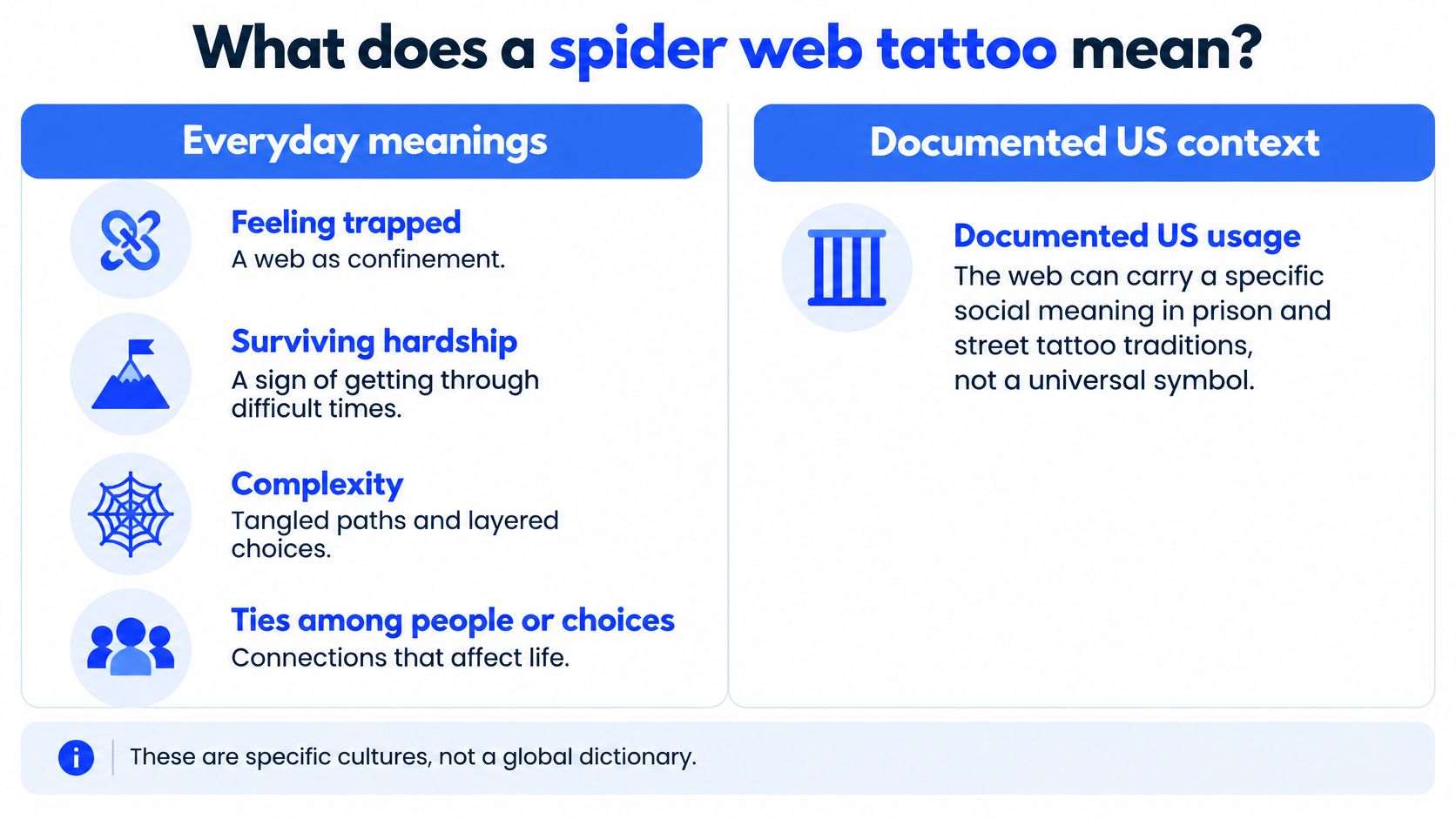
A web can suggest connection as readily as confinement. Its intersecting strands may evoke relationships, choices, complexity, survival, or the feeling of being caught in circumstances beyond one's control. A spider tattoo centers the creature; a web shifts attention to the structure it makes.
The same pattern can carry different personal meanings. Someone may choose it to mark a difficult period, while another is drawn to its radiating lines and intricate geometry.
Why does the prison association need context?
In some US prison and street-tattoo contexts, viewers associate webs with incarceration or being caught in a system or gang lifestyle. These associations are part of the design's social history, not proof of a wearer's conduct, beliefs, or background.
That context can matter especially for recognizable webs placed on the elbow or hand, which some US viewers may read through prison or gang associations. A decorative design can still be misread, so consider how its shape and placement might appear to people unfamiliar with your intention.
The reverse mistake is just as unfair: treating every web tattoo as a sign of criminality ignores designs chosen for their appearance or personal significance.
A web can carry a social history without serving as evidence about the person wearing it.
How can you choose a decorative web thoughtfully?
Look at the full composition. A web between leaves reads differently from a stark, isolated pattern, while an abstract arrangement of intersecting lines may emphasize its geometry. Details guide interpretation, even though they cannot control every viewer's response.
If you're exploring the pattern itself, spider web designs offer a decorative option to consider. Focus on the artwork's shape and setting, rather than treating its product name as a definition of its meaning.
- For connection: Consider how the strands join and whether the composition feels open or enclosing.
- For survival: Decide whether an intact or interrupted web better reflects your own experience.
- For complexity: Let the overlapping structure carry the idea.
- For craft: A visible spider or natural setting can draw attention to the act of making.
A web in a natural scene can give viewers more context than an isolated, familiar emblem. It may suggest craft or resilience, while leaving room for personal meaning.
Where do spider tattoo meanings come from?
A spider can suggest a maker, a protector, or a patient builder. Those meanings have parallels in specific cultural traditions, but the traditions are not interchangeable, and a modern tattoo does not inherit their significance automatically.
The Illinois State Museum's account of Spider Woman and related traditions describes Indigenous connections between spider imagery and creation, weaving, protection, and continuity. It also records that Osage women's ceremonial spider hand tattoos continued until approximately A.D. 1900, with only one surviving woman known to bear those ceremonial tattoos by 1960. These were culturally situated practices, not an early version of a modern trend.
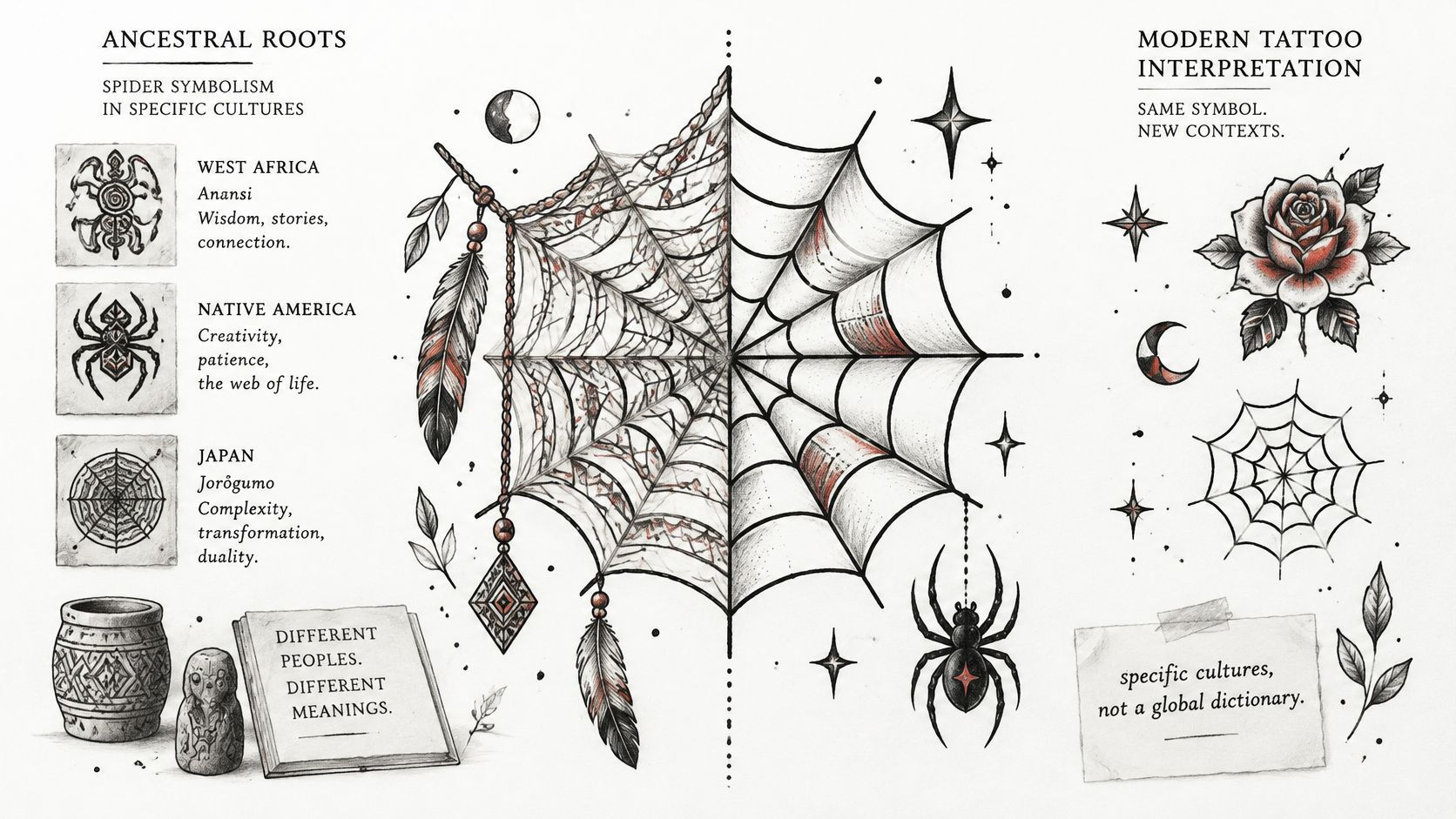
The examples differ in what they describe. The museum account notes that ancient Maya ceremonial stones called spiders were used to map the cardinal directions. Mississippian symbolism associated the spider with women and the continuation of life until death. In Navajo tradition, Spider Woman is a teacher of weaving, connected with knowledge, textile skill, and life-giving water.
A stone used in ceremony, a teaching figure, and a tattoo are different things. Their shared spider imagery does not give them one universal meaning. It points instead to cultural specificity: creativity, feminine power, ancestry, patience, and making a path may resonate with a wearer, but the wearer should identify the reference they intend.
That distinction also helps guide respectful design choices. An original spider inspired by weaving or family continuity can express a personal idea without copying a ceremonial motif. If a design draws on a specific tradition, learn its context rather than presenting distinct Indigenous peoples as sharing one belief. A naturalistic spider and a nation-specific ceremonial design are not equivalent.
The same care applies when comparing animal symbols. A guide to snake tattoo meaning can help clarify whether an animal appeals to you for its appearance, personal associations, or cultural reference.
Meaning comes from the tradition, the image, and the wearer's intention. A spider or web does not carry one fixed interpretation.
Where should a spider tattoo go?
A spider's placement affects how visible it is and which familiar tattoo conventions viewers may notice. A small spider on the ankle and a ring-shaped web over the elbow can feel like entirely different choices, even if both express the same personal idea.
| Placement | What it suits | What to consider |
|---|---|---|
| Inner wrist or ankle | Small spider or mini web | Easy to cover or show; a wrist design may still be visible in everyday conversation. |
| Hand | Compact spider or web | Highly visible, with little room for surrounding context. |
| Elbow | Ring-shaped web | Some US viewers may associate this familiar placement with prison imagery. |
| Forearm | Single spider or partial web | Flexible space; the overall composition affects how the motif reads. |
| Shoulder or thigh | Larger spider | More room to show detail, pose, and scale. |
| Chest or back | Spider-and-web scene | The full composition may be covered, so consider how a partial view could appear. |
For a wrist or ankle design, check how it looks with your arm or leg in a natural position. A tattoo can look clear from your own viewing angle but be harder for someone else to read. The same principle applies to a larger piece: assess the whole design, then consider what remains visible under everyday clothing.
The elbow deserves one specific check. A ring web centered on the joint may prompt prison-related assumptions from some US viewers, regardless of the wearer's intention. If that possibility concerns you, consider shifting the web off the elbow or choosing a less familiar arrangement.
For a larger arm composition, sleeve tattoo ideas for women can help you consider how surrounding artwork changes the impression of one motif. Stand with your arm relaxed and look at the design as a whole, rather than judging each element in isolation.
Before settling on a spot, check visibility, scale, and context. A shoulder or thigh gives a larger image room to read; a hand or wrist keeps it close to everyday view.
Which spider tattoo styles change the message?
A small spider drawn in fine lines can suggest craft and careful construction. A widow-marked spider, especially with a red hourglass, makes danger a clearer part of the image. Add a web, and the relationship between spider and strands can suggest fate or connection.
The details steer the first impression. A calm pose and open space give the spider's form room to show; raised front legs, exaggerated fangs, or a crowded composition make the image feel more threatening.
Let the details carry the idea
Fine-line or geometric webs draw attention to pattern and structure. Open space and incomplete strands soften the ring-web appearance, while a complete web can look more traditional. Some US viewers still associate elbow or hand webs with prison or gangs, so those placements and patterns may carry meanings beyond the wearer's intention.
Leaves and flowers place the spider among other living forms, shifting attention toward nature. Extra symbols can redirect the message: daggers, skulls, or prominent lettering may become the first thing viewers notice.
Compare the whole composition
When browsing animal tattoo designs, compare the pose, linework, and surrounding imagery, not just the species. A few combinations show how those choices work together:
- Small fine-line spider for craft: Choose a calm pose and leave open space around the silhouette.
- Widow-marked spider for danger: Make the identifying mark a deliberate feature, not an unexplained splash of color.
- Spider with a web for fate: Let the creature and strands form one connected scene.
If you're weighing the spider's shape against another creature's symbolism, this guide to moth tattoo meaning offers a useful comparison. Describe the design without naming your intended meaning. If the visible cues suggest aggression while you want quiet creativity, adjust the pose, symbols, or composition.
Can you try a spider tattoo before you commit?
A temporary spider tattoo can help you judge how a design feels in daily life before choosing a permanent placement. A picture shows the artwork; wearing it shows how it looks when your elbow bends, your hand rests, or your clothes cover part of it.
That trial can also help you think through how others may read the placement. In the United States, some viewers still associate webs on elbows or hands with prison or gangs, even though those designs can have personal, creative, or other meanings.
What should you check during a trial?
Wear the design during an ordinary day, with your body relaxed and moving. Take a close photograph to check detail, then a full-body photograph to see how the placement fits your overall look.
- Size: Does the spider remain clear, or get lost among other visual details?
- Position: Does the composition still work when your elbow bends or your hand rests naturally?
- Reaction: Do questions about the design feel comfortable to answer?
- Personal fit: Do you still enjoy seeing it during an ordinary day, not just with a particular outfit?
Just Tattoos offers 300+ artist-made designs, including skin-safe temporary tattoos with a realistic look. The designs are needle-free and plant-based. They can help you test a placement before booking an artist, match with a friend for a trip, or try a weekend look. The temporary tattoo guide for men offers ideas for fitting individual designs into a complete look.
What should you know before ordering?
The ink develops in about 24 hours, and the tattoos last 7–10 days. If you have sensitive skin, consider a patch test before applying a full design.
Shipping is $4.99 flat, with free shipping on orders over $35. Just Tattoos ships within the United States.
A trial gives you a clearer sense of the image, placement, and everyday visibility you prefer. It can't determine how every viewer will interpret the tattoo, so weigh your own connection to the design alongside the associations others may bring to it.
What questions do people ask about spider tattoo meanings?
Is a spider tattoo bad luck?
A spider tattoo doesn't have one universal meaning of luck. The National Folk Museum of Korea's account of spider folklore describes a contrast in which a morning spider is treated as a good-luck sign, while an evening spider is associated with worry.
The example shows how context can shape an interpretation. A wearer might connect a spider with fortune, warning, anxiety, or protection, but the image itself doesn't determine what will happen.
If luck matters to your design, choose the specific story or personal association you want it to express.
Do web rings equal years served?
Web rings have sometimes been linked with time in prison, as discussed in the web section above. A decorative pattern alone can't establish someone's history, and adding or removing a strand doesn't guarantee a particular reading.
Are spider tattoos only for women?
Spider tattoos are worn by people of any gender. Some Indigenous traditions connect spider imagery with women, lineage, and the continuation of life, but those associations don't define every spider design.
A spider might represent craft, danger, fate, or a personal connection with the animal. Fine lines, large scale, flowers, and dark shading shape the artwork, not who can wear it. Viewers may bring their own associations, so choose a design that reflects the meaning you intend.
Just Tattoos offers realistic-looking, plant-based semi-permanent tattoos you can apply at home without needles. Visit Just Tattoos to explore a spider web design and consider whether its shape, scale, and placement suit the message you want to wear.