
A peony tattoo most often means wealth, prosperity, rank, honor and beauty, a reading that grew out of Chinese art and imperial gardens. Japanese-style peony designs add a second layer on top of that base: courage, daring and a willingness to take a risk.
So why do most guides stop at "prosperity" and call it done? Because the peony is one of the few flowers whose meaning changes depending on which tradition the design borrows from, how many blooms are in the composition, and what sits beside them. A peony alone on a wrist and a peony tangled around a guardian lion aren't saying the same thing, even when the petals look identical.
Table of Contents
- What Does a Peony Tattoo Usually Mean?
- Where Does the Peony's Meaning Come From?
- How Do Color, Bloom Count and Pairings Shift the Message?
- Which Placement and Style Suits Your Meaning?
- Can a Peony Tattoo Mean Something Personal?
- Try It Before You Commit
What Does a Peony Tattoo Usually Mean?
Scan the rows and a pattern shows up fast. Petal color is not what splits one reading from another. Bloom stage, the figure beside the flower, and whether the design leans on Chinese or Japanese tradition do that job.
Common peony tattoo meanings at a glance
| Meaning | What It Signals | Where the Reading Comes From | Best-Fit Design |
|---|---|---|---|
| Wealth and prosperity | Abundance and good fortune | Chinese tradition | Full bloom with leaves |
| Rank and honor | Status and dignity | Chinese and Japanese art | Single large bloom |
| Courage and boldness | Daring and resilience | Japanese tattoo tradition | Peony with lion, tiger or koi |
| Beauty and grace | Attraction and refinement | Broader flower traditions | Open fine-line bloom |
| Bashfulness or shame | Shyness, a less common reading | Historical flower-language sources | Bud or half-open bloom |
Use the table as a starting point, then adjust for the design you have in mind. The row you choose sets size, how open the bloom should be, and whether a second figure belongs in the piece at all.
The peony works like a shared word. Context finishes the sentence. A full bloom with leaves, the arrangement long tied to Chinese tradition, reads as abundance and good fortune. Set that same flower beside a lion, tiger, or koi, a pairing drawn from Japanese tattoo tradition, and the sentence turns toward daring. The petal can stay identical.
People get stuck when two matching flowers seem to demand one definition. They do not. Meaning still depends on the wearer. Older flower-language sources treat a bud or a half-open bloom as shyness. An open bloom, in broader flower traditions and in Chinese and Japanese art, leans toward grace, rank, or honor. You decide which of those sentences the tattoo is finishing.
If beauty and grace is your row, floral designs built around one open bloom fit that aim. If courage is your row, leave room for the animal or fish so the peony sits inside a scene.
Picture the same wrist twice. A tight bud reads as reserve. A wide-open bloom in that same spot reads as confidence or status. That change in the flower's stage usually speaks louder than pink, red, or black ink.
Where Does the Peony's Meaning Come From?
Where does a peony tattoo get its meaning? The flower travels. It begins as a Chinese court plant, then arrives in Japan and picks up a second personality.
The Bristol Botanic Garden's history of the peony traces that path through more than 1,400 years of East Asian cultivation: Chinese growers cultivated peonies for medicinal purposes by roughly the sixth and seventh centuries, and the flower became especially prominent during the Tang Dynasty (618–907 CE), when tree peonies were planted in imperial gardens.
Court life is where the vocabulary comes from. Historical botanical sources describe the peony as the "king of flowers" and tie it to wealth, prosperity, social rank, honor, happiness, and nobility. The Chinese name fùguìhuā translates roughly as "flower of wealth and rank," the most direct reason a peony tattoo so often communicates prosperity, status, beauty, or a hope of abundance.
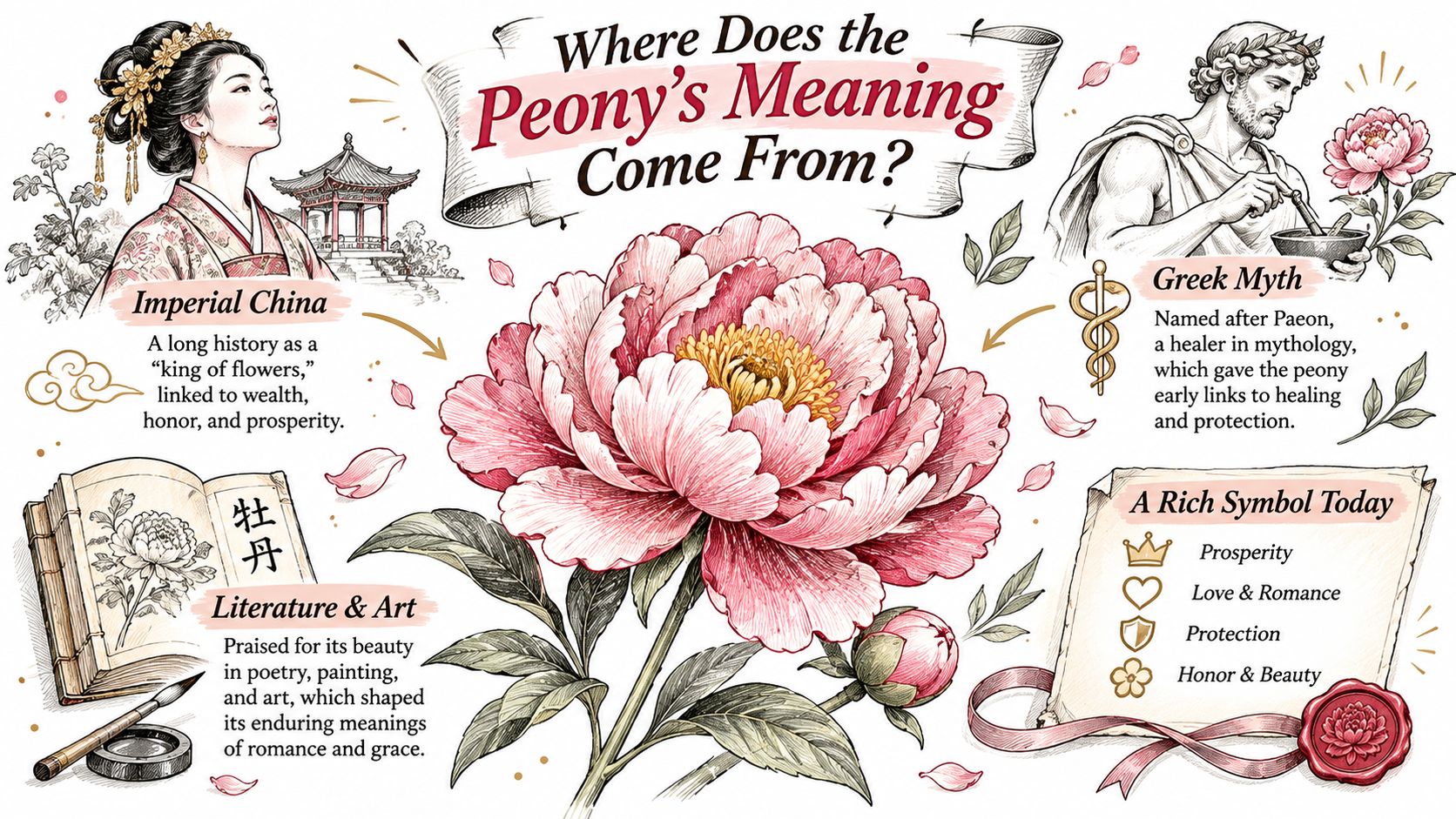
For centuries the flower showed up in Chinese paintings, silk tapestries, lacquerware, clothing, and other decorative arts, sometimes beside phoenixes, lions, peacocks, and pheasants to stress splendor and nobility. A large, fully opened bloom still borrows that imperial-garden scale. It reads grander than a small closed bud, the way a palace hall feels different from a single chair cut in the same style.
How Japan Recast the Same Flower
The Kyoto National Museum calls the peony the "King of Flowers" in Japan and a traditional symbol of wealth and honor, notes that peony imagery appeared constantly on everyday objects such as ceramics and lacquerware as well as in painting, and places the genus's arrival in Japan in the eighth century, carried there by Buddhist monks, after which it spread through Japanese decorative art.
Japanese tattoo imagery took that elegant motif and turned the volume up. In that visual language the peony also came to suggest bravery, a bold character, and a devil-may-care attitude toward consequences.
For a designer, the two traditions point in different directions. The same flower reads as luxury in a Chinese frame and as courage in a Japanese irezumi-style composition. What sits around the bloom decides which of those readings a viewer gets. A peony set into a scene tells a story. A small bloom on its own reads as decorative beauty.
If you want the bolder version, Japanese-style peony designs show how the flower sits inside wind bars, waves, and animal pairings rather than floating alone. The same logic runs through the lotus flower tattoo meaning, where the surrounding water and light change the reading more than the petals do.
Decide first whether you want people to see luxury, courage, or both. Then let the companions and the framing carry that choice. The wearer still gets the last word. Two people can share one flower and mean different things by it.
How Do Color, Bloom Count and Pairings Shift the Message?
A peony, a white magnolia and crabapple blossoms stop being three separate plants once they share a design. In Chinese decorative art that trio forms the phrase "yutang fugui." The Asian Art Museum's documentation of hidden meanings in Chinese art shows the combination conveying wealth and rank in an honored, prosperous household. The group works like a short sentence. Remove one plant and the household blessing no longer reads.
Bloom count changes the sentence again. A single open bloom reads as beauty and one person's status. A dense cluster signals abundance and ceremony, and it needs more skin to stay legible, so the size of the piece follows the size of the claim.
Color gets more credit than it can carry. A pink or red peony can suggest warmth and love, yet the same red changes jobs as soon as a companion arrives. A red peony beside a lion or guardian dog belongs to Japanese composition, where that pairing signals protection and courage. A peony beside birds or crabapple blossoms belongs to Chinese decorative art, where those companions point to longevity and household prosperity. Linework shifts the tone a third time. Black-and-white blackwork reads bold and graphic. Soft shading reads refined.
If a meaning depends on a color code you can't explain in one sentence, pick a different route to the same message.
The rose tattoo meaning follows a similar pattern, where surroundings and the color story do more work than one fixed definition.
Your own story can override the tradition. Before a layout is settled, ask three things: what the bloom count should say, what the companions should say, and what you would tell a stranger who asked.
Which Placement and Style Suits Your Meaning?
Placement does more than fit a design onto a body. It decides which reading a stranger gets in the first two seconds, before anyone asks a question.
Large compositions earn the grand readings. The back, chest, upper arm and thigh give a full bloom enough room to sit beside a lion, koi or tiger, and that pairing is what carries courage and grandeur. A big peony spread across the upper back reads as dignity and strength from across a room.
Compact single blooms carry the quieter readings. Wrist, ankle, hand, finger and foot placements suit one open bloom, which lands as beauty or personal status rather than power.

Two examples worth borrowing. A matching pair of small blooms, one on each wrist, can hold a shared story between two people without either design going large. A single large bloom across the upper back makes a statement about bearing and confidence, and the scale itself is part of the message.
Style then sharpens the reading:
- Traditional Japanese composition. Bold outlines, saturated color, wind bars and water. This is the version that reads as courage.
- Fine-line botanical. Delicate and quiet, closer to a drawing than a tattoo. It leans beauty and grace.
- Blackwork. Solid fills and high contrast. Graphic, modern and confident.
- Colored art. Warmth and richness, the closest match to the imperial-garden associations.
For single blooms and small clusters, browse floral designs and check the listed dimensions against the body site you have in mind. If you're building something bigger, these sleeve tattoo ideas for women show how a bloom and its companions can divide the space.
Scale is also the main reason to test first. With a black-and-white version, our designs develop in about 24 hours and most designs last 7–10 days, depending on skin and placement. Anyone with sensitive skin should run a patch test before a large placement.
Pick the placement first, then the style that fits it. Doing it the other way around usually means shrinking a design until the detail disappears.
Can a Peony Tattoo Mean Something Personal?
A peony tattoo can carry a story that has nothing to do with wealth, romance, or femininity. Inherited symbolism is a starting point, and a personal meaning can override it.
Associations have shifted across periods. Flower-language lists have included bashfulness, shame, and anger, while Chinese cultural history stresses status, prosperity, and honor. You can set both lists aside. A personal reading works like a nickname: the public word stays the same, and the private sense belongs to the person who uses it.
Healing, grief, and family heritage fit here as readily as resilience or sensuality, as long as the wearer's story supports them. Pairings and bloom count shape that story more than petal color does. A full bloom beside one tight bud can mark a recovery still in progress, the open flower for what has mended and the bud for what has not. Place the same peony next to a sprig of a family flower and it can honor a relative without spelling out a name.
Color changes the mood. It seldom writes the sentence. A private meaning often reads as decoration to a stranger. Some wearers want that story obvious. Others are content that only they can translate it.
Try It Before You Commit
Your peony's meaning comes down to a combination: bloom count, color, companions and placement. Test the exact version you have in mind rather than a generic flower, because a single bloom and a peony with companions are two different sentences written on skin.
The full catalog lets you compare designs across floral and Japanese-style collections, so you can see how the same flower reads in each tradition. Two peony-specific sets make the comparison easy: the Elegant Peony Blossom Blackwork 6-pack and the Night Blossom Japanese Style Peony 6-pack, both $7.99, marked down from $12.99. Each design develops over about 24 hours, so judge the result only once the ink reaches full shade. Shipping is $4.99 flat, and free on orders of $35 or more.
Choose the meaning you settled on, pick the one design that matches it, and apply it following the step-by-step application guide. Then live with it. Pay attention to whether the companions and bloom count change how the tattoo reads day to day, since those tend to carry more of the message than petal color does. If the reading still holds after the ink fully develops, you have found your design. If a cluster feels heavier than your intended meaning, or a blackwork peony leans more Japanese than you wanted, you have learned that for $7.99. For a fuller method covering placement trials, read how to try a tattoo before you get it.
Just Tattoos makes semi-permanent tattoos printed in plant-based ink that soaks into the top layer of skin instead of sitting on it like a sticker, with no needles involved. You can wear a peony on your wrist or shoulder for a week and see how the bloom, the scale and the companions sit on your body before any artist picks up a machine. Visit Just Tattoos to find the peony design that says what you mean.