
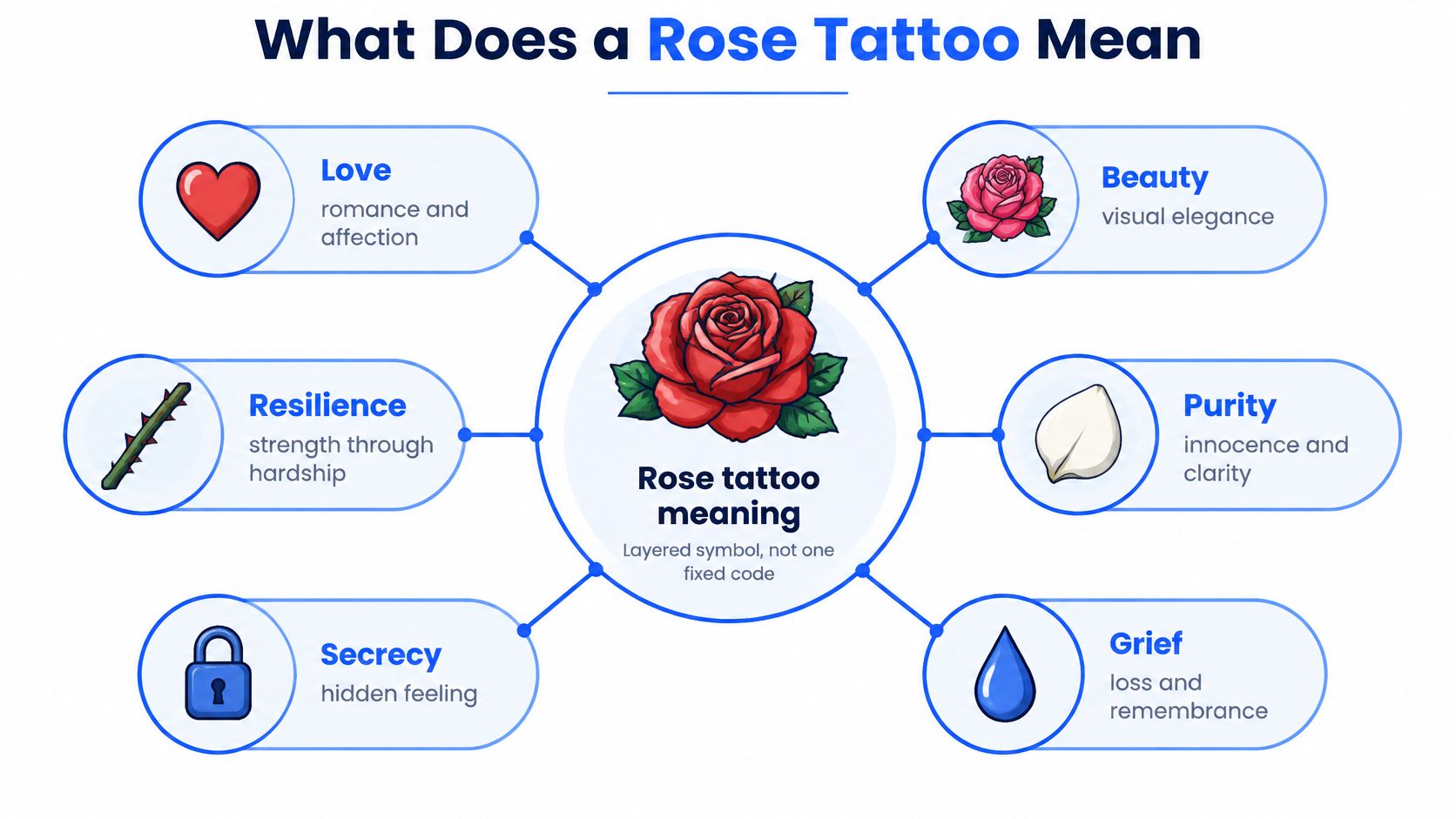
The usual advice, pick a rose color and you've picked its meaning, leaves out most of the story. A rose tattoo is a layered symbol of love, beauty, grief, or resilience, not a fixed code. Color gives viewers a starting point, but the thorns, accompanying imagery, style, and placement help determine what they read.
Table of Contents
- What Does a Rose Tattoo Mean
- What Does Each Rose Color Usually Mean
- Where Do Rose Tattoo Meanings Come From
- How Do Thorns and Extra Symbols Change a Rose
- Which Rose Style and Placement Fit Your Story?
- How Can You Keep the Meaning From Being Misread?
- Can You Try a Rose Tattoo Before You Commit
What Does a Rose Tattoo Mean
A rose tattoo commonly represents affection and beauty, but it can also express purity, secrecy, remembrance, or strength through hardship. Those meanings don't cancel each other out. A design can honor something beautiful while acknowledging what it cost you.
The flower's history helps explain that range. The National Trust's guide to roses in art traces associations with love, purity, grief, secrecy, and even political reconciliation. That's a much broader vocabulary than the simple equation of rose equals romance.
Start by separating what the image suggests from what you intend it to mean. You might choose a rose because your grandmother grew them, while someone else sees a declaration of love. Neither reading makes your personal connection less legitimate.
Personal meaning doesn't need a universal code
You don't have to choose between a meaningful tattoo and a beautiful one. A rose can be primarily decorative, personal, or both. Liking the shape of its petals is enough reason to wear it.
A useful distinction is between a recognizable association and a private dedication:
- Recognizable association: Viewers may connect a lush rose with beauty or affection without knowing anything about you.
- Private dedication: The flower might recall a garden, a family tradition, or a turning point that only you recognize.
- Combined meaning: You can use a familiar symbol while giving it a specific role in your own life.
Practical rule: Choose a rose because its likely reading fits your story, not because a color chart promises everyone will understand it.
This flexibility matters when you're comparing flowers, too. Exploring lotus flower tattoo meaning can help you decide whether the rose's mix of tenderness and difficulty expresses your intention better than another bloom.
The strongest choice isn't necessarily the design with the most symbolism. It's the one you can explain comfortably, or enjoy without explaining at all.
What Does Each Rose Color Usually Mean
| Color | Usual modern reading | Older or conflicting reading | Detail that locks the meaning |
|---|---|---|---|
| Red | Romantic love or desire | Still the strongest love reading | A partner's name or meaningful relationship date makes the romance specific |
| Dark crimson | Mourning or deep loss | Distinct from bright red romance | Skip it if the only goal is straightforward love |
| White | Purity, innocence, reverence, or a new start | Also used for remembrance | A date or portrait turns it toward a memorial |
| Pink | Grace, happiness, gentleness, or gratitude | Less historical conflict than yellow | Soft companions keep it warm rather than mournful |
| Yellow | Friendship and joy | Victorian jealousy or declining love | Bright botanical styling favors friendship |
| Orange | Enthusiasm, energy, and desire | Less fixed than red | Fits passion that isn't only romantic |
| Lavender | Love at first sight or enchantment | A modern extension of flower language | Suits a rare, personal color story |
| Black | Grief, resilience, rebellion, or a preferred look | Not a single mourning code | Thorns or a date can push it toward grief; clean linework can stay stylistic |
Rose tattoo color meanings are a starting vocabulary, not a translation key. The table's final column offers ways to steer interpretation, not guarantees that a viewer will read your mind. Think of those details as context that makes an otherwise broad message more specific.
Yellow makes the problem especially clear. An older flower-language reading connects it with jealousy or declining affection, while a modern wearer may choose it to celebrate friendship and joy. Neither interpretation disappears because the other exists.
Choose the emotional tone before the shade
Ask what you want the color to contribute: warmth, intensity, softness, solemnity, or contrast. That question is more useful than asking whether a shade has a single correct definition.
Red is a straightforward choice when you welcome a romantic reading. Dark crimson, despite belonging to the same color family, can feel more solemn and is associated with mourning. Don't treat every dark red as an interchangeable substitute for a bright love-themed bloom.
White and pink can both feel gentle, but they suggest different directions. White can support reverence or a fresh beginning; pink can emphasize appreciation and tenderness. If you're choosing a flower for someone who supported you, a pink rose may express gratitude without making the design feel like a romantic declaration.
Orange offers a more energetic option. You might use it to express enthusiasm for a new chapter rather than desire for a particular person. Lavender can suit a story about enchantment or an unusually immediate connection, but it shouldn't be presented as a message every observer will recognize.
Don't let black become an automatic diagnosis
A black rose doesn't prove that someone is grieving. A wearer might prefer its contrast, want a rebellious mood, or enjoy monochrome artwork. An aesthetic choice doesn't require a tragic explanation.
Say you want a black rose to mark rebuilding your confidence. You could choose an upright bloom with balanced, uncluttered linework rather than a drooping flower surrounded by memorial details. The color remains the same, but the composition supports a different story.
Color can establish the mood. Specific details make the dedication clearer.
When combining a rose with another image, consider the combined message rather than assigning separate dictionary definitions. The associations explored in butterfly tattoo meaning, for example, can help you think through a design about change rather than courtship.
You also don't need to force your favorite color into a symbolic justification. If yellow looks right to you, you can choose it knowing that friendship is a plausible reading, not an exclusive one. A deliberate choice includes accepting some ambiguity.
Where Do Rose Tattoo Meanings Come From
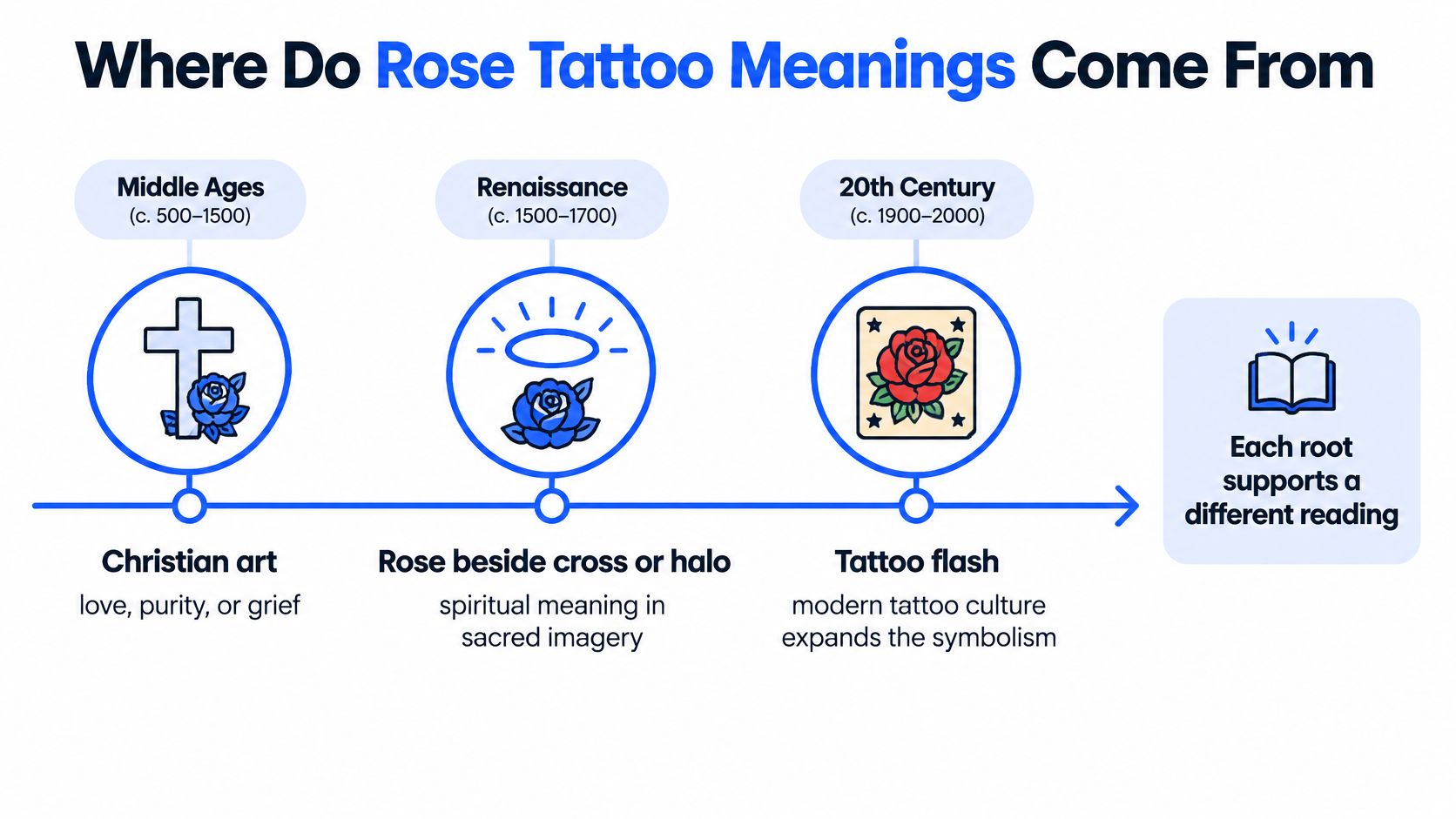
Cultural background gives a rose more to work with than a Valentine's Day association. Centuries of religious art, classical mythology, and national emblems layered extra meanings onto the flower, and a modern design can draw on any of them. Color sets the mood. History can supply the plot.
In Christian art, roses could represent love, purity, or grief. In classical tradition, their connection with Aphrodite and Venus offers a different foundation: love and beauty. The same flower can therefore support sacred devotion or earthly affection without either interpretation being a mistake.
Different traditions support different stories
The Tudor Rose brings another possibility. By combining the white rose of York and red rose of Lancaster after civil conflict, it became an emblem of reconciliation. For someone thinking about repaired relationships, that history offers a more specific idea than generic romantic love.
Persian literary tradition connects the rose with divine love and longing. The broader associations discussed in this Harvard-hosted overview of rose tattoo designs also include familial love, remembrance, resilience, and personal transformation.
- For faith: Name the tradition you mean. A rose read through Christian art can carry love, purity, or grief, so identify which one you intend rather than treating spiritual imagery as interchangeable.
- For family: Choose details tied to the person or a shared experience. Remembrance and familial love need more than a generic romance motif to come through.
- For cultural connection: Learn the emblem before you borrow it. The Tudor Rose means reconciliation precisely because of the conflict behind it, and that backstory is what gives the design its weight.
A viewer may recognize only the familiar love-and-beauty association. That doesn't erase a more specific cultural meaning, but it does make context and intention important when explaining your choice.
How Do Thorns and Extra Symbols Change a Rose
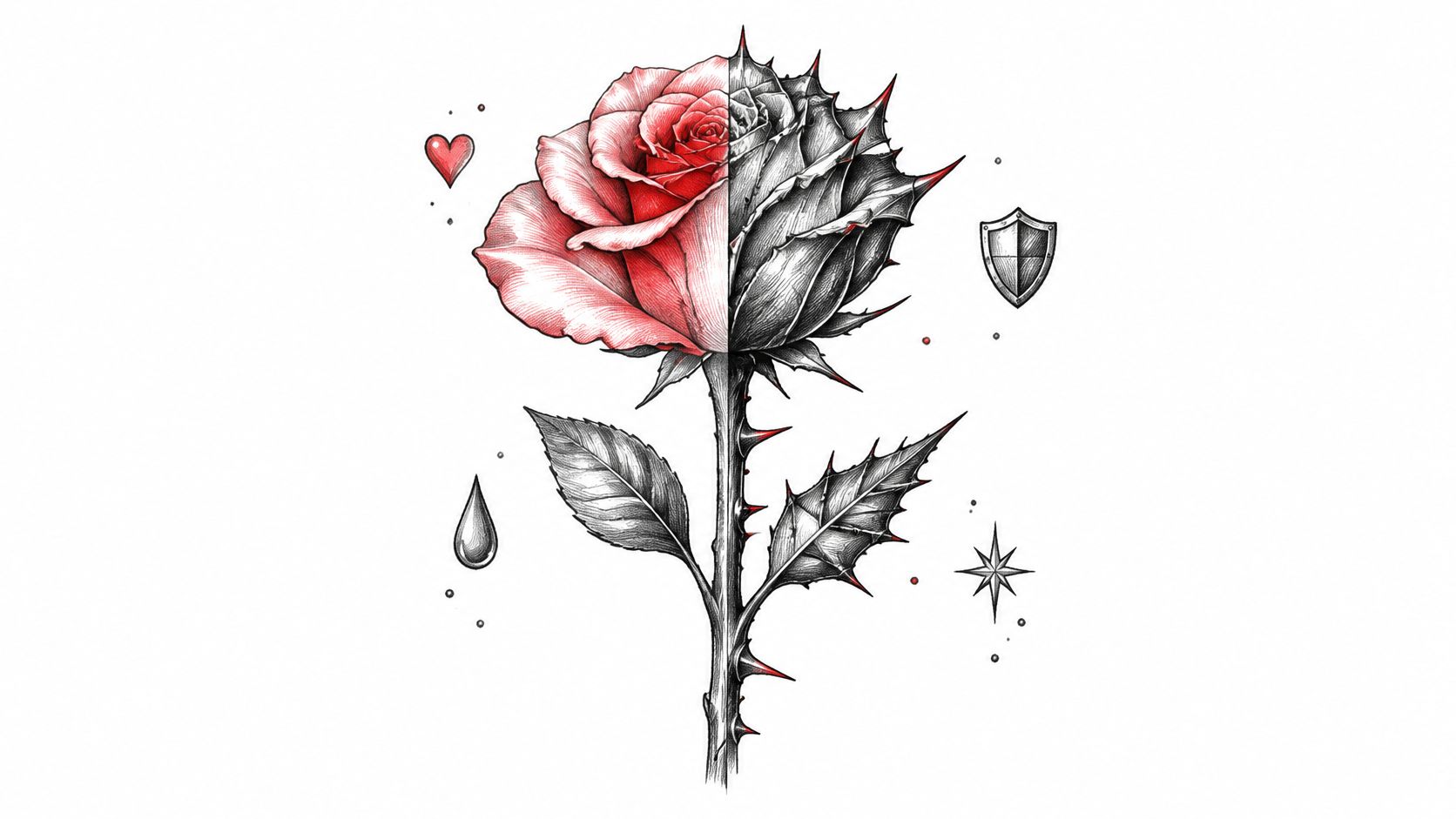
Color is only the first word of a rose's message. Thorns, the condition of the bloom, and whatever shares the design decide which story a viewer reads. A rose combines softness with physical defense: its petals invite a reading of tenderness, while its sharp thorns introduce discomfort, protection, or sacrifice. That botanical contrast underlies the symbolism described in this guide to botanical tattoos.
In a drawing, the artist decides which part you notice first. Enlarged thorns and a tightly curved stem push the defensive qualities forward. A broad, open flower with an unobtrusive stem keeps attention on the bloom.
Read the condition of the flower
An open, healthy bloom can support beauty, affection, or self-expression. A wilted head, falling petals, or a broken stem introduces impermanence and can suggest mourning or the aftermath of difficulty.
That difference matters if your intended message is recovery. A damaged flower looks back at what happened to you, while an upright bloom looks ahead to where you are now. Pick the version whose direction matches your story.
Thorns aren't automatically evidence of heartbreak, either. You might choose them to represent boundaries: tenderness remains possible, but access isn't unconditional. If that's your intention, a living bloom on a clearly thorned stem may fit better than a collapsing flower.
Give each companion a clear job
An additional symbol should make the rose more specific rather than making the design busier. These are useful possible readings rather than fixed definitions:
- Dagger: Can suggest affection tangled with danger, conflict, or betrayal.
- Skull: Makes mortality more prominent and invites a life-and-death interpretation.
- Cross, halo, or sacred wording: Can frame the flower through faith, devotion, or tribute.
- Name or date: Identifies a relationship or event, although the surrounding design determines whether it feels romantic or commemorative.
- Word banner: Can state a quality such as courage or gratitude when the flower alone feels too open-ended.
A first name with a date may suggest remembrance, especially without a romantic frame. A partner's name wound through intertwined stems may suggest commitment instead. Text alone doesn't settle the question; the kind of text does.
Design check: If a companion introduces a story you don't want to tell, leave it out.
Use repetition deliberately
A single stem can focus attention on a person or life chapter. A bouquet can represent a family, a friend group, or several experiences brought together. Those are meanings you assign, not a universal counting system that strangers will decode.
A cluster of flowers can honor several siblings without adding names or dates. Give each bloom a small distinguishing feature, such as a different stage of opening or a slightly different leaf shape. The composition stays readable, and your private dedication remains intact.
Geometric shapes or minimal botanical arrangements can also keep the design primarily decorative. You don't need a companion symbol just because there's room for one. Empty space can help the rose remain the clear subject.
Which Rose Style and Placement Fit Your Story?
Choose the style for its visual emphasis, then choose a spot that suits both the composition and your comfort with visibility. Placement affects who sees the tattoo and how often you'll be asked about it, but it doesn't assign a new universal meaning.
| Style | What it tends to emphasize | Placements that suit it |
|---|---|---|
| Traditional bold rose | Classic love, pride, or commitment | Upper arm, chest, calf |
| Fine-line stem and bloom | Quiet beauty or a private reminder | Wrist, ankle, collarbone, side of hand |
| Black and grey with thorns | Hardship, protection, or realism | Forearm, thigh, rib |
| Full-color botanical rose | Growth, joy, or a garden story | Shoulder, upper arm, calf |
| Small single bloom | Decoration or a focused tribute | Finger, wrist, ankle |
| Bouquet or rose with other flowers | Family, friends, or a longer chapter | Thigh, upper back, partial sleeve |
Decide how public you want it to be
Hands, fingers, and the neck are difficult to keep out of everyday view. Choose them because you're comfortable seeing and sharing the design regularly, not because someone claims those spots make a rose more courageous or meaningful.
A wrist or forearm is also easy for you to look at during the day. That can suit a personal reminder, but it means the design may become a routine conversation starter. Consider whether that feels welcome or tiring.
Ribs, thighs, and the upper back can remain covered more easily, depending on your clothing. A private placement may suit a dedication you don't want to explain at work or during casual introductions.
Check the composition at its actual size
Measure the intended spot and compare it with the design's listed dimensions. Don't judge fit from a close-up image alone. A flower that looks spacious on a screen may feel crowded when its stem, leaves, and companions are placed together on your body.
Use these checks before settling on a layout:
- Look from normal viewing distance: The main flower should still be recognizable without studying every petal.
- Check the direction: Decide whether you want the bloom oriented for your own view or for someone facing you.
- Move naturally: Bend and rotate the area to judge how the composition looks during everyday movement.
- Leave room intentionally: If you may add other flowers later, avoid placing the first bloom where it blocks the larger arrangement.
Browse floral designs when you want to compare stems, petals, and botanical arrangements. For a single rose, start with the rose bud design or the dreamy rose eight-pack. Use the full catalog when you're considering a separate companion image and need to compare its shape with the rose.
For a larger composition, sleeve tattoo ideas for women can help you think about spacing and connections between individual motifs. Plan the overall flow before filling every open patch with another symbol.
How Can You Keep the Meaning From Being Misread?
A red rose beside a heart gets one reading; the same bloom tucked under a compass gets another. Viewers read a tattoo the way they skim a poster: largest shape first, color next, small details last. Color starts the vocabulary, then thorns, companions, style, and placement decide which story feels loudest.
You can lower the chance of a mismatch, though no design controls every stranger's guess. Aim for a public reading you can live with. If romance is the wrong signal, reduce the cues that usually invite it. If remembrance is the wrong signal, make the composition feel more active than solemn through motion, brighter spacing, or a companion tied to beginnings.
Write a sentence before choosing details
Put your intention into ordinary language. For example, write that the tattoo celebrates your sister's support, marks your independence, or is a flower you enjoy looking at. Then test each choice against that sentence.
- Keep details that support the sentence: A shared garden flower might make a family dedication specific without adding a formal tribute.
- Change the loudest cue first: If the wrong meaning dominates, adjust the companion, scale, or mood before changing the whole concept.
- Use words selectively: A brief banner can clarify your intention, but only if you want the message stated openly.
- Check your assumptions: Don't expect someone else to recognize a private reference without an explanation.
Ask a friend what they notice first without telling them the backstory. Treat that first reaction as a practical check on the most obvious cues.
You can keep a private meaning without making the tattoo a puzzle everyone else must solve.
If their reading differs from yours, decide what the difference costs. A decorative rose can still hold recovery for you. Repeated corrections mean one cue is doing too much work, so strengthen the intended signal until the first guess lands closer to your sentence.
Can You Try a Rose Tattoo Before You Commit
A permanent tattoo goes deeper than color resting on the skin's surface. A clinical review hosted by the NIH describes tattoo needles passing through the epidermis and depositing pigment in the dermis. That lasting placement makes it sensible to test the look before choosing permanent ink.
A trial also answers questions a sketch cannot. Do you enjoy seeing the design every day? Does the position feel right on your wrist, shoulder, or ankle? And since color is only the starting vocabulary, a trial shows how the rest of your design reads in real life: whether a thorned stem reads as guarded, whether a companion symbol shifts the mood, and whether a passerby sees the story you intended. Wear it with ordinary clothes and through a normal week, not just for a photo.
Test the look in everyday life
Our guide to what a semi-permanent tattoo is explains the format. At Just Tattoos, we offer 300+ artist-made designs of semi-permanent tattoos made with plant-based ink, applied at home with no needles. They develop in about 24 hours and typically last 7–10 days, depending on skin and placement, which is long enough to live with the design rather than just glance at it.
You can use a trial to test a placement before booking an artist, wear a fake sleeve for a weekend, match with a friend for a trip, or change your look without a permanent commitment. Our Try On AR feature also lets you preview designs on your skin before ordering. We ship to all 50 US states for $4.99 flat, free on orders of $35+, and orders leave within 1–3 business days. If you have sensitive skin, consider a patch test first.
Just Tattoos offers realistic-looking, plant-based semi-permanent tattoos you can apply at home without needles. Visit Just Tattoos to compare floral designs and try a rose placement before deciding whether its look and meaning belong in permanent ink.