
A sacred heart tattoo shows the heart of Jesus Christ, a symbol of his love, compassion, and sacrifice rooted in Catholic devotion, and many people wear it as a sign of faith, remembrance, or personal commitment.
Yet why can two people look at the exact same flaming heart on a forearm and read completely different messages? One viewer sees an unmistakable Catholic profession of faith. Another recognizes a tribute to Mexican-American family heritage, or a highly personal memorial for someone who passed away. The same image carries different weight depending on who wears it, where it sits on the body, and which visual elements surround it, because every flame, thorn, and cross in the design speaks its own small language.
That is why a flat list of meanings, "love," "sacrifice," "devotion," only gets you halfway. Learning the sacred heart tattoo meaning means understanding both where the symbol comes from and how its visual grammar tells others what story you are carrying. Once you can read those cues, you can choose a design that says exactly what you intend, and nothing you do not.
Table of Contents
- What Does a Sacred Heart Tattoo Mean?
- What Do the Flames, Thorns and Cross Stand For?
- Where Does the Sacred Heart Design Come From?
- Where Should a Sacred Heart Tattoo Go?
- Which Sacred Heart Style Fits Your Idea?
- Does Your Personal Story Change the Meaning?
- What Questions Do People Ask About Sacred Heart Tattoos?
- Try It Before You Commit
What Does a Sacred Heart Tattoo Mean?
A sacred heart tattoo is not a dressed-up version of a Valentine's heart. It's a compressed piece of Christian iconography representing the whole person of Jesus Christ, uniting his divine love and his emotional humanity in a single physical emblem. According to the Vatican's 2024 encyclical Dilexit Nos, Catholic teaching views the heart as the privileged sign of Christ's inner being and of his simultaneously divine and human love, pointing toward compassionate, personal, and boundless devotion rather than casual romance.
The symbol moved from private religious devotion into global recognition over several centuries. As documented in the Wikipedia overview of the Sacred Heart, the modern form of this devotion traces back to Saint Margaret Mary Alacoque, a Visitation nun in Paray-le-Monial, France, who reported visions from December 27, 1673, through roughly 1675. Church leadership later made the symbol universal: Pope Pius IX extended the Feast of the Sacred Heart to the entire Catholic Church in 1856, and Pope Leo XIII consecrated the entire human race to the Sacred Heart in 1899.
The heart works so powerfully in devotional art because it points to an inner life of active compassion, not just an anatomical organ.
Two Ways People Wear the Symbol
Because the symbol is recognized worldwide, wearers today generally fall into two camps. Knowing which reading fits your intent helps you avoid sending mixed signals.
- Explicitly Catholic devotion: Many wearers choose the full traditional icon to express Christian faith, gratitude, forgiveness, spiritual protection, or a promise to live with compassionate love. Keeping every classic cue signals that the artwork belongs squarely to that religious tradition.
- Broader spiritual or personal meaning: Others keep the emotional weight of the flaming heart while adapting the design to honor someone who died, mark survival after a painful chapter, or represent unconditional love for family. Dropping certain theological cues shifts the piece away from formal church doctrine and toward personal resilience.
Whether you lean toward formal devotion or personal remembrance, the smallest artwork choices determine which of those two messages comes across first.
What Do the Flames, Thorns and Cross Stand For?
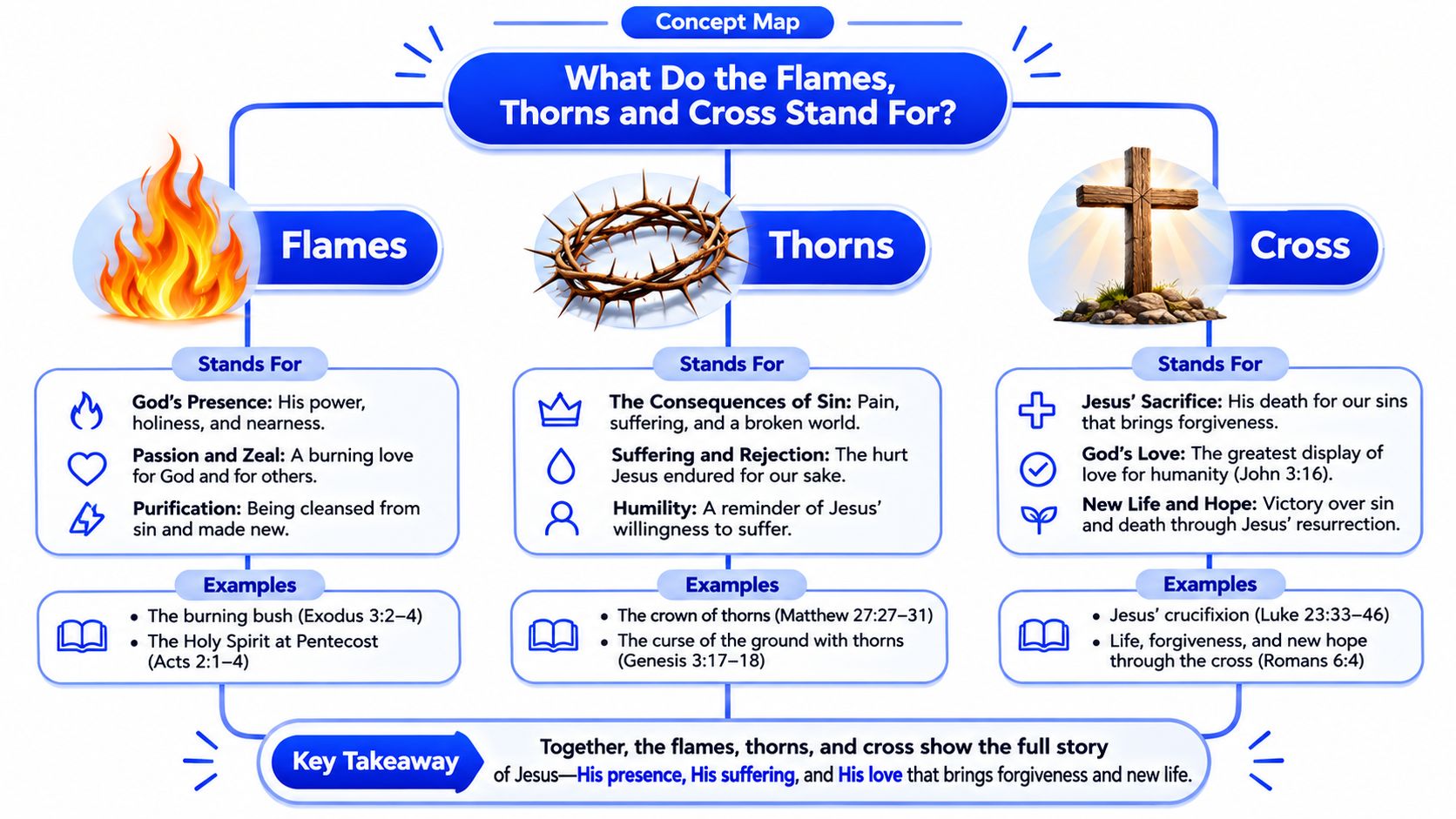
Every traditional element around the heart does a specific job. Instead of acting as decorative flair, each piece works like a word in a sentence, building a clear theological and emotional statement.
| Element | What It Signals | Design Note |
|---|---|---|
| Heart | Christ's whole person and his love | Keep it as the clear focal point |
| Flames | Burning, intense, or divine love | Keep the flame shape simple so it reads at small sizes |
| Crown of thorns | Suffering, sacrifice, and the Passion | One simplified thorn band reads better than dense detail |
| Wound | The Crucifixion and love shown through injury | A small wound or drops keep the reference clear |
| Cross | Crucifixion theology and a Christian identity | Removing it shifts the design toward personal symbolism |
| Rays or light | Enduring or redemptive love, not defeat | Fine rays can merge as the design fades |
How Suffering and Endurance Work Together
A common mistake is reading a Sacred Heart as a tug-of-war between "love" and "pain." Art historians describe a different relationship. As outlined in Encyclopedia.com's entry on Sacred Heart iconography, the wound and encircling thorns signify suffering, while the flames and radiating light keep the heart from reading as defeated, showing love that actively endures through injury.
The pierced opening on the side of the heart carries particular weight in Catholic thought. In a 1979 General Audience address by Pope John Paul II, Catholic teaching connects the pierced heart directly to the Gospel account of Jesus's side being struck by a lance after his death, where blood and water flowing from the wound symbolize sacrificial love and a source of new spiritual life. Including a visible wound, spear mark, or small drops of blood turns the image into a statement about suffering transformed into redemption and self-giving care.
The visual map below shows how each element connects inside traditional Christian symbolism.
Keeping the Details Clear on Skin
When you translate centuries-old devotional painting onto skin, scale becomes your biggest practical constraint. Tiny rays, overlapping barbs, and dense cross-hatching look crisp on a printed prayer card, but micro-detail can blur together as skin renews and ink softens. Prioritize a bold heart silhouette, a clean flame outline, and a single simplified thorn band if you're going small.
Swapping or removing even one piece changes how others interpret the tattoo, much like how an anchor tattoo's layered symbolism shifts from maritime safety to steadfast faith when paired with a cross or banner. Look at a flame-led design that centers on fire and wings without thorns or a cross: it reads immediately as passion, spirit, or freedom rather than church liturgy. Keeping the thorn band and cross is what keeps the reading specifically Sacred Heart rather than general passion.
Where Does the Sacred Heart Design Come From?
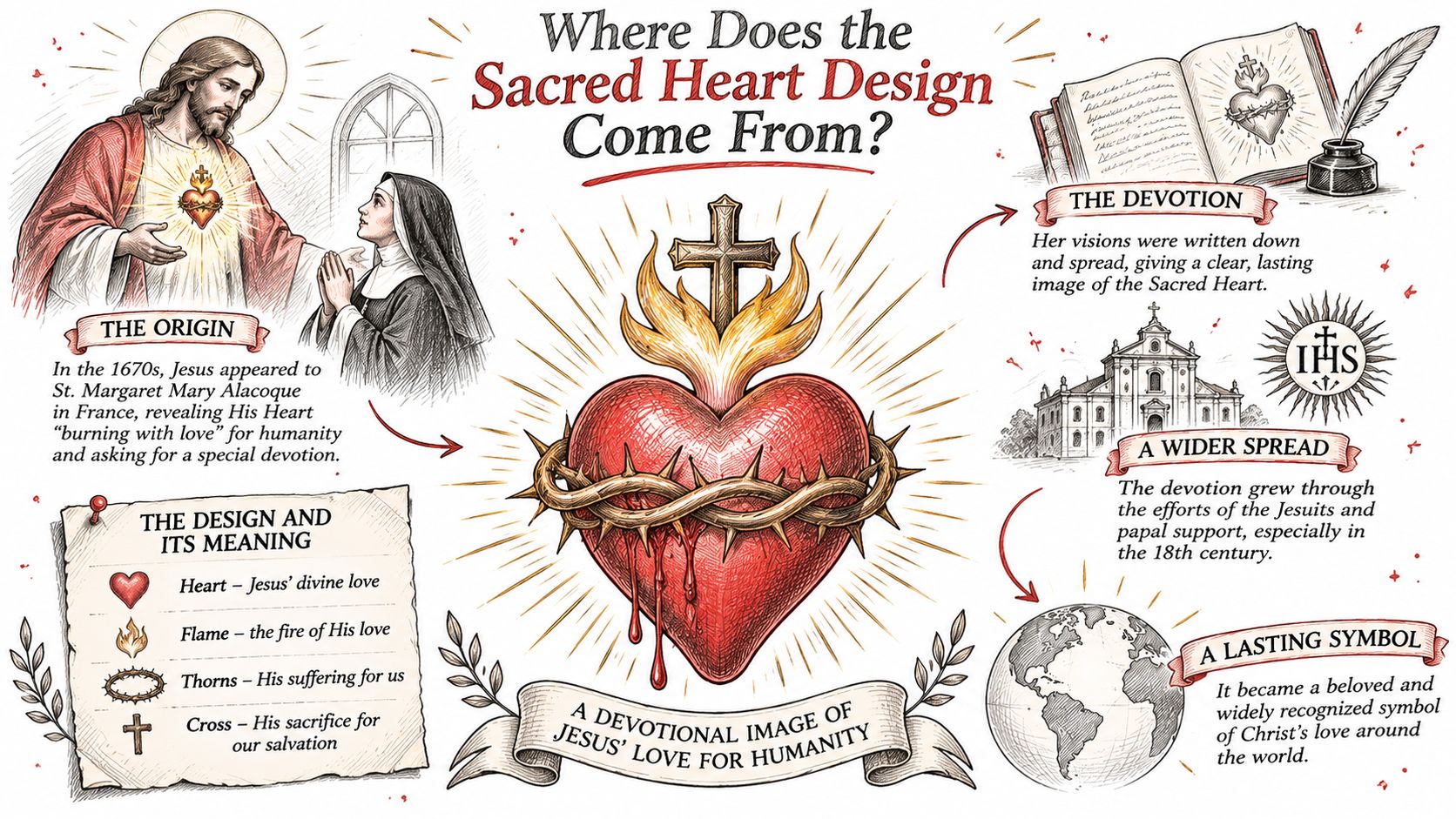
Understanding where the imagery traveled explains why the same heart can feel European in a cathedral, richly familial in a Mexican kitchen, and proudly regional in a Southern California tattoo shop. The visual devotion didn't appear overnight. According to the Catholic Encyclopedia on New Advent, the earliest unmistakable evidence of the devotion emerged in the 11th–12th centuries, when Christian writers linked the wound in Christ's side to his wounded heart and the "wound of love," eventually growing into a distinct liturgical observance with a documented Sacred Heart feast celebrated at Rennes in 1670.
Three years later, the devotion gained the personal narrative that many people recognize today. As noted in Pope Francis's June 2024 General Audience, December 27, 2023, marked the 350th anniversary of the first manifestation of the Sacred Heart of Jesus to Saint Margaret Mary Alacoque, and from there the devotion spread far past monastery walls through religious teachers, preachers, and founders of religious congregations.
This historical timeline traces how those devotional origins evolved into the iconic imagery seen in body art today.
From Sagrado Corazón to Chicano Tattoo Heritage
As missionaries and devotional prints crossed the Atlantic, the Sagrado Corazón took deep root in Mexican Catholic life. Framed images of the flaming, thorn-wrapped heart hung in homes, neighborhood parishes, and family altars, becoming a daily visual marker of faith, family loyalty, and protection. When Mexican families migrated north to the United States, they brought those home-altar aesthetics and prayer cards with them.
In Mexican-American communities, particularly among Chicano artists working in East Los Angeles during the mid-to-late 20th century, the Sacred Heart stepped off the prayer card and onto skin. Artists refined a distinctive black-and-grey, fine-line shading style that turned the heart into a badge of cultural pride, faith, and neighborhood identity alongside roses, banners, and religious portraits.
That cultural lineage creates a practical blind spot for modern tattoo shoppers. Say someone picks a finely shaded black-and-grey Sagrado Corazón straight off a flash sheet because they like the dramatic lighting. Without knowing its history, they may unintentionally wear a visual signature tied closely to Mexican-American and Chicano heritage.
Three Respectful Ways to Approach the Lineage
Before choosing a design, run through three grounded habits that keep your choice informed and respectful:
- Identify the visual lineage first. Notice whether a piece draws from European stained-glass style, bold American traditional flash, or prayer-card-inspired black-and-grey Chicano artistry.
- Check the religious cues you're keeping. Decide intentionally whether the cross, thorns, and wound belong in your piece, because viewers raised in Catholic or Mexican-American households will read those elements immediately.
- Honor the heritage instead of treating it as generic filler. If you're drawn to Chicano black-and-grey work and don't share that background, learn the history behind the artists who built the style, credit the tradition openly when asked, and make sure your personal intent aligns with the weight of the symbol.
Where Should a Sacred Heart Tattoo Go?
Placement sets two things at once: how much visual detail the artwork can safely hold, and how publicly you're broadcasting the symbol. A heart tucked over the collarbone feels like a quiet vow, whereas the same design centered on a forearm becomes an immediate conversation starter.
| Placement | What It Communicates | Design Tip |
|---|---|---|
| Chest or sternum | Personal devotion, faith, or a private vow | Larger heart and full flames fit the space |
| Upper arm or forearm | Visible faith or memorial in daily life | Medium size with simple thorns |
| Wrist or ankle | A quiet memorial or private reminder | Heart silhouette with one flame band |
| Hand or finger | A small, personal statement | Small bold silhouette; avoid fine palm-side lines |
| Back | A large devotional composition | Room for the full crown, cross, and flames |
Size, Skin Wear, and Social Reading
Body location affects how cleanly ink stays legible over time. High-friction zones test fine detail relentlessly: small, bold hand tattoo designs hold up best, while fine lines on the palm side fade fastest. If you want intricate thorns, radiating light beams, and a shaded wound, give the artwork breathing room on the chest, upper arm, or back rather than squeezing it onto a finger or inner wrist.
Placement also shapes social assumptions. A prominent chest or forearm Sacred Heart frequently reads as an overt Christian identity signal to coworkers, family members, and strangers, even if you got it as a secular memorial for a grandparent or a reminder of personal resilience. If you want the meaning to stay mostly between you and the people closest to you, a smaller silhouette near the ankle, ribcage, or sternum keeps the conversation optional. For a deeper look at balancing visibility with everyday wear, explore our tattoo placement guide.
Placement rule: Never judge a design only on a phone screen. Measure the exact area on your skin with a ruler, compare those inches to the artwork's real dimensions, and check whether the cross and thorns still feel right at full scale.
Before you book a session or order a test design, walk through three quick checks: measure the exact width and height of your target spot, compare those measurements directly against the design's listed dimensions, and ask yourself whether the religious cues are as explicit or understated as you want for the people who will see that spot daily.
Which Sacred Heart Style Fits Your Idea?
You can keep the exact same heart, flames, thorns, and cross, yet change the entire emotional temperature of the tattoo just by switching artistic styles. Line weight, shading, and color decide whether a design feels bold and vintage, solemn and portrait-like, or quiet and modern.
| Style | How It Treats the Image | Best For |
|---|---|---|
| Traditional or American | Bold outlines, flat color, strong flames | Designs that must read from a distance |
| Black-and-grey, Mexican-American influence | Shading and a devotional, portrait-like feel | Honoring Sagrado Corazón or Chicano heritage |
| Blackwork | Heavy solid areas and high contrast | Dramatic, graphic statements |
| Fine-line | Thin single lines and fewer interior marks | Subtle, small pieces that need legibility |
| Colored | Warm flame tones and richer detail | A more vivid, celebratory image |
| Minimalist | The heart with one or two elements | Quiet personal remembrance |
Matching Your Style to Your Intent
Start with the feeling you want the tattoo to carry, then pick the rendering style that reinforces it.
If you're honoring Sagrado Corazón or Chicano family roots, smooth black-and-grey shading naturally mirrors the classic prayer cards and East Los Angeles artistry that shaped the tradition. Those soft gradients give the heart a solemn, three-dimensional presence without relying on bright pigments.
If your goal is a private memorial or a subtle daily reminder of compassion, fine-line or minimalist treatments keep the visual footprint light. Trimming away heavy shading and dense rays prevents small wrist or collarbone pieces from looking crowded.
If you want a high-contrast statement that stays readable across a room, American traditional or bold blackwork delivers clean structure. Traditional flash also pairs smoothly with companion motifs like scrolls, daggers, or blossoms; if you're thinking of framing the heart with florals, our guide to rose tattoo meaning breaks down how flower shapes and pairings add layers of love or mourning.
One key distinction keeps design planning clear: changing line weight or color changes the mood, not the core meaning. A minimalist line drawing with a cross, wound, and thorn band still reads as a Catholic Sacred Heart, while a heavily shaded blackwork heart without the cross or thorns moves toward general passion or resilience.
Does Your Personal Story Change the Meaning?
A Sacred Heart works like a frame around a memory. The image keeps its Catholic and Mexican-American lineage, yet the wearer decides which details sit in front. In a 2023 survey, Pew Research Center reported that 32% of U.S. adults have at least one tattoo, 22% have more than one, and among tattooed Americans, 24% said they regretted at least one tattoo. Tattoos often carry layered stories about faith, relationships, grief, and personal milestones, so a Sacred Heart can hold devotion and memory at the same time.
People also bring personal symbols into the mix. A 2025 YouGov poll found that 7% of tattooed U.S. respondents said a favorite animal, flower, or symbol inspired one of their tattoos. Pairings change what viewers notice first. Roses can suggest tenderness or mourning. A banner can name a person. A medical motif such as a Sacred Heart Caduceus can shift the reading toward healing, service, and care. Think of the heart as the main sentence and each added motif as a footnote that guides the reader.

The One-Sentence Meaning Test
Small edits give you fine control over how explicitly religious the tattoo feels. Adding a parent's initials, a wedding date, or a short banner anchors the heart to remembrance or a personal promise. A Sacred Heart placed near hospital-themed imagery may be read as a memorial for someone who cared for others, even if the wearer intended it as a symbol of their own recovery. The heart still carries its sacred visual language, while the nearby cues direct attention toward service, illness, or survival.
Even with careful edits, a gap can open between what you feel inside and what others assume on sight. Your grandmother might read your Sacred Heart as a return to church, a coworker might assume it is a family heritage emblem, and you might see it as surviving a hard year. That gap matters because a tattoo stays visible while the story behind it may stay private. A quick test helps close the distance between intention and first impression.
Reality check: Write down what your tattoo means in a single plain sentence, then look at your chosen artwork and ask what a stranger would guess in three seconds. If those two answers clash in a way that bothers you, adjust the elements or placement before making it permanent.
What Questions Do People Ask About Sacred Heart Tattoos?
How Do You Explain the Tattoo to Family?
A Sacred Heart can carry faith, family memory, cultural pride, or personal survival, so a short explanation often prevents confusion. It works like naming the "chapter title" before someone reads the whole book. You might say, "It's a Sacred Heart design that reminds me of Compassion and endurance," or "It honors my family's Mexican and Chicano heritage." If the design includes familiar Catholic cues, acknowledge that history clearly. That respect matters, especially because viewers may recognize devotion before they hear your personal reason.
Can a Nonreligious Person Wear One Respectfully?
Respect begins with understanding what the image has carried in Catholic devotion and in Mexican-American traditions. A wearer who does not claim the religious meaning can still approach the design carefully, by avoiding wording that presents it as a creed they do not hold and by being candid when asked. The design works like a borrowed language: the symbols have grammar, even when the speaker has a different story. Choosing elements that match the wearer's actual intent helps the image stay honest in conversation.
How Do You Add a Name or Date Without Crowding the Heart?
A name, initials, or meaningful date can turn the heart into a dedication, but placement changes how clearly it reads. A banner across the heart makes the lettering part of the emblem, while small text beneath the point feels quieter. Think of the heart as a picture frame: too much writing competes with the image inside it. Keep the wording simple, leave space around the letters, and make sure thin strokes will not blur over time.
What If the Meaning Changes Later?
Meanings can shift as a person moves through grief, faith, family life, or recovery, so the design should leave room for that change. A Sacred Heart with a few carefully chosen elements can hold several layers without becoming cluttered. A flame, thorn, or initials may speak differently years later, much like a song that changes with the listener. Before committing, ask what the design says today, what it may say in a hard year, and whether that range still feels wearable.
Try It Before You Commit
Choosing the right Sacred Heart comes down to a clear sequence: settle on the meaning you want to carry, select the visual elements that speak that meaning accurately, and match the placement and style to your everyday life. Testing the artwork on your own skin first removes the guesswork before you ever sit in a tattoo chair.
At Just Tattoos, we make needle-free, semi-permanent designs with plant-based, skin-safe ink that you apply right at home. Our ink develops over 24 hours from faint to a deep blue-black that reads like a real tattoo, and most designs last 7–10 days, depending on skin and placement, giving you plenty of time to see how the heart, flames, and scale feel in the mirror and around friends. If you have sensitive skin or allergies, we recommend patch-testing a small area first.
Want to test placement and visibility across a full week of work, workouts, and outfits? Read our guide on how to try a tattoo before you get it, and follow our step-by-step application guide to get crisp, even results on your first try. When you're ready to compare flaming hearts, symbolic pairings, and religious motifs side by side, browse the full Just Tattoos collection to pick a design that fits your story.
Just Tattoos offers over 300 artist-made semi-permanent tattoos printed with plant-based, skin-safe ink, shipped across the United States for $4.99 flat or free on orders of $35 or more. Whether you want to test how a Sacred Heart looks over your collarbone, compare traditional flames against fine-line shading, or wear a meaningful memorial piece without needles, you can try the exact size and placement at home first. Explore designs and start your test drive at Just Tattoos.
Part of our Tattoo Symbols and Meanings guide, which groups every symbol by theme, from animals and flowers to sun, moon and stars.