
An anchor tattoo usually stands for stability, steadiness, and hope, while the details around it shape the exact message. It can represent holding firm through difficulty, a connection to the sea, Christian faith, or someone who helps you feel grounded.
But if an anchor means staying steady, why can one design feel like a sailor's badge while another feels like a promise to a loved one? The answer lies in the whole composition, including its companion symbols, style, size, and placement.
Table of Contents
- What Does an Anchor Tattoo Mean?
- Where Did the Anchor Tattoo Come From?
- Why Does an Anchor Stand for Stability and Hope?
- How Do Pairings Change the Message?
- Which Anchor Styles Change the Meaning?
- Where Do People Usually Place an Anchor Tattoo?
- What Do Readers Ask About Anchor Tattoos?
- Should You Try an Anchor Design Before You Commit?
What Does an Anchor Tattoo Mean?
Anchor tattoo meaning isn't a single definition. The recognizable shape carries established associations, but the wearer chooses which ones matter most. An anchor can express a commitment to home, the determination to keep going, or the comfort of having something dependable in your life.
Its meaning starts with an ordinary physical job: holding a vessel in place. Translating that function into a personal symbol gives the anchor its connection to steadiness. You don't need a dramatic life story to choose it, either. Wanting a reminder to stay focused is enough.
What common anchor details signal
Use the whole design, not just its central object, to judge the likely message.
| Design detail | Meaning it usually signals | Example |
|---|---|---|
| Plain anchor with no extras | Stability, steadiness, resilience | Small anchor on the wrist |
| Rope wrapped around the shank | Seafaring life, sailor identity, voyages | Anchor with a coil of rope |
| Ship's wheel or compass | Direction, navigation, finding your way | Anchor paired with a compass rose |
| Cross or anchor crossed by a cross | Christian faith and hope | Anchor with a small cross behind it |
| Name, date or banner | Memorial or dedication | Anchor with a date on a ribbon |
| Heart, initials or flowers | Love, family, close relationships | Anchor with a heart at the crown |
| Thin single-line anchor | Quiet personal reminder | Fine-line anchor on the ankle |
These are likely readings, not a code everyone follows. A sailor might notice the nautical construction first. A churchgoer might recognize a cross-like silhouette, while a close friend might connect the same image with a difficult period you've overcome.
That distinction matters when you're choosing artwork. You control the design and your explanation, but you can't guarantee that every stranger will understand your private meaning. If recognition matters, choose details that make your intention easier to read.
Choose the message before the artwork
Compare the H6-007 anchor design against the table, looking at the complete composition rather than deciding from its name alone. Notice which elements catch your eye first and whether they support the meaning you want.
Say you want to honor a dependable parent. A design that strongly emphasizes navigation may communicate travel before it communicates family. That doesn't make it wrong, but it gives you a useful question to answer before choosing it.
Practical rule: Decide what you want the anchor to say, then choose details that support that message.
You don't have to explain every line. A coherent design gives your personal story a clearer visual starting point.
Where Did the Anchor Tattoo Come From?
The familiar Western sailor-tattoo tradition developed through contact between seafarers and other tattooing cultures. According to the U.S. Naval History and Heritage Command, Captain James Cook's Pacific voyages during the second half of the 18th century exposed Royal Navy personnel to Polynesian body-art traditions and helped tattooing spread among British and American sailors.
That history needs a distinction: Cook's voyages didn't invent tattooing. They helped spread the practice among the sailors involved in this particular maritime tradition. The anchor's place in Western tattoo culture grew within that exchange.
A visible record of experience
Within the sailor's developing visual vocabulary, an anchor originally indicated that a mariner had crossed the Atlantic Ocean. It wasn't a decorative statement about liking the water. It could communicate an accomplishment to people who understood the symbol.
Think of a sailor arriving in another port. Clothes and possessions might change, but a tattoo remained a portable record of experience. In a dangerous, mobile occupation, that made the image something closer to a credential than a general inspirational emblem.
The Navy also describes the anchor as a common first nautical tattoo and a possible initiation mark into naval service. That association helps explain why a traditional anchor can still suggest belonging as well as endurance.
- Experience: The historical mark connected the wearer to an ocean crossing.
- Identity: The image placed the wearer within a recognizable maritime community.
- Homecoming: The broader symbolism connects a life of movement with the possibility of returning.
From sailor identity to a personal emblem
As people outside maritime communities adopted the motif, its meaning became more flexible. Safe return could mean coming home from a voyage, but it could also become a personal metaphor for finding security after upheaval.
Other nautical motifs carry their own histories, which is why understanding swallow tattoo meaning can help when planning a larger maritime composition. Combining symbols thoughtfully is different from treating every nautical image as interchangeable.
Today, choosing an anchor doesn't automatically claim a seafaring record. You can draw on the symbol's heritage while giving it a personal purpose. The design can carry the sea's memory even if you've never left dry land.
Why Does an Anchor Stand for Stability and Hope?
An anchor stands for stability because its job is to keep a vessel from drifting. The Hong Kong Maritime Museum connects that physical role with constancy, security, and resilience: it holds by resisting movement across the seabed. As a tattoo symbol, it works in a similar way. It can point to a dependable foundation while life keeps shifting around you.
That makes the anchor useful for personal meaning. A person might choose one after a difficult period as a reminder of what kept them grounded, such as family, faith, recovery, or a hard-earted sense of direction. The image does not have to deny change. It can mark the part of life that stayed steady during change, like a weight that keeps a boat in place while water moves around it.
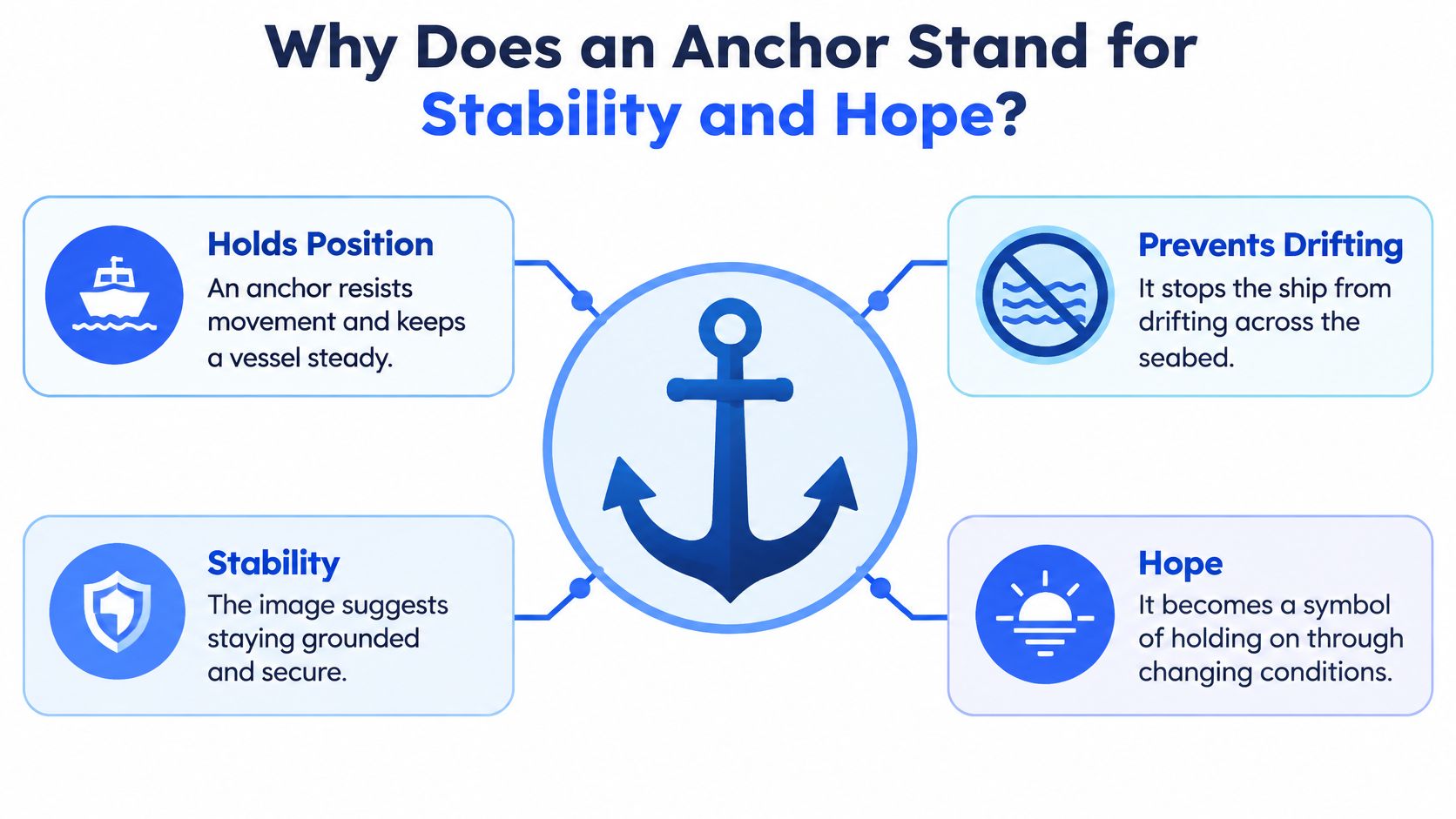
Hope comes from a related but distinct idea. Steadiness describes what helps you hold firm; hope describes what you believe remains possible. The anchor holds the line, while hope looks toward the return, the safer shore, or the next chapter. That is why the symbol can feel both protective and forward-looking.
Where the Christian meaning fits
In Christian symbolism, the anchor has an established link with hope and faith. Early Christians used anchor imagery as an emblem of hope and salvation, and its cross-like form helped it carry a religious reading. The object itself gives that idea a clear visual shape: something lowered into uncertainty, then trusted to hold.
A cross, scripture, or other unmistakable religious detail makes that meaning more explicit. Without those details, the same anchor can stay open. One viewer may see devotion, while another may see courage, security, or recovery.
How a secular reading works
For a nonreligious wearer, hope can mean trusting that difficult circumstances can improve. Steadiness can refer to a supportive relationship, a renewed sense of direction, or a commitment to personal recovery. Friends might choose matching anchors to recognize the dependable support they give each other, with no devotional meaning attached.
The image also carries a useful tension. Holding position can feel reassuring, yet some viewers may associate being anchored with being held back. Small design choices help settle that reading. A compact anchor with clean lines may feel calm and private. An anchor paired with open water, a rope, or a compass can shift attention toward travel, commitment, or movement with purpose.
Steadiness describes what helps you hold firm; hope describes what you believe remains possible.
Choose how strongly the design should lean toward faith, maritime identity, or personal grounding. Each reading changes the emphasis, and the surrounding details help the viewer understand which meaning you want to carry forward.
How Do Pairings Change the Message?
An anchor-and-compass pairing combines remaining grounded with having somewhere to go. It suits a message about exploring without losing your sense of home or personal values. A friend might read that combination as a balance between commitment and adventure rather than a wish to stay in one place.
When planning that composition, compare the anchor with the Guiding Star Compass design. Look at how the shapes could work together without assuming that every compass design already contains an anchor.
Direction without losing your foundation
A compass can add a forward-looking element to an anchor's grounded character. For someone moving away from home, the combined message might be about carrying their foundations into an unfamiliar place.
Understanding compass tattoo meaning helps distinguish navigation imagery from a general travel aesthetic. The important question is whether you want the composition to emphasize the journey, the destination, or what remains dependable along the way.
Compare the other combinations
Other pairings shift the balance in different directions:
- Anchor with rope: Together, these elements create a more complete maritime image. On someone who sails with family, the composition could connect a shared activity with belonging, rather than suggest a beach vacation.
- Anchor with a cross: The combination places faith at the center of the grounding message. A viewer is more likely to recognize a spiritual commitment than interpret the piece as nautical decoration alone.
- Anchor with a name, date, or banner: The added information connects the symbol to a particular person or event. A memorial date can turn an otherwise general emblem into a reminder of someone whose influence remains dependable.
- Anchor with a heart or flowers: The composition takes on a more relational or affectionate tone. A heart can make a partnership central, while flowers can soften the overall presentation of a family dedication.
The arrangement matters, too. A large compass with a tiny anchor makes navigation visually dominant. A prominent anchor with a small compass beside it gives the grounding theme more weight.
Before choosing a pairing, finish this sentence: I want this tattoo to represent…
Then compare the complete design with your answer. If you want to express loyalty to family, ask whether a stranger would see that connection or mostly notice the travel imagery.
Keep only the details that help. A crowded composition doesn't necessarily communicate a richer story, especially when several symbols compete for attention. A clear relationship between the elements usually makes your intended message easier to understand.
Which Anchor Styles Change the Meaning?
Style works like a volume control for an anchor tattoo. It shapes how quickly the symbol reads as nautical, personal, decorative, or firm. The same anchor can carry different weight depending on line thickness, shading, and how much detail the viewer can see.
Traditional and understated approaches
A bold traditional anchor, with substantial outlines and strong shading, emphasizes the motif's sailor-tattoo heritage. Friends may describe it as nautical or classic before asking about its personal meaning. The heavy outline also helps the design stay readable when it is small or seen from across a room.
A fine-line version creates a quieter effect. Thin outlines and restrained detail suit a personal reminder, especially when the wearer wants the image to stay visually understated. Try viewing the design at a normal conversational distance. If the anchor becomes hard to recognize, the style may be working more as a private symbol than a clear public one.
Softer and more graphic approaches
Other styles change the emotional tone while keeping the anchor's basic structure recognizable:
- Watercolor or soft shading: A softer presentation can support a hopeful or affectionate dedication. The mood comes from the treatment and the surrounding composition, so the same palette can feel tender in one design and airy in another.
- Blackwork: Solid dark areas create a firm, graphic impression. This style gives the anchor a resolute presence without adding extra symbols.
- Geometric or minimal: Simplified construction can make the design feel modern and orderly. Keep the hook, shank, and crossbar clear enough for immediate recognition if that matters to you.
Color guides the eye and sets a mood. A blue anchor may feel closer to the sea, while a black anchor often reads with more graphic strength. Viewers still bring their own associations, so the surrounding shapes and placement help steady the message.
Choose the style that fits the idea you want the anchor to carry. Before settling on one, test the design in three ways: at arm's length, in a small preview, and beside the clothing you wear most often. A strong style choice keeps the anchor clear while matching the tone you want.
Where Do People Usually Place an Anchor Tattoo?
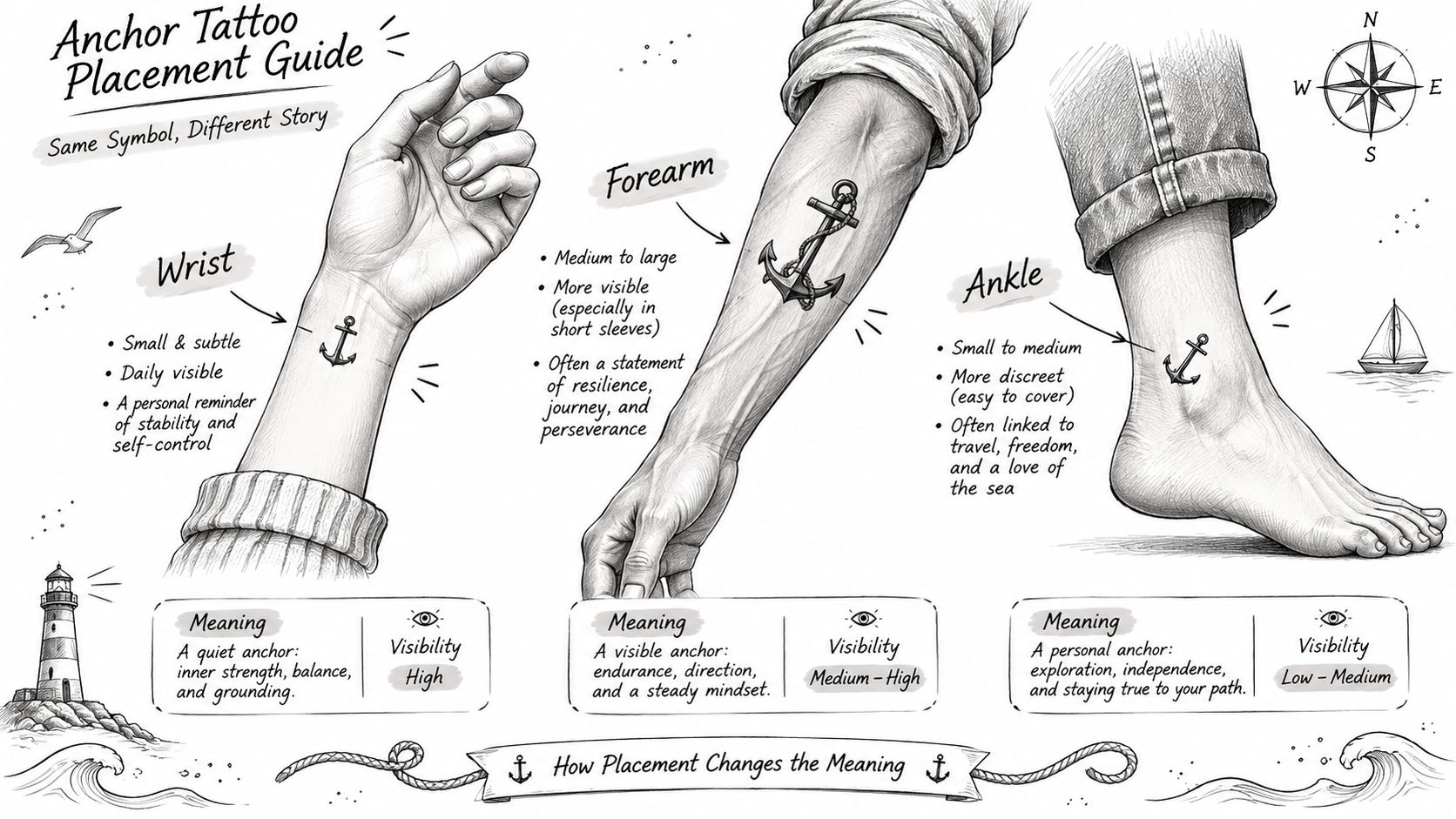
Placement changes both who sees the anchor and how often you see it yourself. A visible location can make it an everyday reminder, while a covered location lets you decide when to share its meaning.
Start with visibility, then consider the space the composition needs. Our tattoo placement guide can help you compare locations beyond their appearance in a cropped photograph.
How placement changes the anchor message
| Placement | How the anchor reads | Practical note |
|---|---|---|
| Wrist | Personal reminder or everyday accent | Visible daily; a forearm placement offers a similar look with more room |
| Ankle | Quiet, private reminder | Suits a fine-line or small anchor |
| Forearm | Classic nautical or steady statement | Room for a medium anchor with a simple rope |
| Upper arm | Bold, visible and balanced | Room for a larger anchor with rope or a banner |
| Shoulder | Strong, visible and resilient | Curved surface suits a medium composition |
| Chest | Personal or memorial meaning | Suits larger compositions and a more private message |
| Back | Large narrative or memorial piece | Room for detail; hard to see without help |
Test the exact location
Compare small designs if you want a compact result, but don't assume smaller always means subtler. A small anchor on an exposed wrist may attract more daily attention than a larger one under a shirt.
Check the location with your arm relaxed, while moving, and in ordinary clothing. Look at the full placement in a mirror rather than judging only a close-up.
For longest-lasting results, we recommend areas with minimal friction and hair, such as the forearm, calf, or shoulder. Avoid areas that bend frequently or sweat a lot. If you have sensitive skin, do a patch test before a full application.
What Do Readers Ask About Anchor Tattoos?
Does an anchor always mean the wearer is a sailor?
The maritime reading matters, but the history section already covers why the symbol became linked with seafaring. A modern wearer may choose it for a personal reason, so the design alone says little about service, travel, or family background.
Does an anchor always mean faith?
Faith is one possible layer, as explained in the stability and hope section. The design reads more clearly as religious when it includes a cross or devotional imagery. The wearer's own intent still decides what the symbol means.
Is a small anchor less meaningful than a large one?
A compact anchor can carry just as much meaning as a larger one. Scale works more like the size of a sentence on a page. A small mark might feel private and precise, while a larger design leaves room for rope, a banner, or a compass to shape the story.
For example, a small anchor on the wrist can act like a daily reminder, steady and easy to keep close. A larger anchor on the upper arm can make the nautical style more visible and give supporting details more space. The meaning sits in the choice of image, pairing, and setting, not in size alone.
Can the meaning change over time?
Meanings can shift as life changes. Someone may first choose an anchor for a relationship, then later connect it with independence or resilience. The image stays the same while the wearer's understanding develops.
Other people's interpretations can change too, especially as they learn more about the wearer. That's why an anchor tattoo doesn't have to explain its whole story at a glance. Like a familiar symbol on an old map, it can keep guiding the same person through different routes.
Should You Try an Anchor Design Before You Commit?
Try it before you commit, especially if you're uncertain about the pairing or placement. Wear a temporary anchor where you're considering permanent ink, then notice your response during ordinary routines. Treat it as a dress rehearsal for the whole composition.
Ask friends, family, or coworkers what it represents before explaining your intention. Their answers can show how the pairing and placement read through someone else's background. Our guide to trying a tattoo before getting it helps you approach that decision.
Make the comparison useful
- Write your meaning sentence: Refer back to the sentence you already drafted, adjusting it only if your intention has changed.
- Compare complete compositions: Compare a plain anchor with an anchor and compass, then consider how a compact version changes the overall impression.
- Check your daily response: Notice whether you enjoy the location and whether the symbolism feels right without an explanation.
Follow the step-by-step application guide for at-home application without needles and ink development over about 24 hours. Designs remain visible for 7–10 days, depending on skin and placement.
Just Tattoos offers realistic-looking semi-permanent tattoos made with plant-based ink, available within the United States.
The goal is a design you enjoy wearing that expresses something you want to carry.
Part of our Tattoo Symbols and Meanings guide, which groups every symbol by theme, from animals and flowers to sun, moon and stars.