
Why can the same feather design read as freedom on one person and as a carried memory on another? Because the bird, the feather type, and the design built around it each change the message. A plain quill reads as writing and learning. An eagle feather carries earned honors and protection in some Native American traditions, a history a generic feather does not share. Style and placement add another layer, from a single fine line to a feather dissolving into birds in flight.
Table of Contents
- What Does a Feather Tattoo Mean?
- Where Do Feather Meanings Come From?
- Which Specific Feathers Carry Deep Histories?
- How Do You Choose a Feather Design Respectfully?
- How Do Style and Placement Change the Reading?
- Should You Try It Before You Commit?
What Does a Feather Tattoo Mean?
The feather tattoo meaning most commonly centers on freedom, lightness, independence, and personal growth. For some people, it suggests rising above a difficult time; for others, it's a reminder to stay curious, follow their own direction, or carry a memory with them.
Use this table as a starting point for choosing a design:
Feather types and the meanings they usually carry
| Feather or bird | Common meaning | Where the association comes from |
|---|---|---|
| Generic natural feather | Freedom, lightness, personal growth | Broad cross-cultural use of feathers as symbols of flight and elevation |
| Quill | Writing, learning, authorship | Western literary symbolism |
| Eagle feather | Courage, honor, leadership, protection | Earned honors in some Native American traditions |
| Ostrich feather | Truth, justice, balance | Egyptian symbolism of Ma'at |
| Raven feather | Mystery, knowledge | Bird symbolism in folklore and myth |
| Owl feather | Wisdom, transition | Bird symbolism linked to night and insight |
| Peacock feather | Beauty, display, watchfulness | Ornamental and display symbolism |
Think of these meanings as possibilities, not a dictionary. The bird, the visual style, and any words or dates beside the feather all affect how someone might read it. A feather turning into birds, for instance, suggests motion more strongly than a single feather lying still. An eagle feather and an ostrich feather also have specific traditional histories, so their meanings deserve more context than a generic design.
If you're comparing bird-inspired tattoos, the hummingbird tattoo meaning guide can help you consider how a particular bird changes a design's message. For your own quick check, choose the feather or bird you have in mind, find its row, and ask whether that association still feels like yours.
Where Do Feather Meanings Come From?
A feather is a material before it is a symbol, in the same way a ring is metal before it is a promise. Meaning gets attached by the bird it came from, the object it becomes, and the community that used it. The Ethnologisches Museum in Berlin's featherwork research describes feathers as materials with practical, social, and spiritual roles at once, so a single object can be a tool, a trade good, and a mark of standing.
Museum collections show that layering clearly. A feather becomes a headdress, a garment, or a religious object, and each form narrows what it can say. Status, age, and role are communicated through what a person wears and how they wear it, not through feathers in the abstract. That is why "feathers mean freedom" works only as a first guess.
Featherwork also appears across the Americas, Europe, Asia, and the Pacific, and each tradition shapes the material differently. A feather that signals rank in one setting may signal something devotional in another.
For a tattoo, the practical distinction is this: a generic feather usually suggests lightness or independence, while a culturally specific feather can carry a more particular meaning. Before choosing a design that resembles a ceremonial object or a specific tradition, ask where that visual comes from and what it means in that context.
Which Specific Feathers Carry Deep Histories?
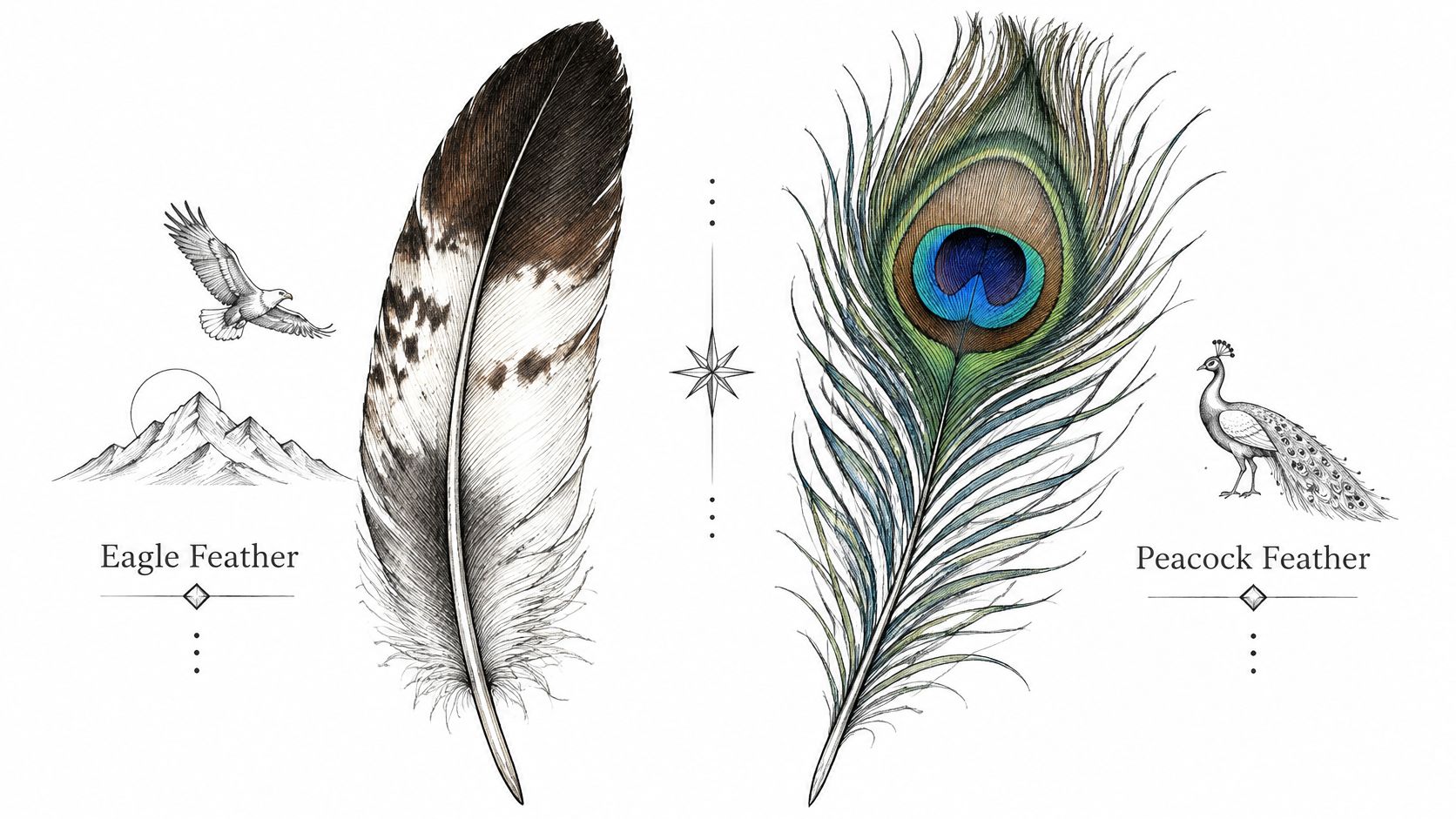
A feather works like a word: the bird supplies the language, and the surrounding design supplies the sentence. An eagle feather can look like a simple outline, but its history may be far more specific than a generic feather design. In some Native American traditions, each tail feather in an eagle-feather headdress represented a distinct honor earned in war by the wearer or another tribal member. The full headdress stood for bravery, political stature, and responsibility to the community, as the Nelson-Atkins Museum of Art's account of an eagle-feather headdress explains.
By the beginning of the 20th century, the eagle-feather headdress had become a broadly recognized symbol of Native American identity across North America. That recognition also meant some original tribal-specific significance was lost. The history is a reminder that a design can become widely recognizable while still referring to living traditions and distinct community meanings.
An eagle-feather tattoo can be read as courage, honor, leadership, protection, spiritual connection, or remembrance. Those are possible interpretations, not meanings that apply to every tribe or community. If the headdress example makes the image feel more serious, that is the point. A ceremonial symbol and a loose feather do not carry the same weight. If you're interested in this specific imagery, avoid treating a ceremonial headdress or nation-specific design as a generic decoration.
If your interest is in a whole bird rather than a single plume, the swallow is another bird-based design with its own references. This explanation of swallow tattoo meaning shows how the bird changes the story, which is the same principle that makes an eagle feather different from an unspecified feather.
The ostrich feather and Ma'at
In ancient Egyptian symbolism, the ostrich feather was associated with Ma'at, the principle and goddess linked to truth, justice, balance, and order. In the Hall of the Two Maats, the deceased person's heart was weighed against Ma'at's feather, a comparison connected to whether that person's life aligned with truth and justice. The Egyptian Museum's account of Ma'at provides context for this symbol.
For a tattoo, an Egyptian-style ostrich feather can express a commitment to living truthfully, seeking balance, or following personal principles. These meanings belong to specific traditions, so describe them with that precision rather than presenting them as universal feather symbolism.
How Do You Choose a Feather Design Respectfully?
Start by separating general feather symbolism, such as freedom, lightness, remembrance, or personal growth, from meanings tied to particular traditions. A standalone feather can express a broad personal idea; recognizable ceremonial imagery calls for more care.
- Name the bird or feather. Write down why you want that form. If you're drawn to a quill because writing matters to you, that's a clearer starting point than choosing an unspecified feather and hoping it says the same thing.
- Check for a living tradition. Ask whether the design refers to a feather with ceremonial or earned meaning, such as an eagle feather in some Native American contexts. Specificity matters because those traditions aren't interchangeable.
- Pause before borrowing recognizable cultural designs. If a design copies a ceremonial style, headdress pattern, or nation-specific motif, don't use it as decoration without understanding its source. If you're referencing it, name that source clearly and use culturally informed wording.
- Build around your own story. A date, name, or personal memory can explain what the tattoo means to you without claiming that it represents an entire group.
- Test whether the image reads clearly. Ask someone who doesn't know your story what they notice first. If the answer differs from your intended meaning, adjust the bird, linework, or accompanying elements.
Practical rule: Choose a simple feather for a general message. Research a specific traditional design before you wear it.
How Do Style and Placement Change the Reading?
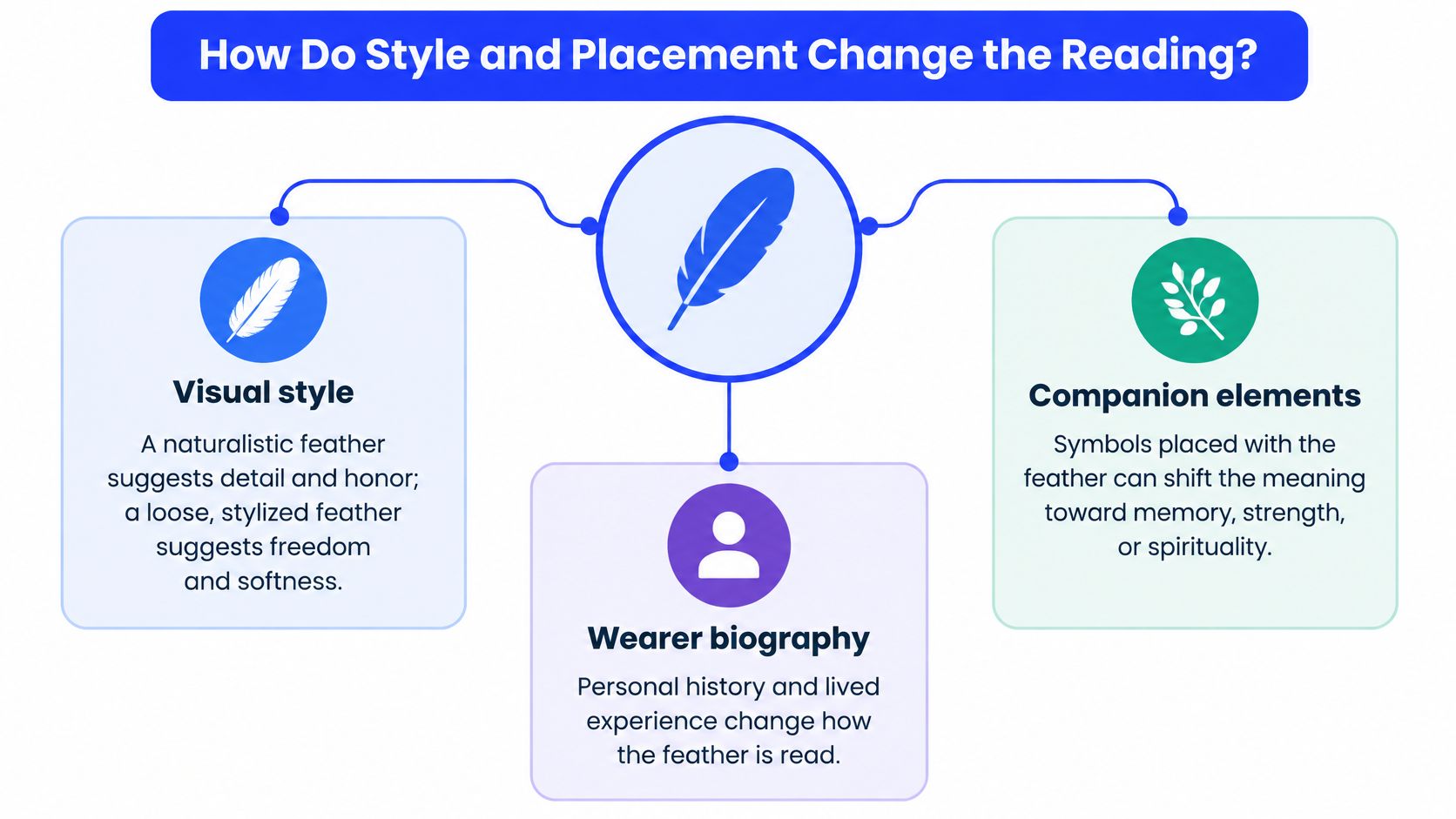
Once you've chosen a bird, style helps determine whether the tattoo feels delicate, bold, or in motion. A naturalistic feather emphasizes detail; a loose line drawing can feel softer and more personal; and a feather that dissolves into birds makes movement part of the image. Your own history can carry more meaning than any standard interpretation, so treat common associations as options.
Feather style, meaning fit and placement
| Style | Best meaning fit | Placement ideas | Legibility note |
|---|---|---|---|
| Realistic feather | Courage, honor, strength | Upper arm, back, thigh | Needs enough size to show barb and shaft detail |
| Fine-line single feather | Personal growth, quiet remembrance | Wrist, ankle, collarbone, inner forearm | Very fine lines can blur, so keep the feather large enough |
| Feather dissolving into birds | Freedom, transition | Forearm, shoulder, ribs | Motion reads well when the birds are clearly defined |
| Feather with date, name, stars, or arrow | Remembrance, direction | Wrist, back of neck, behind the ear | Keep text short and readable at a glance |
Companion details can steer the interpretation. A name or date often makes a feather feel like a memorial; an arrow may add direction, while stars can suggest spirituality. An infinity symbol can reinforce continuity or transition. For a visual example with movement, consider this flying feather design. If direction is the point, our guide to arrow tattoo meaning covers how the arrow itself is read.
Placement affects how much room your design has and how often you'll see it. A wrist or inner forearm can keep a personal reminder in view. An ankle or the back of the shoulder offers a quieter line, while an upper arm or back gives a larger realistic design space. The collarbone or ribs can suit a feather you'd rather keep close and mostly private.
Smaller placements may work better with a simplified shape than with dense feather barbs or tiny lettering. If you're exploring a more compact option, browse small feather designs.
A feather's meaning can also shift with the wearer's biography. The same image might mark a change in one person's life and honor a family memory for someone else. If you're considering other transformation-focused imagery, the phoenix tattoo meaning guide offers another way to think through a design's symbolism.
Before you settle on a sketch, ask yourself: Which bird do I mean? Which style fits my message? What, if anything, belongs beside the feather?
Should You Try It Before You Commit?
A feather tattoo's meaning depends on its details, and the placement can change how those details come across. Seeing a design on your skin first can help you judge its size, position, and overall impression before booking a permanent tattoo. Temporary designs can also suit a weekend look, a matching trip tattoo, or a sleeve idea you want to try out.
Just Tattoos sells semi-permanent tattoos with a realistic look, made with plant-based ink and applied at home without needles. The ink develops in about 24 hours, and most designs last 7–10 days, depending on skin and placement. If you have sensitive skin, consider doing a patch test before applying a design.
Try the flying feather design to test a sense of motion, explore feather-adjacent fantasy designs, or browse the full tattoo collection. For more ideas on short-term styling and trying a design before committing, see our guide to temporary tattoos for men.
Choose the bird and style, pick a placement, and see how the design reads on your skin over the first few days.
A feather tattoo can be a quiet reminder of freedom, growth, or someone you carry with you. Visit Just Tattoos to explore semi-permanent designs you can apply at home, without needles, and try a look before committing to permanent ink.