
Semi-permanent tattoo ink is plant-based ink that absorbs into the top layer of skin, develops over about 24 hours, and fades as skin renews. Most designs last 7–10 days, depending on skin and placement.
Why can the same design look different on a finger and an upper arm? The answer starts with where the color sits, then comes down to what that patch of skin encounters each day. Understanding that difference helps you choose a placement, recognize normal development, and avoid confusing a topical stain with a permanent tattoo or black henna.
Table of Contents
- What Is Semi-Permanent Tattoo Ink?
- How Does Semi-Permanent Tattoo Ink Develop in Skin?
- Why Does Wear Time Change by Placement?
- Why Is Black Henna Different From Semi-Permanent Ink?
- How Do You Apply Plant-Based Ink at Home
- Should You Test a Design Before Permanent Ink?
- What Else Do People Ask About This Ink?
What Is Semi-Permanent Tattoo Ink?
Where does the color go when you press a design onto clean, dry skin with a damp cloth?
Semi-permanent tattoo ink is a topical stain in the epidermis, the thin outer layer of skin. In this use, “semi-permanent” means the color becomes part of how that outer layer looks for a limited time. A water-transfer sticker works as a printed film resting on the surface.
Two ordinary objects make the split concrete. A sticker bought at a fair shows its full print the moment the backing comes off. A plant-based stain applied at home soaks in the way berry juice marks a fingertip, so the color you wear is stained skin. For a shorter definition, our semi-permanent tattoo explainer introduces the category without the layer-by-layer detail.
Four Ways Skin Color Gets Onto the Body
| Type | Where the color sits | How the look arrives | How it leaves |
|---|---|---|---|
| Permanent tattoo ink | Dermis, placed with needles | Color is there after the session, then the skin heals | Stays unless removed by a professional method |
| Water-transfer sticker | Printed film on the skin surface | Full print is visible immediately | Film lifts with oil, friction, or peeling |
| Semi-permanent plant-based ink | Outer skin layer, the epidermis | Faint at first, full shade in about 24 hours | Most designs last 7–10 days, depending on skin and placement, then fade as skin renews |
| Black henna | Marketed as a dark skin stain, often with hair-dye chemistry | Often very dark soon after application | A separate product from a plant-based epidermal stain |
The useful comparison is film, outer-layer stain, or deeper injected pigment. Those categories explain more than the word “temporary” does.
A sticker can have crisp artwork, and its printed material remains on the surface until oil, friction, or peeling lifts the film. A permanent tattoo places pigment in the dermis, under the epidermis, so ordinary shedding of the surface leaves the design in place. An absorbed plant-based stain occupies the epidermis itself. During wear you are looking at stained skin, with nothing left to peel.
That stained layer also has a placement-and-friction life. On a covered area such as the upper back, fabric is the main contact. On a wrist or an ankle, soap, shoes, and steady rubbing wear the stained skin down sooner. The 7–10 day span describes that range across skin and placement.
What the Name Doesn't Tell You
The phrase semi permanent tattoo ink is only a label. It leaves out how carefully you prepare the skin, how the shade will read on one placement versus another, and how your skin responds to the formula.
“Plant-based” names the origin of a formulation. A realistic look, or a comfortable first application, is an observation about appearance. It sits apart from medical evidence about your own skin.
Useful distinction: Ask where the color sits before you judge the mark by how dark it looks.
Black henna stays in its own row because hair-dye chemistry sets it apart from a plant-based epidermal stain. Calling it natural, temporary, or especially dark leaves questions about that chemistry unanswered.
For an everyday choice, separate the questions. Decide whether you want a removable surface print, a stain in the outer skin, or permanent pigment in the dermis. Then match placement, application, and skin precautions to that choice.
How Does Semi-Permanent Tattoo Ink Develop in Skin?
Tea soaking into a paper towel works the way this ink does: the color enters the sheet you can see, with no needle pushing it into a separate layer underneath. Living skin is more complex than paper, but the comparison captures the basic idea of a stain in the epidermis.
Say you apply a small black design to your forearm. When you peel away the paper, the outline looks pale rather than finished. A pale outline is normal at this stage. Wait before judging it, and resist the urge to press a second tattoo over the area or scrub it and start again.
From a Faint Mark to a Developed Shade
The ink develops into its finished shade over about 24 hours. Black designs deepen from that faint start toward a blue-black appearance that reads like healed tattoo ink.
The shade you see when you lift the paper is a starting point. Give the mark its full development period before deciding whether you like the contrast, the line weight, or how it sits against your skin tone.
The sequence is application, gradual color development, ordinary wear, and eventual fading.
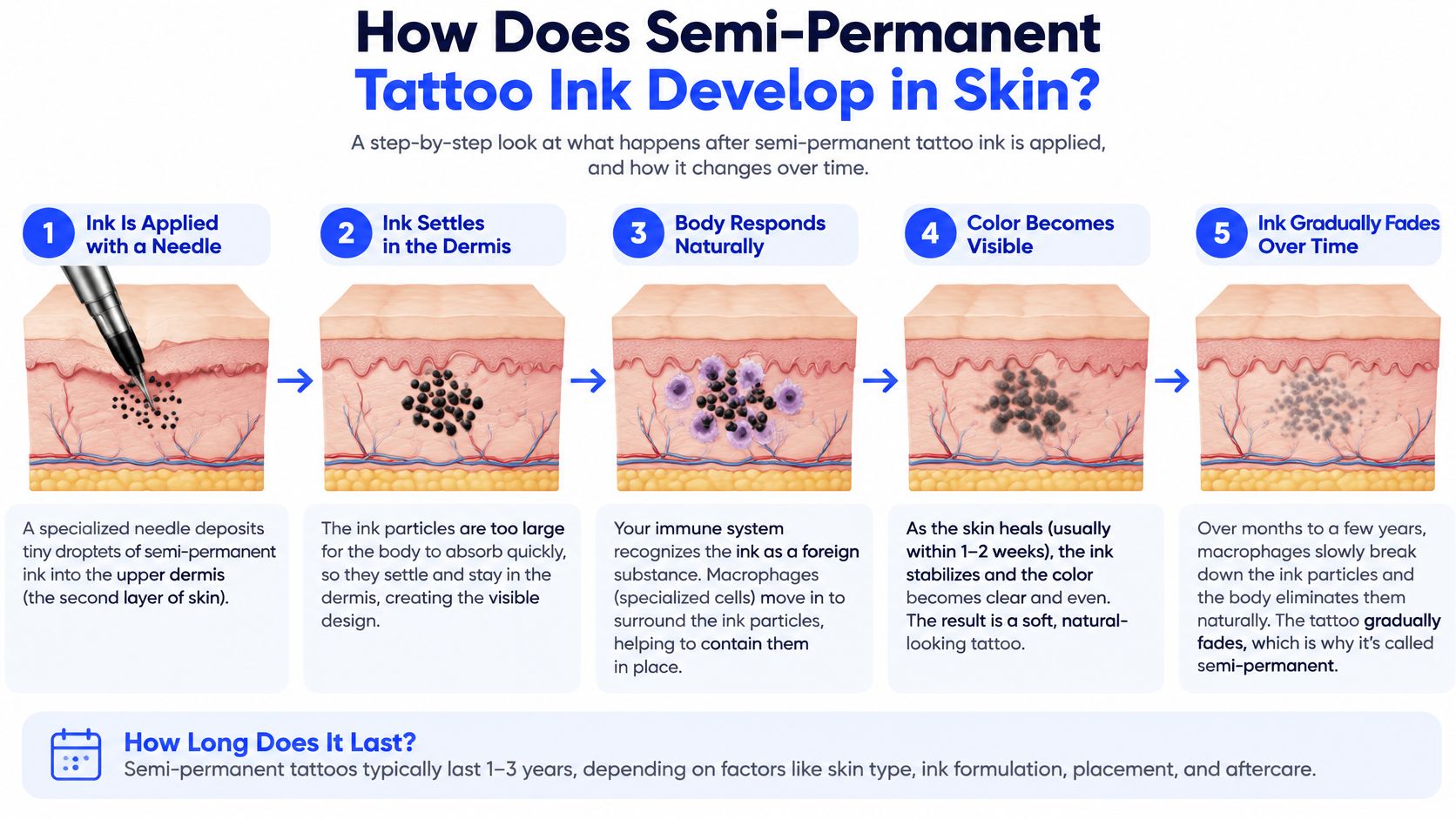
Colored artwork follows the same pattern. A koi or a sunflower looks lighter the moment you remove the paper than it will the next morning, and a fully developed black design is the wrong yardstick for judging how a full-color piece should turn out.
For the brand's development notes, visit how the ink works.
Why It Fades Without Peeling
The epidermis continually sheds and replaces surface cells. As stained cells leave the surface, the visible design becomes lighter and less defined until it disappears on its own.
- Absorbed color: Soap and water alone won't lift the design, because the color sits in the skin's outer layer.
- Surface film: A printed transfer can separate from the skin as material.
- Natural fading: An epidermal stain softens as the stained outer cells shed.
That first point is why scrubbing a developed stain the way you would peel off a sticker tends to frustrate people. Repeated rubbing irritates skin far faster than it removes color, so letting the design fade on its own schedule is the gentler path.
The stain analogy has one limit: skin renews at its own pace and varies from person to person, so two applications can develop to slightly different depths of color. A richer shade the next morning shows normal development, not pigment reaching the deeper layer that holds permanent tattoos.
Why Does Wear Time Change by Placement?
A finger touches soap, pockets, handles, and towels throughout the day. A shoulder under a loose shirt has a different routine. Even with the same application method, those placements don't give a stain the same conditions.
Most designs last 7–10 days, depending on skin and placement. Treat that statement as an expectation, not an appointment on the calendar when every line will disappear together.
How Placement and Daily Wear Change the Look
| Placement | Daily stress | What to expect |
|---|---|---|
| Fingers, palms, and feet | Constant washing and abrasion | Color usually softens sooner than on calmer skin |
| Wrists, ankles, and joints | Cuffs, shoes, and bending | Friction can influence the look as much as your choice of ink |
| Inner arm, calf, or shoulder | Often less washing and rubbing | More likely to show the full look when protected from friction |
| Spots under straps or towels | Gym friction and towel rubbing | Repeated rubbing can remove stained surface cells |
These are practical placement patterns, not promises about individual body parts. A calf beneath a tight boot may experience more rubbing than an uncovered wrist. An inner arm beneath a bag strap isn't necessarily a protected spot.
Before applying, think through an ordinary day rather than choosing only from a photograph. Where does your watch sit? Does your work involve repeated handwashing? Will a shoe edge run directly across the artwork?
Count Contact, Not Just Water
Water resistance isn't the same as immunity to wear. A shower and a vigorous towel rub are different events, even though they happen together.
Sweat can lead you to wipe the same area repeatedly. A backpack strap can move across the design whenever you walk. Shaving or exfoliating the spot adds another source of surface disturbance.
A good first placement is one you can leave alone without changing your normal hygiene.
If you're testing the format, small designs make it easier to choose a relatively protected patch of skin. Our guide to placement spots for temporary tattoos can help you compare locations with your daily routine in mind.
When evaluating a visible placement, take a photograph after about 24 hours and another near the end of wear. Use similar lighting and arm position so you're comparing the design rather than the camera angle.
Look at more than whether the tattoo is still visible. Notice which edges soften first and whether clothing repeatedly crosses one part of it. That gives you useful information about the placement without treating faster fading as automatic proof of a faulty application.
Why Is Black Henna Different From Semi-Permanent Ink?
Two products can leave the same deep blue-black mark on your skin and have nothing in common underneath. A semi-permanent tattoo works like a stain that soaks into the outer layer of skin and fades as that layer renews. Black henna reaches a similar color by a different route, and that route is the problem.
The FDA's henna and black henna fact sheet states that henna is approved only as a hair dye, not for direct application to skin, and describes reports of injuries and allergic reactions from products sold as henna or black henna. The agency also explains that black henna often contains para-phenylenediamine, or PPD, a coal-tar hair-dye ingredient not permitted in cosmetics intended for application to the skin.
Why the Distinction Matters
PPD can cause serious skin reactions, including blistering, scarring, and pigment loss. Those outcomes sit in a different category from the ordinary, gradual fading of a cosmetic stain.
Darkness tells you nothing about safety. A seller's emphasis on fast darkening or an especially persistent result doesn't answer the safety question, and neither does a botanical-looking package or a label that uses the word natural.
The comparison below separates the categories without treating appearance as evidence of safety.
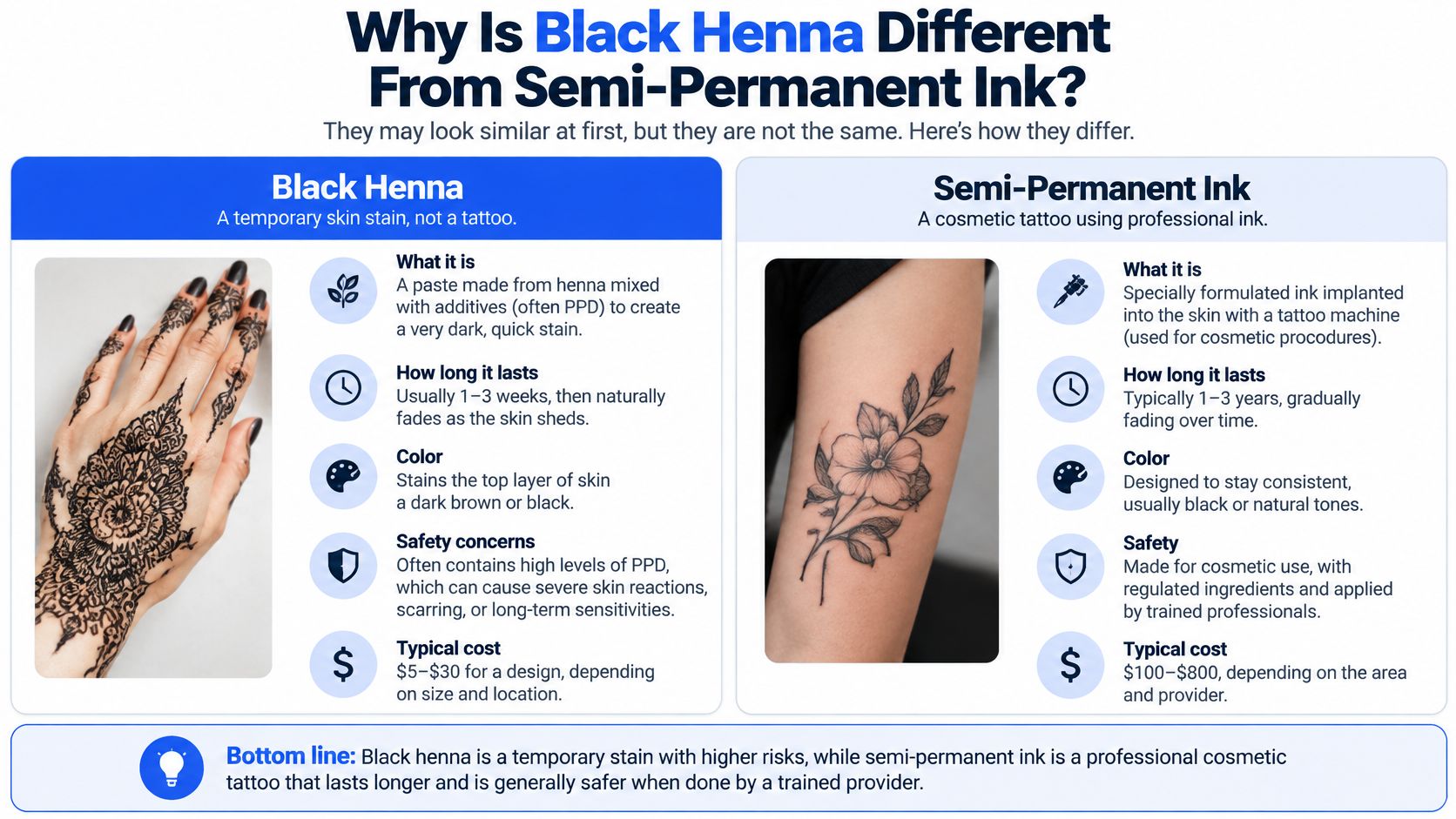
Traditional henna, black henna mixtures, and other plant-derived stains are separate products sharing a shelf of similar names. Our jagua and henna comparison explains that naming distinction in more detail.
Don't try to make a cosmetic stain darker by mixing it with hair dye. A product formulated for hair belongs on hair.
Reactions Can Arrive Late
Reactions can be delayed. Skin that feels calm right after application can still change over the following days, so treat the first comfortable hours as a starting point.
Watch for changes in the skin itself rather than judging only the design. A fading outline is a cosmetic change. Spreading redness, itching, swelling, or blistering calls for a different response.
- Before application: If you have sensitive skin, perform a small-area patch test and give your skin time to respond before applying a full design.
- During wear: Don't cover a developing rash with another application.
- If symptoms worsen: Stop using the product and seek medical advice, especially for spreading redness, swelling, blisters, or weeping skin.
Skin precaution: A patch test may reveal a reaction before a larger application, but a delayed response can still occur after a clear test.
A patch test is a precaution for cosmetic stains, never a justification for trying a product sold as black henna. Skipping that category and testing other stains sensibly are two separate decisions. Plant origin and temporary wear don't eliminate the possibility of an allergy.
How Do You Apply Plant-Based Ink at Home
Application is a press-and-transfer process, not a tattoo appointment. You prepare the skin, place the design, and leave the transferred mark to develop without needles.
Choose the spot before opening the backing. Check how the artwork sits with your arm relaxed or your leg standing naturally, not just when you're twisting to look at it.
Prepare, Press, and Leave It Alone
- Wash the spot and dry it fully. Use plain soap, rinse, and skip lotion so the transfer meets bare skin. A common mistake is applying while the area is still damp or slippery.
- Patch-test first if your skin is sensitive. Try a tiny area and allow time to observe your skin before proceeding with the full design. Don't treat an immediate lack of discomfort as the end of that check.
- Peel off the clear protective film. Handle the backing without repeatedly touching the design face. Leaving the protective film in place prevents the intended contact with skin.
- Place the design face down. Set it on clean, dry skin in the orientation you want. Avoid sliding it around after making contact, which can disturb placement.
- Press a damp cloth against the paper for 30 seconds. Keep the pressure steady across the backing. A cloth that's too dry can leave parts of the paper without adequate contact.
- Peel the paper back slowly. Lift carefully rather than tugging it away in a quick motion. Rushing makes it harder to notice an uneven transfer as you remove the backing.
- Leave the faint mark alone as it develops over about 24 hours. Don't judge the finished shade in the first hour or apply another design over it because it looks pale.
Use the illustrated application guide alongside the directions supplied with your design. If a general explanation differs from those application directions, follow the specific guide.
Keep Aftercare Simple
Ordinary showers are fine once developed, but avoid scrubbing, exfoliating, or shaving across the design if you want to limit the surface wear described in the placement table.
Application instructions aren't medical clearance. Don't apply over irritated or broken skin, and don't continue an application if your skin becomes uncomfortable.
For a closer discussion of precautions, our semi-permanent tattoo safety guide addresses the difference between cosmetic use and a safety guarantee. If you already have a rash or an active skin condition in the intended area, postpone the application rather than trying to work around it.
Should You Test a Design Before Permanent Ink?
Yes, if your uncertainty is about size, visibility, or placement. Wearing a design during an ordinary routine can answer questions that a saved image can't.
A wrist design may look balanced in a close-up but feel too prominent when you're typing at work. Artwork on the upper arm may disappear beneath your usual sleeves. Neither reaction is wrong; each tells you something useful before a studio booking.
Test the Question You're Actually Asking
Start with a clear question rather than asking whether you “like tattoos” in general.
- Placement: Does the artwork sit where you expected when your body is relaxed?
- Scale: Can you read the design from a normal viewing distance, or does it feel crowded?
- Visibility: Do you enjoy seeing it throughout the day, including at work?
- Style: Do you prefer a restrained outline or a more prominent composition once it's on your body?
When placement is the main uncertainty, choose modest dimensions. When style is the question, compare the full set of designs without changing size and location at the same time.
Our guide to trying a tattoo before getting it permanently offers more ways to make that trial useful.
Know What the Trial Can't Predict
A temporary stain can't reproduce needle depth, healed texture, or the long-term aging of permanent pigment. It also doesn't tell you how a permanent tattoo session will feel.
Use your photographs to explain preferences to a tattoo artist, not as a guarantee of the final result. An artist may recommend changes to spacing, detail, or size for permanent work.
Just Tattoos offers realistic-looking, plant-based, needle-free designs for at-home use in the United States only. Black artwork develops toward a deep blue-black, and colored artwork is also available.
If your skin is sensitive, complete a patch test before the full trial. The most useful test is one that helps you make a design decision without overlooking how your skin responds.
What Else Do People Ask About This Ink?
Do Colored Designs Last as Long as Black Ones?
Colored designs run on the same clock. They develop over about 24 hours and generally last 7–10 days, depending on your skin and placement. Color changes the look, not the lifespan.
What If a Design Fades Unevenly?
That's skin renewal, not a defect. Your outer layer sheds faster where it bends or rubs, like a finger under a ring or a wrist under a strap. Flatter spots such as the forearm fade more evenly.
How Do You Time One for a Trip or Event?
Work backwards from the 24-hour development window. For a design to look its best on Saturday, apply it Friday. Friends wearing matching designs on a trip should apply the same evening so everyone's color develops together.
Does Application Hurt?
No. Nothing punctures your skin; you press a damp cloth on the backing for about 30 seconds, then peel the paper away. Stinging or burning isn't something to push through, and a rash or spreading redness warrants medical care.
Just Tattoos offers plant-based, needle-free body art that lets US shoppers try a tattoo look at home before choosing permanent ink. Visit Just Tattoos to pick a design, check its dimensions, and plan a placement that fits your routine.