
A mandala tattoo usually signals balance, unity, spiritual focus, and a path toward self-realization, drawn from Buddhist and Hindu mandala traditions. The circle is only the starting point.
Does a round design automatically mean harmony? Plenty of guides treat every mandala as the same symbol, as if symmetry wrote the sentence for you. It doesn't. A closed center, a square inside the ring, a private back placement, or a deity figure each push the reading somewhere else. Your intent finishes the sentence. What follows separates the traditional reading from the choices that change it, so you can pick a design you can explain without borrowing a meaning you don't hold.
Table of Contents
- What Does a Mandala Tattoo Mean?
- How Do Design Details Change a Mandala's Meaning?
- What Are the Main Mandala Tattoo Styles?
- Does Placement Change How a Mandala Tattoo Is Read?
- How Can You Wear a Mandala Respectfully?
- Try a Mandala Design Before You Commit
What Does a Mandala Tattoo Mean?
A mandala tattoo meaning most often points to balance, unity, spiritual focus, cosmic order, and a path toward self-realization. Those readings come from Hindu and Buddhist mandala traditions, not from a modern tattoo code. The shape is old. The message you wear is still yours to set.
Five readings and the tattoo that matches each
| Meaning | Traditional basis | Typical tattoo choice |
|---|---|---|
| Balance | Radial symmetry repeated around a central axis | Symmetrical circle with even spacing |
| Unity or wholeness | The full circle as a complete form | Single closed circle with no break |
| Spiritual focus | A central point used as a focus for meditation | Bold centered motif |
| Cosmic order | A square inside a circle representing a sacred space | Square-and-circle geometry |
| Self-realization | A mandala entered conceptually as a path | Outward rings or an open, moving pattern |
Say you want calm more than cosmology. A symmetrical circle with even spacing carries balance without claiming a sacred palace. If the story is still unfinished, skip the closed ring and use outward rings instead. That choice belongs with self-realization, not with a finished whole.
Where the form comes from
The word mandala comes from Sanskrit and means "circle" or "disc." Academic sources trace mandala practice to India more than 2,000 years ago, as the EBSCO research starter on the mandala notes. The Rubin Museum defines a mandala as a circle with a center and explains that, in Himalayan Buddhism, it works as an artistic aid for meditation. The center may hold a deity. The structure around it stands for that deity's cosmic palace.
Wellesley College's Davis Museum describes a Tibetan Buddhist sand mandala as a bird's-eye view of a celestial palace. Viewers can metaphorically "enter" that world and meet their deepest nature on a path toward enlightenment, which the Davis Museum exhibition notes lay out. The Rubin Museum also describes deity-yoga visualization, in which practitioners imagine themselves as an enlightened being in order to cultivate that being's qualities.
A tattoo can borrow the idea of a center you return to. It does not automatically make the wearer a practitioner.
People who want the cosmic reading without a ritual diagram often look at celestial-style designs for stars, moons, and open rings. These readings are informed frameworks, not a fixed code. The imagery you select and the intention you bring set the final meaning.
How Do Design Details Change a Mandala's Meaning?
A stem rising through lotus petals can suggest growth within the mandala's ordered form. Petal shape and position shift the emphasis, too: a lotus flower tattoo's symbolism depends on the details included and the meaning the wearer intends.
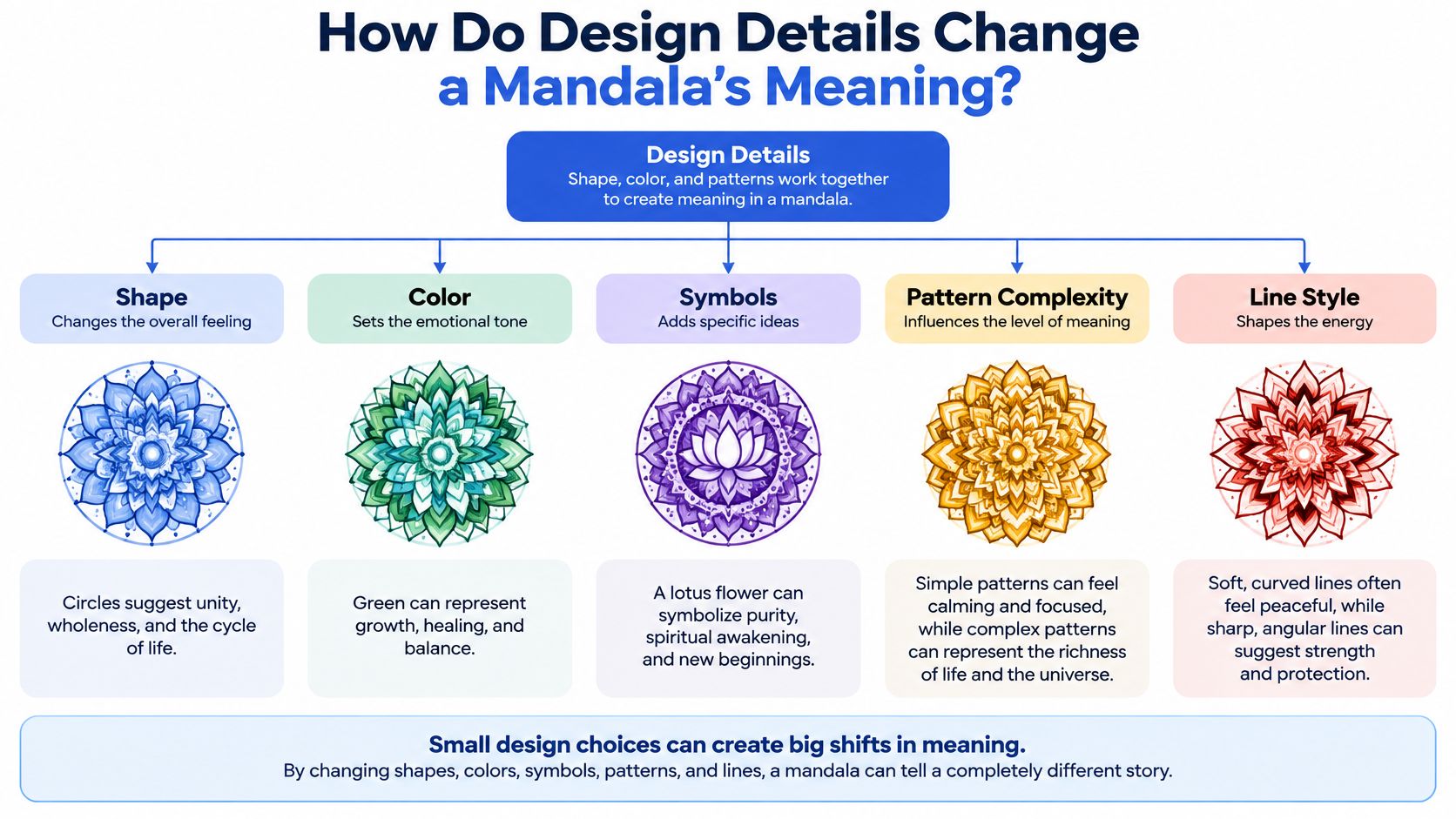
A checklist before you lock the stencil
- Closed center: stability, or an anchor to return to.
- Open or incomplete center: a story still unfolding.
- Square inside the circle: order, direction, and sacred space, as described in the Rubin Museum's mandala highlight.
- Color: a mood or association you choose.
- Initials or a date: a personal marker tied to a person or day.
- Dotwork fill: a textured pattern that can suggest patience through its gradual construction.
A deity figure or ritual diagram carries specific religious meaning, so including one calls for care. A contemporary design can draw on balance and symmetry without reproducing a full religious diagram. Choose details that express your intent, and consider the cultural context of the imagery you use.
What Are the Main Mandala Tattoo Styles?
The concentric build stays put. Style changes the tone.
Geometric mandalas use clean lines and exact radial symmetry. They read as order and precision. Keep the line weight even, or the "order" looks accidental.
Dotwork builds the fill from small dots. The reading leans toward patience and a slow, deliberate process. Give the dots room, or they merge into a gray patch and the patience disappears.
Floral mandalas set petals or leaves in rings. Growth, renewal, and softness come forward. The circle is still the constant. The flower only softens it.
Ornamental or henna-inspired work uses open, lacy patterns. Celebration and personal style lead. You'll see how that open structure sits on skin in the placement notes below.
Blackwork relies on solid shapes and negative space. Strength and contrast do the talking. Leave skin showing, or the center muddies.
Color mandalas use hues you associate with mood and identity. There's no single color chart that every tradition shares, so say what the color means to you.
Pick the style first. Then check that the center and the rings still carry the meaning you intend.
A floral ring around a closed center says renewal inside a finished whole. The same petals around an open center say renewal that isn't done. Style sets the voice. Structure still writes the sentence.
Does Placement Change How a Mandala Tattoo Is Read?
Placement decides who sees the tattoo and how public the statement feels.
| Placement | How visible it is | Usual reading | Suitable design scale |
|---|---|---|---|
| Wrist or inner forearm | Seen daily | Daily reminder or public identity statement | Small to medium |
| Hand or fingers | Very visible | Bold, personal statement | Small, simple geometry |
| Upper arm or shoulder | Visible when chosen | Balanced, easily controlled visibility | Medium with a clear center |
| Back or chest | Private and reflective | Deeper, more personal reading | Large, full composition |
Match the spot to the message
A wrist or inner forearm piece shows up every time you reach for something. That suits a daily reminder. A hand or finger mandala is harder to hide, so keep the geometry simple and accept that strangers will read it as a bold statement. An upper arm or shoulder lets you cover the work with a sleeve and uncover it when you want the conversation. A back or chest piece stays reflective. You see it in a mirror, not in every meeting.
Scale keeps the center readable
Fine radial lines, dense micro-dot shading, and tightly packed negative spaces lose contrast at a normal viewing distance, and they lose more as edges soften. An Ohio State University review of mandala imagery and design construction makes that practical point. Larger motifs and deliberate spacing keep the center-to-edge hierarchy clear. Open ornamental mandala designs show how a bold, airy composition holds up better than a tiny crowded one on a wrist.
Our best placement spots for temporary tattoos walk through flat versus curved skin. Wear a temporary design where you'd want the permanent one, then check how it reads during an ordinary day.
How Can You Wear a Mandala Respectfully?
Copying a specific sacred diagram is a cultural choice, not a neutral decoration. Traditional mandalas can represent deities, teachings, and ritual worlds. Using one purely as decoration can raise cultural-appropriation concerns, because the symbol was not invented as ornament. The Maastricht Diplomat's essay on the politics of tattooing frames that issue through power and through learning from people connected to the culture.
The circle is only the frame.
A feather that belongs to a specific culture's regalia is not a generic bird feather. A feather tattoo meaning shifts once that origin is specific. On a mandala, a copied ritual diagram does that job. The motifs you keep, and the story you can tell, set the message.
Steps that keep the design honest
- Name the tradition first. Before you add a motif, find out whether it comes from a Hindu yantra, a Tibetan Buddhist palace mandala, or a modern ornamental pattern.
- Leave deity figures and ritual diagrams alone unless you've learned their meaning from people connected to that culture. A teacher or practitioner is a better guide than a caption on a flash sheet.
- Personalize with your own story. An open center, colors you chose, initials, or a number that matters to you makes the piece autobiographical without claiming a ritual role.
- Be ready to explain it. Say what you know and what you don't. "I chose symmetry as a reminder to slow down" is clearer than implying a tantric practice you don't follow.
Try a Mandala Design Before You Commit
What if the circle looks right on a screen and crowded on a shoulder? A mandala's meaning is not set by the outline alone. Petals, an open center, a second circle, and the place you wear it all change the reading, and your reason for choosing it changes the reading too.
The ink is plant-based and applied at home, with no needles. It develops over about 24 hours. Designs stay visible for 7–10 days, depending on skin and placement, then fade as skin renews. Orders ship to all 50 US states.
How to run the test
Wear it on the spot you would choose for a permanent piece. Look at it in a mirror and in daylight. Notice whether the scale feels balanced or whether the center pulls attention off to one side. A double mandala design is useful when you want paired symmetry, one circle on each side. You can filter the catalog by style, size, and placement, including hand, wrist and ankle, back and chest, and arm and leg. The full range sits in the full design collection.
Follow the step-by-step application guide so the center stays aligned. If your skin is sensitive, do a patch test first.
Just Tattoos makes semi-permanent mandala and geometric tattoos with plant-based ink you apply at home, so you can live with the meaning, the placement, and the scale before any permanent session. Shipping is $4.99, or free on orders of $35 or more. Browse the full range at Just Tattoos and start with a temporary design at the size you might want to keep.