
Call a dye plant-based and the safety question feels settled. Jagua henna, body art stained with a blue-black dye from the unripe fruit of Genipa americana, is often sold on exactly that assumption. Kit listings and marketplace descriptions pitch it as the harmless swap for black henna.
The word "plant" works like a return address: it says where the dye started and stays silent on what traveled with it. Extra colorants can share the same gel, and a plant stain can still irritate skin. Reactions to dark temporary tattoos sometimes surface days after the design goes on.
The checks happen before the gel touches skin: confirm the botanical source, read the full ingredient list for added dyes such as PPD, and patch test a small area first.
Table of Contents
- What Is Jagua Henna and How Is It Different From Henna?
- Where Does Jagua Come From and Why Does It Turn Blue-Black?
- How Do Jagua and Henna Compare in Color and Wear?
- How Do You Apply Jagua or Henna at Home?
- Is Jagua Safer Than Black Henna?
- What Are the Allergy Risks of Jagua?
- How to Patch Test Jagua Before You Commit
What Is Jagua Henna and How Is It Different From Henna?
Jagua henna is body art made with jagua, a blue-black dye pressed from the unripe fruit of Genipa americana. Despite the shared word, it isn't henna at all. Shelves, kit listings, and search results swap the names freely, yet the two plants differ, and so do the stains and the questions each one raises.
Henna and jagua work like two paints applied to the same canvas.
The paint decides the color and the safety questions. A jar that says "henna" can still hold jagua gel, pure lawsone paste, or henna blended with extra dyes.
How the three dyes differ
| Feature | Jagua | Henna | Black henna |
|---|---|---|---|
| Plant source | Unripe fruit of Genipa americana | Leaves of Lawsonia inermis | Henna mixed with added dyes |
| Main color compound | Genipin, formed from geniposide | Lawsone | Often p-phenylenediamine (PPD) added |
| Typical color on skin | Dark blue to blue-black | Orange to reddish-brown | Very dark black |
| US regulatory status | No single skin-dye approval; read the label | Approved in the US only as a hair dye | FDA warns against use on skin |
Read that table as an identity chart. Wear time, allergy risk, and a skin test each need their own pass, because a correct plant name says nothing about how your skin will take the dye. Botanical origin makes a product plant-derived, and that fact alone settles nothing about how safe it is for your skin.
People often sort these products by the finished shade. Orange through reddish-brown sits in the henna range. Dark blue to blue-black is the jagua range. A very dark black result is what shoppers associate with black henna, usually henna plus an added dye, often p-phenylenediamine (PPD). Shade stays only a clue. A slow blue-black stain can still be a blend, and a fast black stain can hide more than plant juice.
Practical rule: If the label won't name the plant, you don't yet know which dye you're buying.
Jagua and henna also ship as pre-mixed kits and pastes. Some labels stop at a common name, such as "natural black dye" or "henna gel," and never name the fruit or the leaf. Without Genipa americana or Lawsonia inermis on the list, you can't assume the paste will behave like traditional henna.
US status isn't one shared rule either. The FDA fact sheet on temporary tattoos, henna, and black henna states that henna is approved in the United States only as a hair dye, and the agency warns against putting black henna on skin. Jagua carries no single skin-dye approval, so the category printed on that specific package is the one that applies. Match the botanical name to the full ingredient list before treating a product like henna. For a needle-free look, a plain comparison of semi-permanent tattoos versus henna keeps these plant dyes from getting confused.
Where Does Jagua Come From and Why Does It Turn Blue-Black?
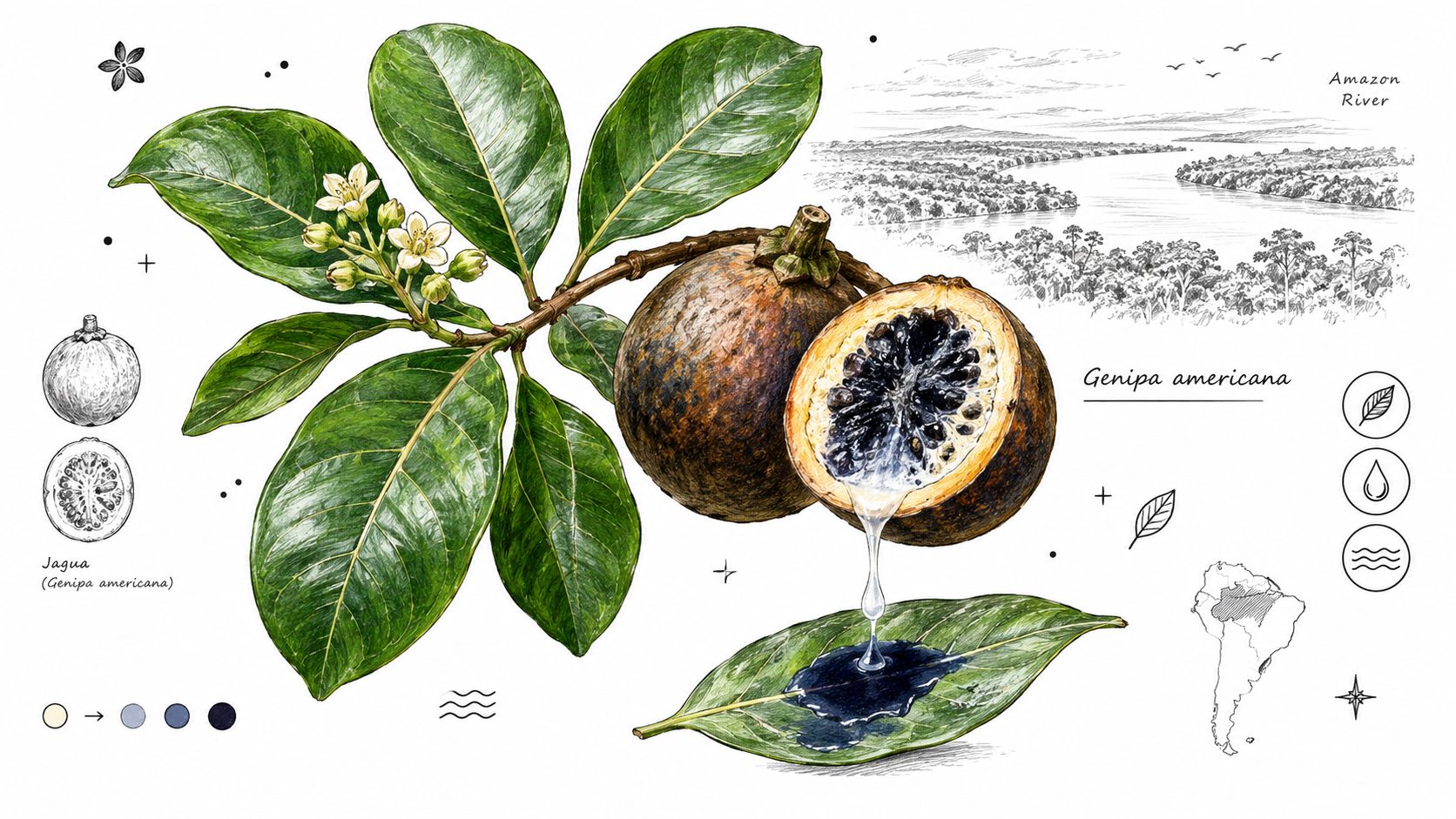
Genipa americana is a tree native to the Amazon region, and Indigenous communities in Central and South America were dyeing skin with its fruit long before it filled any modern gel tube.
Historical accounts describe pressing juice from the unripe fruit and painting it directly on skin. A Science report on the dye's path from rainforest to product records that Indigenous and Afro-Colombian communities have used jagua juice in rituals, ceremonies, and recreation for as long as documentation reaches. The liquid starts pale, then reacts with skin over the following hours and darkens into blue-black markings. Those markings have announced newborns, adulthood, protection, and cultural identity, and the same fruit has served for full-body painting as well as small symbols. Jagua body art carries social and ceremonial meaning in these communities. Modern temporary tattoos borrow the plant and the staining method, then package them as standardized consumer designs.
Why the stain turns blue
Compounds in the unripe fruit break down into genipin, which starts out colorless. In the presence of oxygen it reacts with proteins in the outer skin and forms a blue pigment. That is why the mark builds over hours rather than appearing at full strength the moment the juice touches skin.
Slice an apple and the pale flesh browns as it meets air. Jagua undergoes the same kind of air-driven change, only the reaction runs in the outer layer of skin where genipin meets skin proteins, and the result is blue rather than brown.
Ripe fruit loses much of the chemistry that produces that blue, which is why traditional practice reaches for unripe fruit.
What you see on skin follows from all of this: color builds gradually, it needs contact with both skin and air, and a deep tattoo-like shade says nothing on its own about whether a product is pure or safe to wear.
How Do Jagua and Henna Compare in Color and Wear?
You apply the paste or liquid, let it dry, and wait. Neither dye shows its final color at that moment. Jagua's slow build comes from the genipin reaction described above, and henna goes through its own gradual deepening after the dried paste comes off. The two clocks are not identical, and judging either stain in the first hour is the mistake that throws people off.
What changes on the skin
| Factor | Jagua | Henna |
|---|---|---|
| Stain development | Looks pale when the product comes off, then darkens gradually over hours | Paste is removed, then the stain deepens gradually |
| Fading pattern | Gradual, as the outer skin layer renews | Gradual, as skin renews; exfoliating areas fade faster |
| Speed-ups for fading | Washing, sweating, friction and exfoliation | Washing, sweating, friction, exfoliation and sun exposure |
There isn't a reliable head-to-head on how many days one stain outlasts the other, so no honest comparison can promise that jagua lasts longer than henna or the reverse. Both sit in the outer skin. Both fade as that layer sheds. Naming a winner would invent a comparison the chemistry doesn't settle.
Why the same design fades differently
Skin isn't one surface. Thick skin on the palms and soles takes dye differently from thin skin on the inner wrist. High-friction spots, fingers, heels, and elbows, rub against clothes, soap, and other skin all day, so they fade faster. A design on the upper arm, kept out of straps and scrubbing, usually holds its edges longer than the same design on a finger you wash twenty times.
Say you paint a small band on the inner wrist and a matching band on a fingertip the same afternoon. The fingertip meets water, soap, and friction every time you wash your hands or pick something up. The wrist band sees far less of that. By the weekend the fingertip can look softer while the wrist still reads clearly. That gap is placement and wear, not a bad batch.
The same logic makes a test patch doubly useful. A small mark on the kind of skin where you want the intended design shows how your skin takes the dye, and it shows how your skin tolerates the product before you commit to a large piece. Plant-based describes where the stain comes from, not how your skin will respond to it. If you're weighing a needle-free option whose fade you can plan around, how long semi-permanent tattoos last walks through placement and washing without treating these plant stains as identical.
How Do You Apply Jagua or Henna at Home?
Apply the product to clean, dry, unbroken skin, follow that product's directions, and leave the mixture on for the time the label gives. The steps below are the shared routine. The label still wins if it names a different contact time.
- Read the label first. Confirm the product type and the full ingredient list before you open it, so you know whether you're holding jagua, henna, or a mix.
- Clean the area with soap and water, then rinse and dry it fully. Oil and leftover lotion sit between the dye and the skin and can block the stain.
- Skip cut, sunburned, irritated, or damaged skin. Dye doesn't belong on broken skin, even a small scratch inside the design.
- Apply a thin, even layer with the cone, brush, or applicator the directions name. A thick pile doesn't make a stronger stain, and it smudges while it dries.
- Let it dry undisturbed. Keep water and sweat off the area while it sets. Bending the skin or covering it with a tight sleeve can drag the wet edge.
- Remove the dried layer gently, by scraping or dabbing, not scrubbing. Don't wash the area right away, or you can lift color that hasn't bound yet.
- Leave the stain alone while it develops. Skip scrubs and exfoliating mitts on that spot until the color has settled.
Color builds over hours. Judge it later, not in the minute after you wipe the paste away. If the skin itches, burns, or blisters at any step, rinse the area and stop.
A clean patch of skin and a thin layer beat a heavy coat every time.
Home application can also mean a printed design you place and peel, which is a different process from painting jagua or henna. The step-by-step guide to applying a temporary tattoo covers that needle-free routine, including how long to keep the design pressed in place.
Is Jagua Safer Than Black Henna?
A shopper weighing a tube of jagua against a cone of black henna often reaches for the fruit-based dye, assuming a plant source means gentler skin chemistry. That assumption is the wrong starting point. Black henna carries its warning for one specific reason: it frequently contains PPD, a chemical that can cause serious skin reactions. The compound itself is what places black henna in a higher-risk category.
The Minnesota Department of Health reports that reactions in people already sensitized to PPD may begin within 24 to 48 hours, while most reactions to black-henna products occur 4 to 10 days after application, and some show up as late as three weeks later. Reported effects include intense itching, redness, blistering, lighter or darker patches of skin, and scarring.
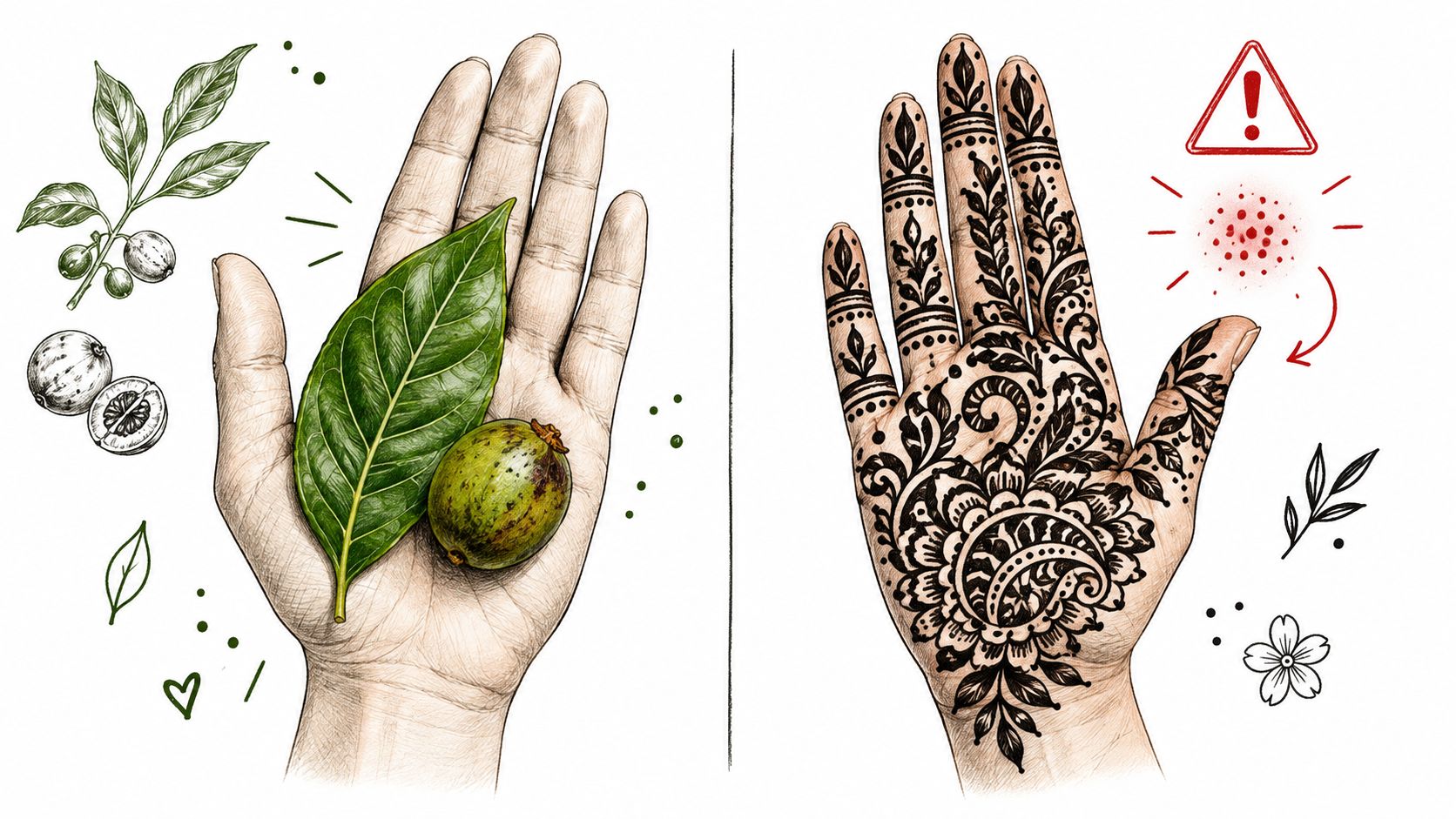
Timing is why a quick glance at the fresh design tells you so little. You can leave a festival with skin that looks fine and still develop blisters days later. Someone who becomes sensitized to PPD may later react to chemically similar substances, including certain hair dyes, sunscreens, or medicines. One application can create a sensitivity that outlasts the design by years.
What separates the products
- Jagua without PPD removes one well-known chemical risk. It doesn't remove the chance of an allergic reaction.
- The useful question is whether the label confirms PPD is absent. "Plant-based" on the front isn't that confirmation.
- Dark color is a poor safety test. A stain that turns black quickly doesn't prove PPD, and a slow blue stain doesn't prove the tube is only fruit juice.
- Prior exposure matters. If you've reacted to black henna or to hair dye before, treat any new skin dye as a higher-stakes choice and talk with a clinician first.
Swapping a PPD mix for jagua lowers one specific hazard while leaving the rest of the risk picture intact. For a separate look at needle-free ink and what a cautious shopper should still ask, see whether semi-permanent tattoos are a fit for your skin.
What Are the Allergy Risks of Jagua?
Jagua can cause allergic skin reactions. Coming from a fruit doesn't change that.
The compound that produces the blue-black stain, genipin, can act as a contact allergen for some people. A reaction can start after the first application, or it can show up only after you've used the dye several times and the skin has become sensitized. A 2019 dermatology case report documented severe allergic dermatitis associated with genipin in temporary jagua tattoos. One published reaction doesn't mean every user will blister. It does mean "natural" isn't a free pass.
Warning signs
Watch for itching that spreads past the design, redness, swelling, and blisters. A reaction that gets worse after the first day is a stop sign, not a phase of the color developing. Color should darken in the lines you painted. It shouldn't spread as a rash, weep, or hurt.
Don't put jagua on irritated, cut, or damaged skin. If you live with allergies, eczema, or skin that reacts easily, talk with a doctor before you try any dye, including one sold as fruit juice.
If a reaction starts
- Gently wash the area with mild soap and water so you remove what's still sitting on the surface.
- Stop using the product and don't reapply to "even out" a patchy stain.
- Get medical care for blistering, a rash that's spreading, swelling of the face or lips, or any trouble breathing.
A small patch test, covered in the next section, is a limited precaution. A calm test spot doesn't guarantee you won't react later, especially after repeat use.
How to Patch Test Jagua Before You Commit
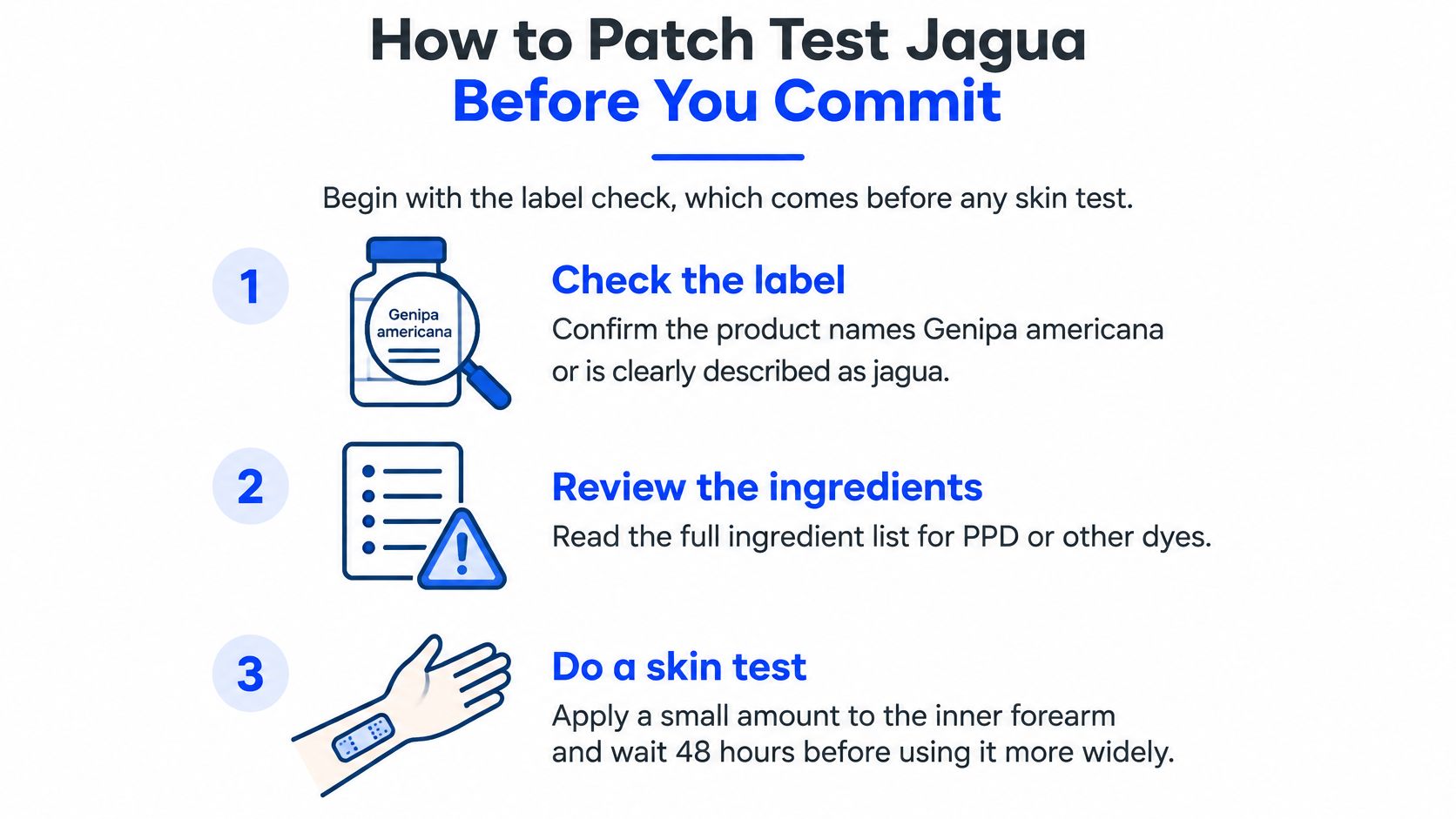
Start with the label. A skin test on a mystery tube only tells you how you react to whatever is inside, and you still won't know what that was. A fruit source changes where the dye comes from; the botanical source, full ingredient list, and PPD status still need checking before any skin contact.
The FDA fact sheet on temporary tattoos, henna, and black henna is a useful reference for temporary-tattoo terms and known dye risks. It does not settle whether a particular jagua gel is truly Genipa americana or what else was mixed into the tube, so the label still has to prove itself.
Label check, then a small test
- Confirm the product names Genipa americana, or is clearly described as jagua. A common name alone isn't enough.
- Read the full ingredient list for PPD and other dye compounds. Skip any product that doesn't list its ingredients.
- Confirm the intended use and the maker's contact details. Note whether it's sold as a cosmetic or as something else, and keep the package.
- Choose a small area, such as the inner forearm. Pick skin you can see and that isn't already irritated.
- Apply a small amount to clean, dry skin, the same way the directions say to apply a full design.
- Leave the test in place for at least 48 hours. Don't cover it with fragrance, scrub, or a tight band.
- Check at 24 hours and again at 48 hours for itching, redness, swelling, or blisters. Keep watching afterward, because reactions can be delayed.
The patch test is a rehearsal with one line instead of the full drawing. A calm spot lowers risk and can still miss a delayed or repeat-use reaction, so keep the package and stop at the first spreading itch, redness, swelling, or blister. If you have allergies or sensitive skin, talk with a doctor before a full design.
If a fruit dye feels like the wrong risk for your skin, Just Tattoos sells needle-free, plant-based designs you apply at home, with botanical linework in the floral collection, lower-commitment options in the small collection, and the full catalog when you already know the style.
If you want to test a look on your own skin before any permanent ink, Just Tattoos offers needle-free, plant-based designs you apply at home, with color that develops in about a day and fades over 7 to 10 days. They're a different process from jagua henna, and a patch test is still wise if your skin is sensitive. Visit Just Tattoos to browse designs and try a placement before you commit.