
The most popular advice about wolf tattoo meaning is also the least useful. You're often told to pick a lone wolf if you're independent and a pack if you're loyal, as if the animal comes with a fixed dictionary entry. It doesn't. The same wolf can signal family, departure, protection, or endurance, and pose, companions, and setting decide which message people read first.
Table of Contents
- What Wolf Tattoos Usually Mean
- Where Wolf Symbolism Comes From and What to Avoid
- Loyalty and Family in Pack Wolf Tattoos
- Independence in Lone Wolf Tattoos
- Howling Wolves, Moons and Calls to Gather
- How Pose and Detail Change the Message
- Where Wolf Tattoos Sit Best and Which Style Fits
- Try It Before You Commit
What Wolf Tattoos Usually Mean
A wolf tattoo most often signals loyalty, independence, protection, or resilience. Which one dominates isn't set by the species. It's set by what the wolf is doing, who it's with, and where you've placed it in the scene.
That's the core rule to keep in mind. A solitary wolf walking forward reads as separation and personal direction. A group reads as belonging. A wolf facing you in rough terrain reads as endurance. Change one element and you change the story, even though the animal hasn't changed at all.
Common Wolf Tattoo Meanings and the Design Cues Behind Them
| Meaning | Common design cues | What it signals |
|---|---|---|
| Loyalty and family | Pack scene or two wolves together | Commitment to a close group |
| Independence | One wolf walking alone | Separation and personal direction |
| Protection | Guarding stance with alert, head-up posture | Watchfulness over others |
| Resilience | Forward-facing gaze in wild terrain | Endurance through hard conditions |
These readings aren't random. They come from two grounded places, documented wolf behavior and a long cultural history. Wolves live in family groups, raise young together, and travel and hunt cooperatively, which is why pack imagery carries family weight. Wolves also disperse, howl to stay in contact, and hold territory, which is why a single wolf or a raised muzzle carries a different set of associations.
Pick the meaning first, then pick the pose and companions that match it. Reversing that order is how people end up with a fierce snarling wolf when they wanted to say something about their kids.
A useful test before you look at any artwork is to finish one sentence in plain words. Try, "This wolf will remind me of the people who raised me," or, "This wolf will remind me of moving out on my own." Once that sentence is clear, the table stops being abstract. The first sentence points you toward a pair or a pack. The second points you toward one animal in motion with open space around it. If you can't finish the sentence yet, that's fine, but don't let a list of qualities like strength, freedom, and loyalty do the job for you. Those words describe almost every wolf design ever drawn, so they won't help you choose between them.
Where Wolf Symbolism Comes From and What to Avoid
Wolf symbolism shows up across major Eurasian and North American mythological traditions, and it doesn't point in one direction. The University of Utah scholarship on wolves in art describes wolves viewed historically both as revered or divine figures and as frightening or evil beings, with interpretations shifting alongside religious and cultural change.
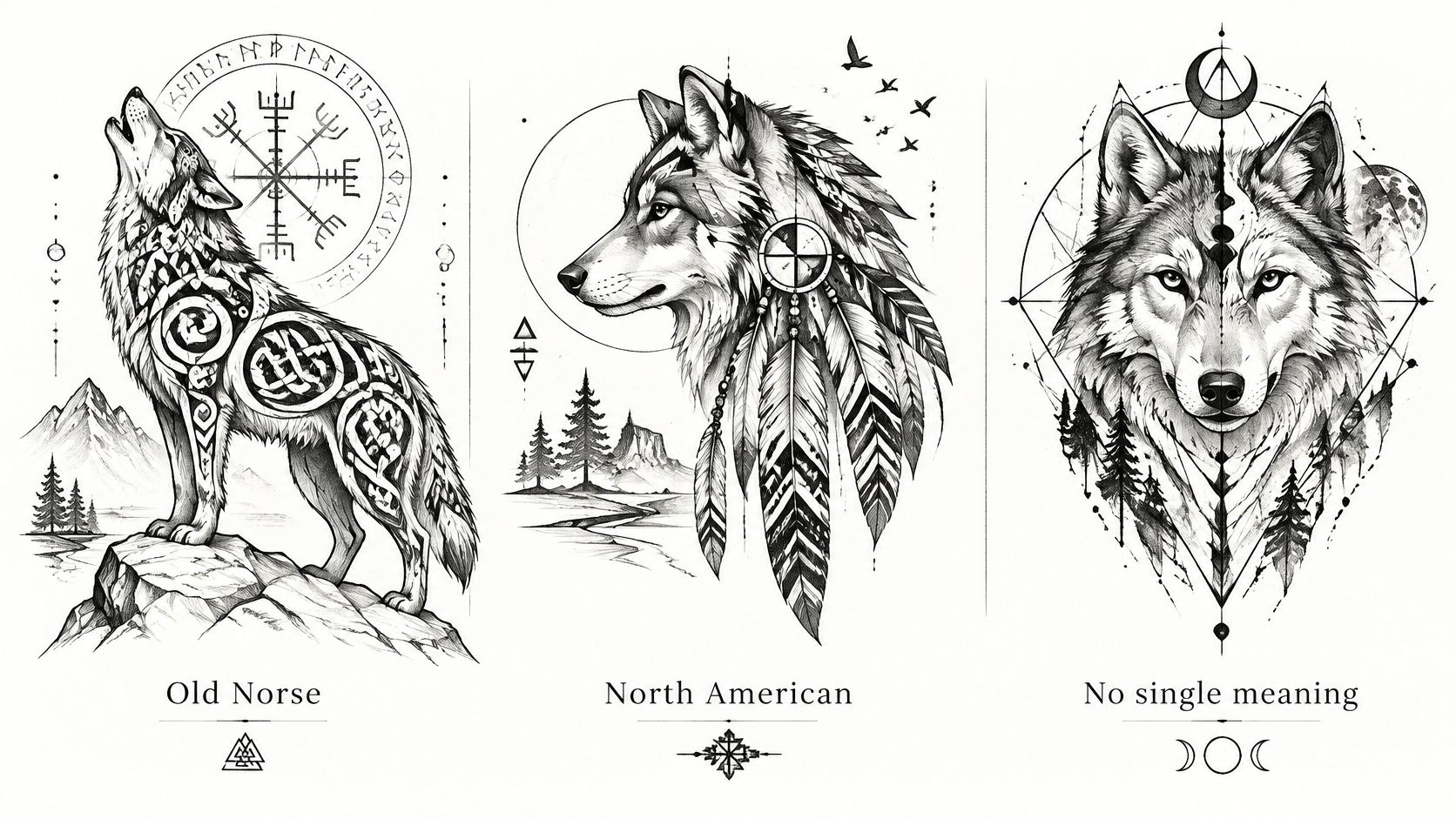
That split makes sense once you remember how people lived with wolves. Wolves were respected as apex predators and feared as threats to livestock and settlements at the same time. Admiration and danger grew side by side, and different traditions kept different halves of that tension.
How Different Traditions Viewed the Wolf
| Tradition | How the wolf was seen | Common tattoo echo |
|---|---|---|
| Old Norse tradition | Linked with powerful figures and destructive cosmic forces | Mythic wolf such as Fenrir |
| Turkic traditions | Revered animal and ancestral emblem | Ancestral or guardian wolf |
| Germanic warriors | Treated as a totem of strength | Warrior-style wolf |
| Celtic and Greek mythology | Admired and positively portrayed | Heritage-themed wolf |
| Indigenous North American traditions | Spiritually powerful, with meanings that differ by nation | Avoid specific sacred motifs unless connected |
| Nomadic Eurasian steppe peoples | Linked with ancestry, protection and leadership | Protective or leader wolf |
If you want a legend-based image, a mythic figure such as Fenrir is a clear, nameable reference. You can say exactly what story you're drawing on, and your artist can research how that figure is usually shown. If that direction appeals to you, mythic wolf artwork can be browsed in the fantasy collection.
The Cultural Respect Rule in Plain Terms
A naturalistic wolf, a paw print, a moonlit silhouette, or a pack scene is widely shareable. Trouble starts when you add dreamcatchers, feathers, named tribal totems, or Plains-style pictographic conventions to make the design feel more meaningful. Those elements can reference active or sacred traditions rather than generic decoration, and there isn't one unified category called Native American symbolism. Meanings and protocols vary among nations, and a general internet explanation can't authorize sacred imagery.
Adding cultural motifs doesn't necessarily deepen a tattoo. If you have no relationship to the tradition behind them, they borrow meaning you haven't earned and can make the design less appropriate, not richer. A clean, culturally neutral wolf that tells your own specific story will almost always say more than borrowed symbols you can't explain.
Loyalty and Family in Pack Wolf Tattoos
Pack imagery reads as family for a concrete reason. Gray wolf packs are structured family groups, not random gatherings of unrelated animals, and the Smithsonian National Zoo gray wolf profile notes that a typical pack contains five to eight wolves, although groups of up to 36 have been reported.
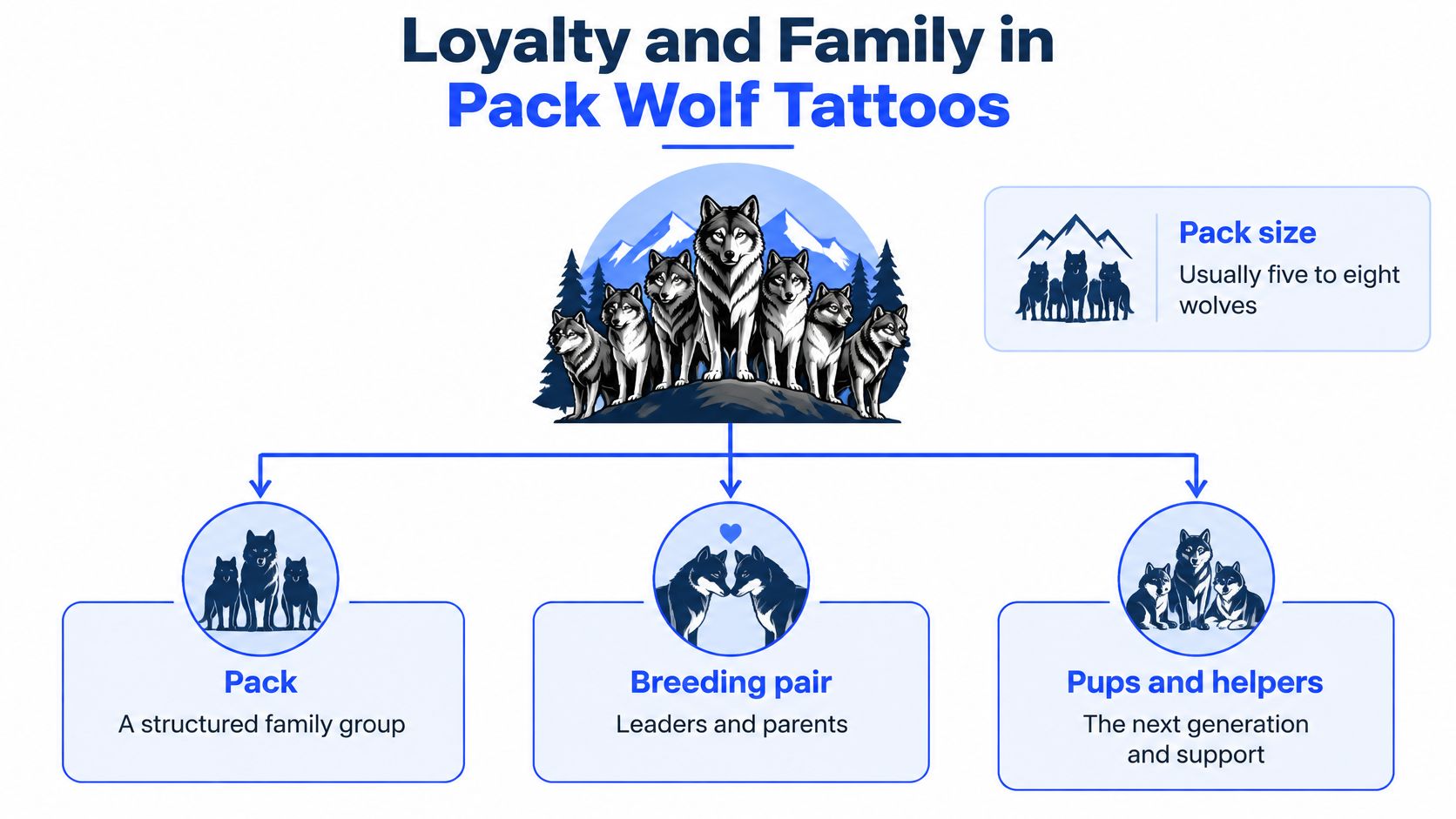
The typical group is an adult pair and their offspring. That adult pair guides movement and takes control during critical activities such as hunting. The dominant pair may also mate for life, which is why paired wolves so naturally suggest steadfast partnership rather than a casual bond.
Turning Pack Structure Into a Design Choice
- A full pack scene signals a close-knit group or chosen family, especially when the animals move in the same direction.
- Two wolves together suggest partnership, commitment, or a pair who lead together.
- A wolf with a pup emphasizes caregiving, teaching, and protection of someone younger.
- A larger group with varied sizes communicates collective strength across generations.
Before you settle on a number, count the wolves you want on your skin and decide which relationship you're honoring. You don't need one animal for every person you love. Two silhouettes close together, or one adult sheltering a smaller wolf, can carry the whole idea without turning your tattoo into a roster.
Direction matters more than people expect. Wolves facing the same way read as a group with a shared purpose. Wolves facing each other read as a bond between two individuals. A larger wolf slightly ahead with others behind reads as leadership and responsibility. Small choices like these do the storytelling work, so talk them through with your artist instead of leaving them to chance.
If you're comparing group scenes against single animals, you can browse pack and paired-wolf designs alongside solitary options to see how different the readings feel. Keep in mind that these are associations drawn from real behavior, not fixed rules. Your pack tattoo means what your story makes it mean, and the behavior explains why other people will likely read it as loyalty first.
Independence in Lone Wolf Tattoos
Young wolves sometimes venture beyond their territory before deciding whether to leave their parental pack, according to the Smithsonian National Zoo's guide to wolf behavior. That behavior gives the lone wolf a grounded association with transition: exploring what lies beyond familiar boundaries and choosing a direction.
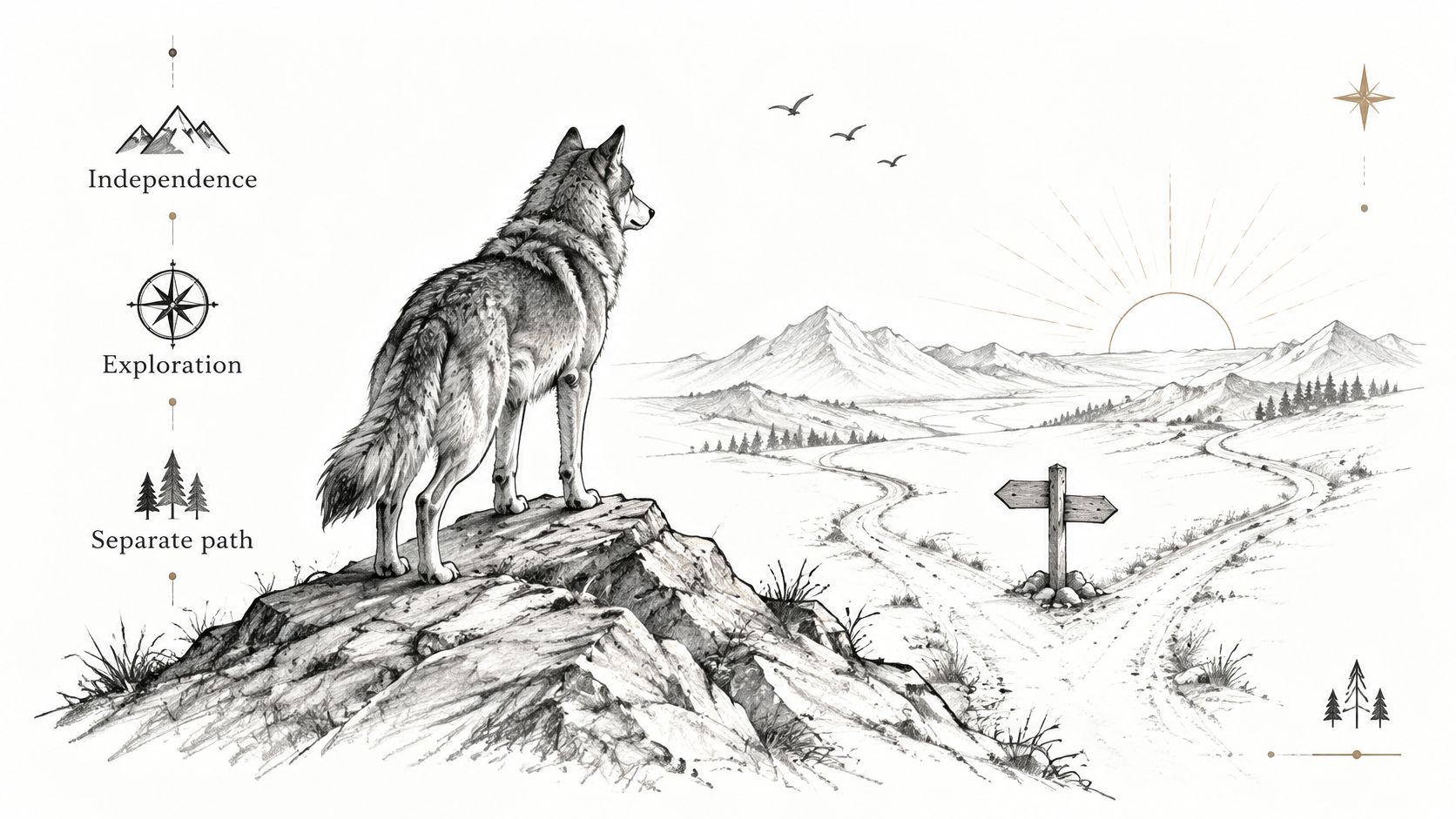
A lone wolf tattoo can mark self-discovery, a new chapter, or the confidence to follow a personal course. A path splitting ahead, for example, makes the choice itself part of the story. The animal's pose and surroundings shape the message more than its solitude alone.
Design Cues That Make Independence Clear
- A wolf looking toward the horizon suggests attention to a goal or an unfamiliar place.
- Open space around the animal gives the design a sense of room to explore.
- A path, ridge, or distant tree line frames departure as a journey with somewhere to go.
These details can suit someone marking a move, career change, or decision to follow a path their family did not choose. Where a pack design foregrounds belonging, a lone wolf in a chosen setting can focus on personal direction.
For a lighter symbol of change, compare this interpretation with feather tattoo meaning. A feather suggests freedom through its airy form; a wolf can express it through deliberate movement and the setting around it. Some designs add sacred or tribal motifs, but those carry cultural meanings of their own. Use them with a genuine connection to the tradition rather than as decoration.
Howling Wolves, Moons and Calls to Gather
A raised muzzle gives a wolf tattoo a voice. The Smithsonian American Trail animal bios describe howling as a way wolves keep their pack together, stimulate a hunt, and mark territorial boundaries. The sound can carry a message across distance: I'm here, and my group can find me.
What a Howling Design Can Say
A howl can suggest finding your people after a period of change, making your presence known, or staying connected to family across distance. It can also represent setting boundaries. The pose communicates these ideas through a call rather than a threatening expression.
Separating Biology From Visual Symbolism
The moon is visual symbolism; wolves howl to communicate socially and defend territory. Pairing a wolf with a moon can still suggest night, solitude, or a personal memory. Explore other ways to use that imagery in celestial tattoo ideas.
A raised head needs enough vertical room to read clearly, so the upper arm or back can suit the pose. A wolf silhouetted against a full moon forms a rounder composition that may fit a shoulder. Keep the muzzle visibly lifted: a partly raised head may look like the wolf is sniffing the air instead of calling.
Choose a howl when the message is about reaching others or being heard. A level, quiet pose conveys a different kind of presence. The moon adds atmosphere, while the wolf's posture carries the call.
How Pose and Detail Change the Message
A wolf's expression matters, but it does not tell the whole story. The animal's companions and surroundings can change its message: a calm wolf beside a pup suggests care, while the same calm face framed by sharp geometric lines may feel more controlled and formal.
Pose and Detail Intensity Cues
| Pose or detail | Likely reading | Design tip |
|---|---|---|
| Calm, naturalistic profile | Quiet strength and respect for wilderness | Keep the background simple |
| Bared teeth or snarl | Ferocity, warning or confrontation | Use only when the message is defiance |
| Red or glowing eyes | Intensity and danger | Use sparingly so the image does not overpower the body |
| Geometric framing | Structure and order | Keep lines clean for readability |
A calm profile beside a pup can signal protection without aggression. Add a snarl, and the relationship changes: the wolf may look less like a caregiver and more like a defender facing a threat. Companions give the expression context, much like a sentence changes meaning when you add the words around it.
Bared teeth and glowing eyes push the design toward confrontation or danger. Neither choice is wrong, but both can dominate the image's message. If you're comparing fierce animal expressions, tiger tattoo meaning explores a similar contrast between calm and aggressive designs.
Check the design from the distance a friend standing across a room will see it from. If the main expression or relationship between animals is unclear, fine detail may not solve the problem.
A Three Step Design Test
- Choose one focal point, such as the wolf's expression, a companion, or a framing shape. Remove details that compete with it.
- Check readability by imagining the design at half its displayed size. Does the expression or relationship still come through?
- Match intensity to intent by checking that the calmest or fiercest element supports your message.
Geometric framing can make a wolf feel structured, while loose, natural linework keeps it wild. Sacred or tribal motifs carry meanings rooted in particular traditions, so adding them without a connection to that tradition can borrow symbolism without understanding its context. Choose details that support the story you mean to tell, rather than adding symbols to fill space.
Where Wolf Tattoos Sit Best and Which Style Fits
Placement changes what a wolf design can say, because each area gives you a different amount of room and a different shape. A pose that reads clearly on a back can collapse into a blur on a wrist.
Placement by Design Type
- Upper arm gives enough room for a full wolf with its head raised, so a howling wolf or a solitary wolf in motion reads clearly.
- Forearm suits a narrow, forward-facing wolf or a short vertical composition, and the gaze stays visible when your arm rests.
- Back is the largest canvas and the best fit for a pack scene or a wolf with pups, since several animals and a horizon fit without crowding.
- Calf or shoulder works for a single calm profile or a small guardian wolf that needs less detail.
Matching Style to Size
Naturalistic fur and a calm profile carry the quiet-strength reading, but fine fur needs space, so save it for larger placements. Geometric framing and clean lines carry structure and order, and simple linework holds up well on narrow areas like the forearm. Mythic or fantasy styles suit legend-based wolves such as Fenrir, where exaggerated features are part of the point.
Each style changes how much detail survives on your body over time and at a glance. Dense shading crammed into a small area tends to merge visually, while bold outlines stay legible. If a design only works when you zoom in on a screen, it probably won't work at the size you're planning.
Do one final check before you commit. View the design at arm's length and ask whether the placement still shows the pose and companions you intend. If the pup disappears or the raised muzzle gets cut off by the shape of the area, resize or simplify now rather than after the ink is in.
Try It Before You Commit
A semi-permanent tattoo lets you see how your chosen pose reads on your own skin and placement before you book an artist. That's especially useful for wolves, since a calm profile and a snarling one can feel very different once they're on your forearm in daily life.
The Shewolf temporary tattoo is one example you can test at home. Just Tattoos sells semi-permanent tattoos made with plant-based ink, applied at home without needles, for US customers. The design develops in about 24 hours, and most designs last 7–10 days, depending on skin and placement.
People use these designs to test a placement before booking an artist, to wear a sleeve design for a weekend, to match with a friend for a trip, or to change their look more often than permanent ink allows. If you're weighing options by wearer and style, temporary tattoos for men offers more placement examples. If you have sensitive skin, do a patch test first.
When you're ready to compare, browse all designs to set wolf options beside other animal artwork and check sizes against the area you have in mind. Live with the pose for a few days, watch how it reads in the mirror and in photos, and only then decide whether it has earned a permanent version.
Ready to see which wolf story fits you, the loyal pack member or the wolf walking its own path? Just Tattoos offers semi-permanent, plant-based designs you can apply at home without needles, so you can test the exact pose and placement before committing to permanent ink. Visit Just Tattoos to browse wolf and other animal designs and try your favorite first.