
Sticker-style temporary tattoos usually fade within a few days, while semi-permanent plant-based designs such as Just Tattoos last about 7-10 days, depending on skin and placement. That is the typical window for anything you apply at home without a needle, whether you want a design for a week of work or matching with a friend for a trip.
Most advice about long lasting temporary tattoos starts in the wrong place, with the product page and whatever number sits on it. Wear time gets set by something more basic. The layer of skin that holds the color decides how long the color can stay, and placement plus daily friction decide where in that range you land. Once you know that, a six-month or one-year claim stops sounding ambitious and starts sounding impossible.
So what determines wear, what extends it, and how to pick a design that fits the window you have.
Table of Contents
- How Long Does Each Temporary Tattoo Type Last?
- Why Do Six-Month and One-Year Claims Fail?
- What Decides How Long a Design Stays, and How Do You Extend It?
- Which Body Placements Make a Design Last Longest?
- How Do You Patch Test Before Applying?
- Which Design Fits Your Wear Window?
- What Do Readers Still Ask About Wear Time?
How Long Does Each Temporary Tattoo Type Last?
A water-transfer sticker may fade within hours or a few days. Semi-permanent tattoos absorb into the outer layer of skin, so they generally last longer. Just Tattoos designs use plant-based ink and last 7–10 days, depending on skin and placement. Henna, a plant stain rather than a transfer, can last longer still.
| Type | How it sits on skin | Typical wear |
|---|---|---|
| Water-transfer sticker tattoo | Sits on the surface of the skin | Usually hours to a few days |
| Semi-permanent plant-based tattoo (Just Tattoos) | Absorbs into the outer layer of skin | 7–10 days, depending on skin and placement |
| Natural henna stain | Colors the outermost skin cells | About several days to about 3 weeks (FDA fact sheet; clinical review) |
| Permanent tattoo | Ink deposited in the dermis | Generally a lifetime |
The middle column explains the difference in wear. A water-transfer sticker rests on the skin's surface, where rubbing or washing can wear it away. Absorbed stains color the outer layer of skin and fade as that skin renews. Their wear time is still temporary, but the stain can outlast a transfer.
For the longest-lasting temporary tattoo, henna is the longest-wearing option in this comparison. The FDA fact sheet on henna and temporary tattoos describes henna stains lasting several weeks. A clinical review of superficial henna puts the typical range at about 1 to 3 weeks, with fading beginning after 2 or 3 days. That is a longer window than most temporary designs, but it is still a surface stain, not permanent ink.
Permanent tattoos stay because a needle deposits pigment in the dermis. The other types in the table color or sit on more superficial skin. For details on the 7–10-day wear window and how it varies by skin and placement, see our guide to how long semi-permanent tattoos last.
Why Do Six-Month and One-Year Claims Fail?
Six-month and one-year temporary tattoo claims don't hold up for anything that sits in the top layer of skin. The reason is mechanical: surface color leaves when the cells holding it shed.
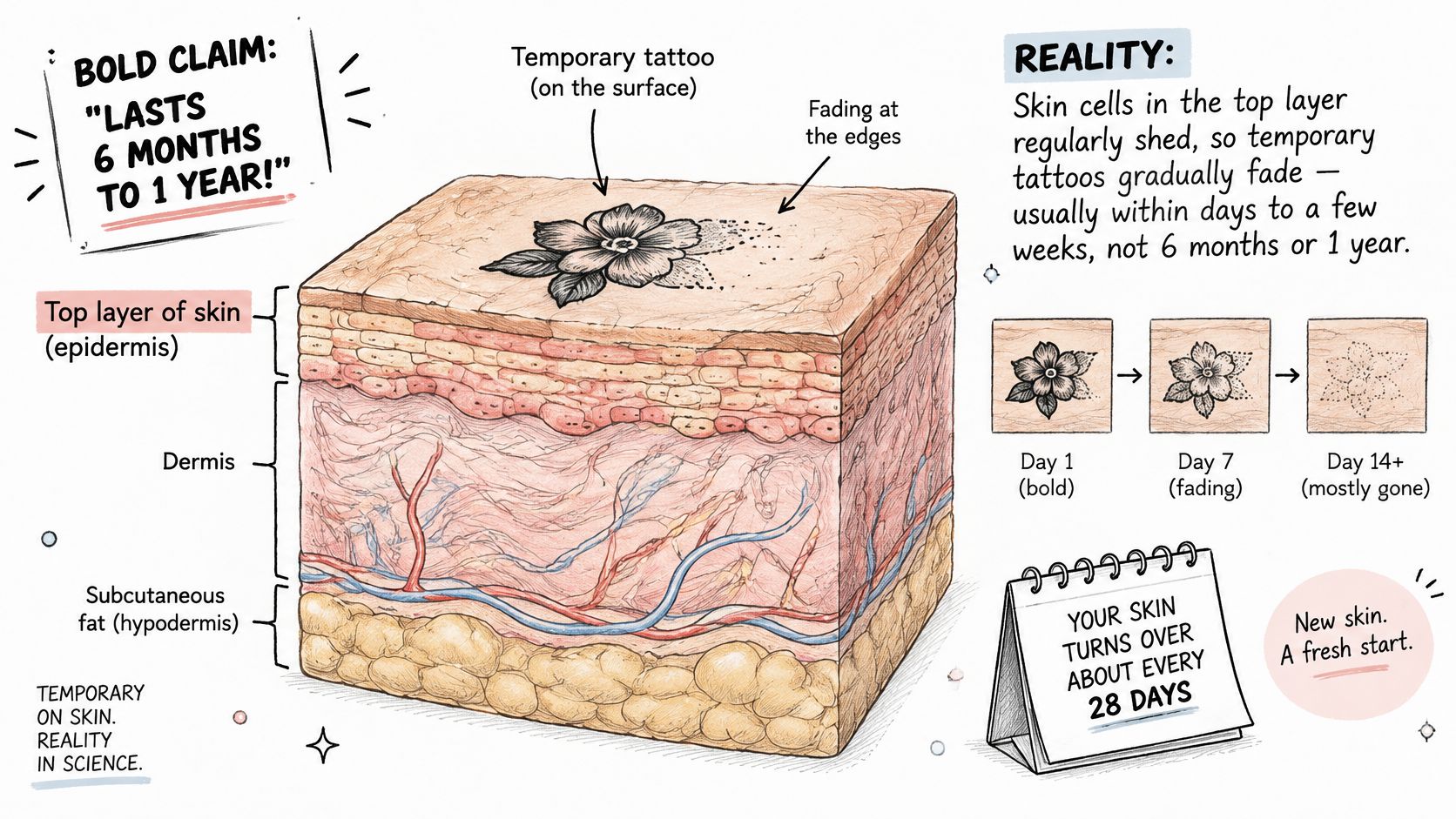
Your outermost layer, the stratum corneum, works like a conveyor belt. Cells form at its base, travel upward, and flake off the surface on a steady cycle. Color that lives only in that layer rides the belt out with them. No ingredient can talk a skin cell into staying longer than its normal life, and no adhesive can reach past that cycle. A surface stain colors the stratum corneum, so it disappears as those cells naturally shed. Permanent tattooing works differently: a needle carries pigment through the epidermis into the dermis, a deeper layer that shedding cells never touch.
Henna shows where the ceiling sits. The FDA's henna and mehndi guidance puts henna tattoos at approximately 3 days to several weeks, with fading that can begin after 2 to 3 days and a documented ceiling around 3 weeks. That upper end is the limit for surface dye, reached by the longest-wearing natural stain on record. A six-month claim asks for many times that.
Permanent ink sits somewhere else entirely. The FDA's guidance on tattoo removal explains that pigment is injected through the epidermis and deposited in the dermis, where it generally remains for a person's lifetime. The layer that holds the pigment is the whole difference.
A wear claim with no test method and no body site is a marketing number.
Skin renewal sets the schedule, and washing, friction and sun can shorten it further. Our designs are printed in plant-based ink that soaks into the top layer of skin instead of sitting on it like a sticker, and they fade on their own as that layer renews, which is why a realistic wear window is measured in days, typically 7 to 10. Aftercare can slow that process. It cannot reverse it.
Before you buy anything marketed as long-wearing, run three checks:
- Where the ink sits. On the surface, in the outer layer, or in the dermis. Only the last one lasts for years.
- How the duration was measured. A number without a method, a test site and a body location is guesswork.
- Whether the number changes by body area. If a brand gives one figure for hands and back alike, it hasn't tested carefully.
What Decides How Long a Design Stays, and How Do You Extend It?
Two people can apply the same design on the same day and get noticeably different results a week later. The product sets the ceiling. Daily life decides where in the range you land.
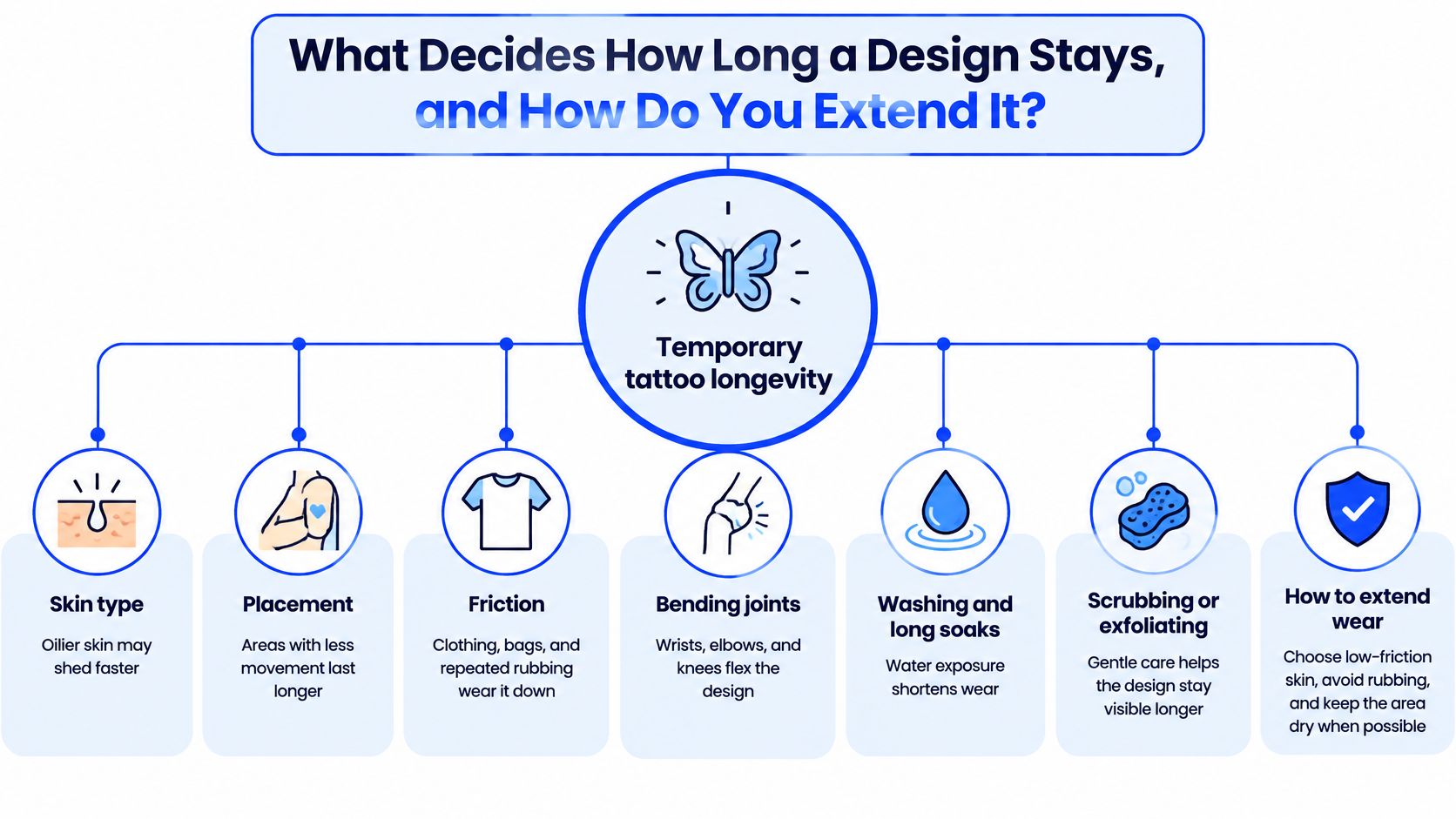
The factors that move the number, in the order you'll encounter them:
- Skin type. Oilier skin can lift a surface design faster, and very dry, flaky skin sheds unevenly, which makes fading patchy.
- Placement. Spots with little movement and little hair keep color longest. The forearm, calf and shoulder are the friendly choices.
- Friction. Clothing, bag straps, seatbelts and repeated rubbing wear the design down edge by edge.
- Bending joints. Elbows, knees and the wrist crease flex the design hundreds of times a day, and once a crack opens it spreads.
- Washing and long soaks. A quick shower is fine. A long bath, a hot tub or a chlorinated pool softens and speeds the exit.
- Sun and heat. Strong sun and heavy sweating push the fade along faster than a mild week indoors.
- Preparation. Oil, lotion or sunscreen left on the skin blocks proper contact, and the design starts behind.
What to do before the design goes on
Clean the area with mild soap, rinse, and let it dry completely. Skip moisturizer, sunscreen and body oil on that spot until after application. If you applied lotion an hour earlier, wash it off again, because even a faint film interferes with how evenly the design takes. Our step-by-step application guide covers the mechanics, from removing the protective film to the 30-second press with a damp cloth.
Your first-week routine
- Leave it alone for the first 24 hours. The design is still developing, and early rubbing dulls the final shade.
- Wait at least 24 hours before lotions, sunscreens or heavy oils. We recommend this delay, since those products sit on the surface you're trying to preserve.
- Pat dry instead of rubbing. A towel dragged across the design removes surface cells and takes color with them.
- Skip scrubbing, loofahs and exfoliating products on the area. Physical exfoliation is the fastest way to erase a design that was doing fine.
- Cover or shade it in strong sun. Sun exposure is the one factor people forget, especially on the shoulder and calf.
- Choose loose clothing around the spot. Waistbands, bra straps and tight cuffs create exactly the friction the design can't absorb.
- Expect a gradual, even fade. A design that softens across the whole shape is behaving normally. One that disappears from the edges first usually had friction trouble.
Rule of thumb: judge a design's wear by its placement before you judge the product. Hands and joints live at the short end of the range no matter what you do.
If a design fades faster than you expected, check placement and friction first. Was it on a finger? Under a strap? Washed a dozen times a day? Compare that against the typical range before you decide the product underperformed. Our guide on making temporary tattoos last longer goes deeper on the care side.
Which Body Placements Make a Design Last Longest?
Friction and washing decide most placement differences. The ink sits in the outer layer of skin, so a design lasts as long as the surface cells beneath it do. Every spot on the body sheds those cells at a different speed, which is why the same product can hold past a week on one area and soften early on another.
| Placement | Expected wear | Why |
|---|---|---|
| Forearm, calf or shoulder | Among the most stable spots | Minimal friction and little hair |
| Upper arm or back | Steady wear with little rubbing | Few washing and rubbing contacts |
| Hands and fingers | Fades sooner than the typical 7-10 day range | Frequent washing, sanitizing and rubbing |
| Palm-side fine lines | Fade fastest of all designs | Constant contact and friction |
| Feet and joints | Shorter wear | Bending, footwear pressure and sweat |
Read the table as a spectrum from calm skin to busy skin. Flat, low-contact areas hold their surface longer, so color there fades evenly across the whole shape. Bigger compositions belong on the upper arm and back for exactly this reason: the skin is broad, stable and rarely scrubbed.
Hands sit at the busy end. They are washed, sanitized and rubbed more than any other spot, so a hand design usually fades sooner than the typical range. Small, bold shapes cope with that pace, while fine lines on the palm side go first because every grip works directly on them. For a finger or the back of the hand, browse small designs that read clearly at that size. A hand piece is still worth wearing to work for a real week if you want to see how a design reads before committing to a permanent one.
Feet and joints round out the short list. Shoes press, socks rub, and every bend folds the skin like a crease in paper. Keep those placements for weekends and events. Broader coverage does better higher up: sleeve designs suit the upper arm and shoulder, where the surface is flat and stable. Our guide to the best placement spots for temporary tattoos ranks more options if you are deciding between two areas.
How Do You Patch Test Before Applying?
If your skin is sensitive or you've reacted to body products before, spend two days on a test before you commit to a visible design. The FDA's tattoo and permanent makeup fact sheet notes that temporary tattoos can produce allergic reactions, so this step is a sensible precaution. It reduces risk for you specifically. It can't promise safety for everyone.
- Pick a quiet spot. The inner forearm works well, because it's easy to watch and easy to keep covered.
- Apply a small design the same way you'll apply the final one. Same cleaning, same drying time, same press. A test that skips steps tells you nothing.
- Leave it for the full development window, about 24 hours, without washing the area.
- Watch for two days. Look for redness, itching, swelling or a raised rash rather than expecting an instant reaction.
- React immediately if something appears. Wash with mild soap, stop using the product, and seek medical advice if the reaction is spreading or uncomfortable.
- Apply the larger design only after the test area stays clear. Clear skin after 48 hours is your green light.
Keep it small: a patch test on a hidden area costs you two days and one small design. A reaction on a full forearm piece costs you a week of discomfort.
If you've used natural pastes before, remember they behave differently from printed transfers, and our guide to jagua and henna explains how those plant dyes work. A reaction to one type doesn't automatically predict a reaction to another, so test each product on its own.
Which Design Fits Your Wear Window?
Start with the goal, then work backward to the design and the spot. That order saves you from buying a beautiful large piece for a placement that will erase it in three days.
- A weekend look, a trip, or matching designs with friends. Go small. Small designs hold up best because they sit inside one low-friction area rather than crossing a joint or a waistband.
- A placement test before booking an artist. Choose a semi-permanent design that typically lasts 7-10 days and put it exactly where the tattoo would go, even if that spot fades faster. You're judging how the placement feels at work, at the gym and in the mirror, not chasing maximum wear.
- A week of work with a visible hand piece. Wear it through real meetings and real typing. Temporary hand tattoos are a practical way to see how a design reads in an ordinary week before deciding on a permanent one.
- A sleeve concept you're not ready to commit to. A temporary sleeve composition shows you how the artwork wraps and sits before any appointment.
Name the limit clearly. If your goal is months of wear, a temporary product is the wrong tool, and a permanent tattoo is a separate decision to make with a professional artist. No amount of care turns a surface design into a seasonal one.
A short checklist to close the decision: choose the goal first, pick a placement from the table above, set a reminder for the day fading should begin, and check the product listing before ordering if you want a colored design.
Browse the full Just Tattoos range when you're ready to pick.
What Do Readers Still Ask About Wear Time?
Do colored designs last as long as black designs?
Colored designs aren't given a set wear time, so check the individual product listing for what's stated before you order. If you're planning a large colored piece in a visible spot, run a patch test first so you know how your skin responds before a full application.
Can I shower with a temporary tattoo on?
Normal showers are fine. Long soaks, hot tubs and scrubbing are the parts that shorten wear, and no specific duration is promised either way. Keep the water warm rather than hot, don't aim the stream directly at the design, and pat dry afterward.
Can a faded design be refreshed?
Once the color has faded, the ink doesn't come back. The design fades because the skin cells holding it have shed, so the practical option is a new design on a lower-friction spot. Reapplying the same artwork a little higher on the arm often lasts noticeably longer than the original placement did.
If you want a design that looks like real ink without a needle, Just Tattoos makes semi-permanent tattoos with plant-based ink that develop over about 24 hours and typically last 7-10 days, depending on skin and placement. Choose a spot with minimal friction, follow the first-week routine, and you'll get the most out of the wear window. Visit Just Tattoos to find a design for the week ahead.