
A moth tattoo most often means transformation or resilience, and species and design cues such as flames, skulls, or moon imagery can shift that meaning. If a moth always meant darkness or death, why would a botanical moth feel so different from one with a skull?
The answer is in the details. A moth tattoo meaning comes from the insect, the surrounding artwork, and the wearer's story, not a universal code that everyone reads the same way.
Table of Contents
- What Does a Moth Tattoo Usually Mean?
- Why Do Moths Symbolize Transformation?
- What Does a Moth Drawn to Light Mean?
- Which Moth Species Changes the Meaning?
- Does a Moth Tattoo Mean Death or Bad Luck?
- Which Placements and Styles Suit a Moth Design?
- Try a Moth Design Before You Commit
What Does a Moth Tattoo Usually Mean?
Transformation, change, and resilience are the most common starting points for interpreting a moth tattoo. Darker meanings usually come from recognizable features, such as a skull marking or a flame, rather than from the insect alone.
Think of the artwork as a combination of visual clues. The moth provides the central subject, while its life stage, wing markings, and surroundings help explain what kind of change or experience the wearer wants to express.
Moth design cues and their usual meanings
| Design cue | Common meaning | Why it reads that way |
|---|---|---|
| Cocoon, pupa or shed skin | Transformation and identity change | Shows the in-between stage of metamorphosis |
| Realistic adult moth | Emergence and independence | Shows the finished, winged stage |
| Flame or artificial light | Risk, obsession or pursuit of a goal | Moths can circle lights they cannot navigate by |
| Moon or star imagery | Guidance, calm and night beauty | Some nocturnal moths use celestial cues for navigation |
| Skull or skull-like thorax | Mortality or memento mori | Echoes the death's-head hawkmoth |
| Flowers or botanical details | Life, regeneration and beauty | Floral detail shifts the tone toward growth |
| Eye spots or leaf-like wings | Defense, vigilance and survival | Patterns help moths avoid predators |
These are common readings, not definitions everyone must accept. Someone might choose a moth because it reminds them of a garden, a loved one, or a fascination with insects, without intending any spiritual meaning.
How combined cues change the message
A moth surrounded by flowers can suggest renewal, but add a flame and the composition becomes more complicated. It might express wanting something beautiful despite its risks, or learning to separate healthy ambition from a harmful attraction.
The largest or most prominent element often determines the first impression. A small skull within a leafy composition may feel like a quiet reminder of impermanence; a large skull above the wings is harder to read as a minor detail.
Practical rule: Choose the meaning you want people to notice first, then make the supporting imagery agree with it.
List the two or three most noticeable cues in your design. Decide which should lead and whether the others support that message or deliberately complicate it.
Why Do Moths Symbolize Transformation?
Say you're choosing a tattoo after changing careers. An adult moth could represent stepping into your new identity, while a pupa could acknowledge the uncertain period before you knew what came next.
That distinction has a biological foundation. The Utah State University Extension guide to clothes moths describes four distinct life stages: egg, larva, pupa, and adult, giving moth symbolism a concrete connection to becoming something different.
From beginning to emergence
- Egg. This is the beginning stage, before the insect's more recognizable form appears. In artwork, it can suggest potential rather than accomplishment.
- Larva (caterpillar). The insect feeds and grows. As a personal analogy, this stage fits learning, preparation, and the work that happens before a visible change.
- Pupa. The insect remains largely still while its body changes. This is the least outwardly visible phase, which makes it especially useful for representing private transformation.
- Adult. The winged moth emerges. An adult-centered design can mark arrival, independence, or the willingness to move beyond an earlier identity.
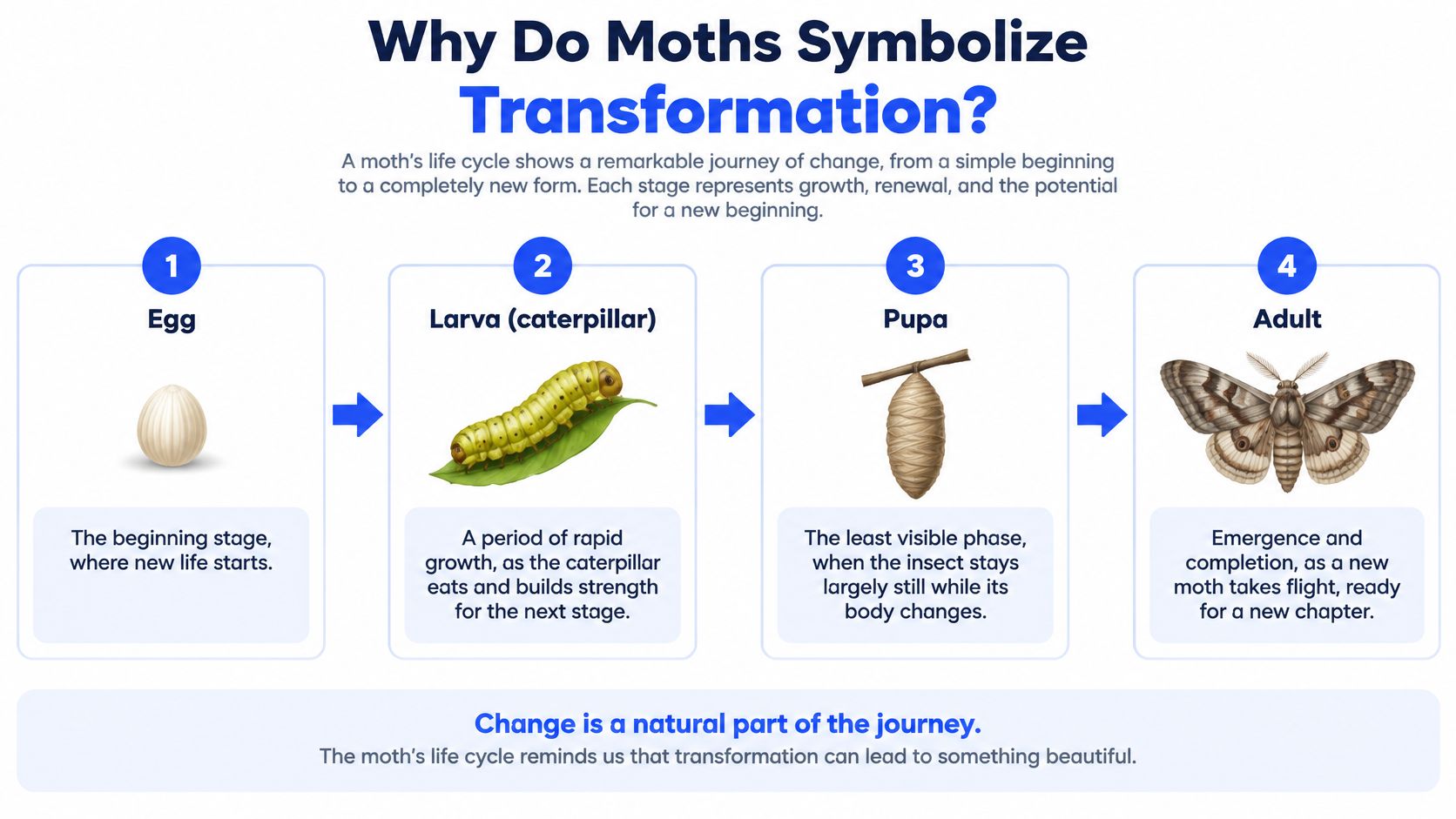
A cocoon or shed skin emphasizes the transition itself. A realistic adult emphasizes its outcome, while a composition showing several stages recognizes gradual development rather than one dramatic turning point.
You don't have to consider yourself finished changing to wear a moth. A design can acknowledge that you're still in the middle of becoming someone new.
Where the artistic association comes from
European imagery has treated moths both as pests threatening crops and textiles and as subjects worthy of close observation. Natural-history artists helped viewers look beyond damage and notice the insects' forms, patterns, and development.
The painter and naturalist Maria Sibylla Merian (1647 to 1717) published three books documenting butterfly and moth metamorphosis, according to The Conversation's art-history account of moth imagery. Her work helped establish insect transformation as an artistic and scientific subject.
Transformation doesn't automatically mean improvement. Losing an old identity can involve grief, uncertainty, or an awareness that nothing stays unchanged; some traditions also connect moths with souls or death, while contemporary tattoo interpretations often emphasize endurance.
Our guide to butterfly tattoo meaning offers a related way to consider winged transformation. For your moth, the useful question is whether you want to honor the process of change or the result of renewal.
What Does a Moth Drawn to Light Mean?
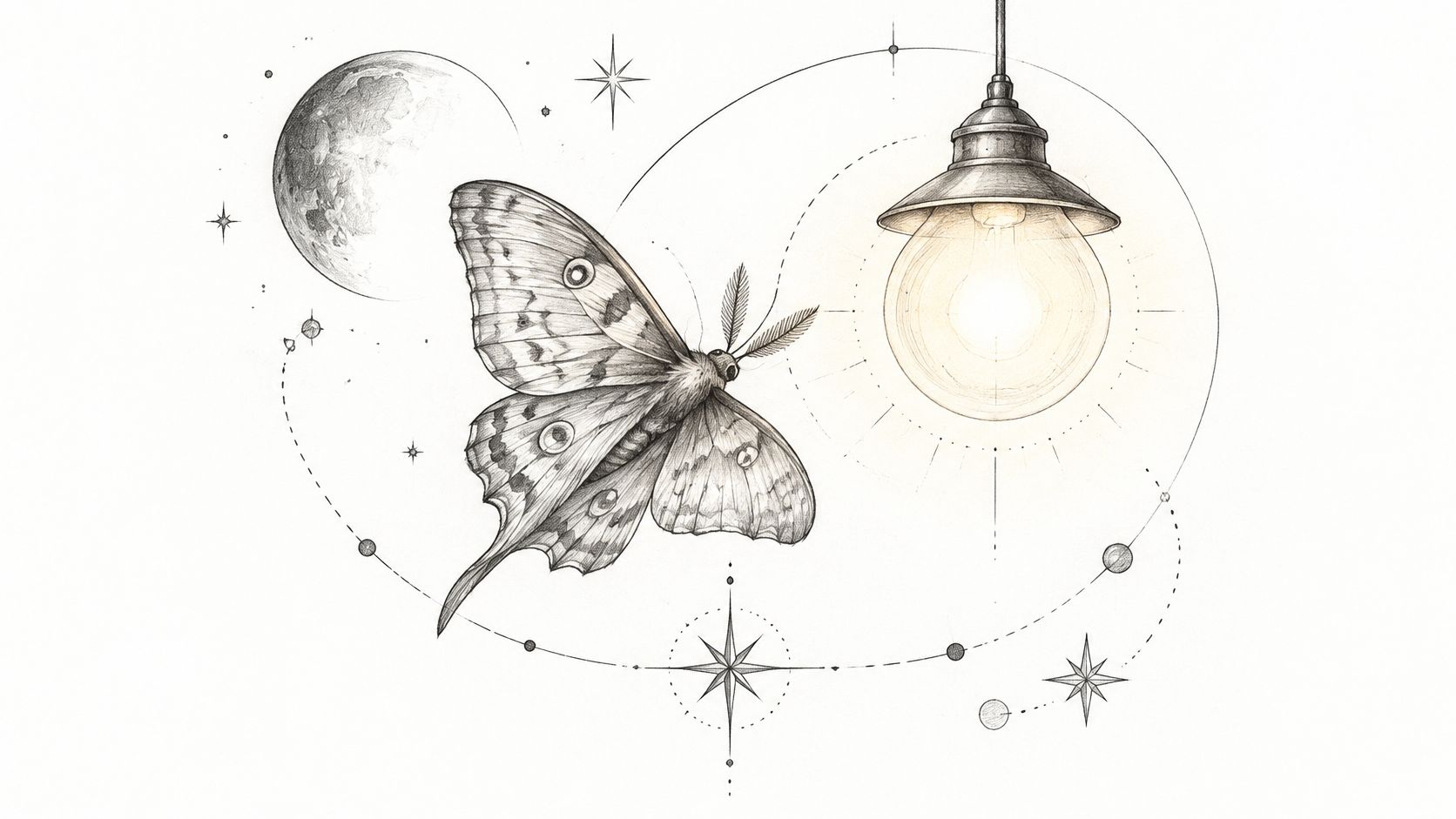
A moth drawn toward a light can symbolize desire, temptation, or a search for direction. In a tattoo, the glow might represent something the wearer wants, even when its consequences are uncertain.
The phrase “like a moth to a flame” captures one familiar reading, but real moth behavior is more complex. A nearby lamp can disrupt a moth's orientation rather than draw it directly toward danger.
Attraction isn't always a straight approach
One explanation of nighttime navigation is that moths maintain a relatively constant angle to distant celestial light. The Moon can serve as a stable reference, while a nearby lamp shifts position from the moth's perspective and disrupts that orientation. If the moon is part of your design, our moon tattoo meaning guide explains what each phase suggests.
Penn State's entomology reporting on moths and light explains this navigation problem and reports that only 4% of tracked insects flew directly at streetlights in more recent field research. Many instead became disoriented and trapped in the surrounding light.
The story can center on trusting an unreliable guide. That makes the image about more than desire: the glow may offer direction while also leading the moth into confusion.
Danger or direction?
A moth circling a flame can suggest entanglement in an unhealthy relationship, a repeating habit, or attention mistaken for support. A moth approaching a distant glow can represent searching for purpose during uncertainty.
- For a cautionary reading, use a close flame, enclosing smoke, or a circular flight path. These cues suggest entanglement.
- For a hopeful reading, leave an open path toward a distant light. The moth's direction can feel purposeful.
- For an ambivalent reading, show the moth turning partly away from the flame. That hesitation suggests awareness of risk.
The flame can represent what you want, what you fear, or something you're learning to stop following.
Decide what the light means to you: danger, guidance, or a difficult mix of both. The design's direction and surrounding details can shape that meaning without making it a rule about moths or about every wearer.
Which Moth Species Changes the Meaning?
A luna moth and a death's-head hawkmoth can give similar compositions very different meanings. The luna moth often suggests quiet renewal, while the death's-head hawkmoth's skull-like marking can bring mortality to mind.
Moths vary widely in appearance. Scientists have described more than 160,000 moth species worldwide, according to the University of Florida IFAS moth guide. Choosing a recognizable species gives the design a more specific starting point than an unspecified winged insect.
Moth species and their usual tattoo meanings
| Moth type | Common meaning | Why it reads that way |
|---|---|---|
| Luna moth | Renewal, calm and fleeting beauty | Its association with moon imagery and nighttime |
| Death's-head hawkmoth | Mortality and memento mori | Its skull-like thorax marking and the name Atropos |
| Cryptic bark or leaf moth | Discretion, vigilance and survival | Its markings help it blend into its surroundings |
What each choice emphasizes
A luna moth suits a design about quiet renewal or fleeting beauty. Moon imagery can strengthen that reading, though it is a contemporary interpretation shared by some, but not all, cultures.
A death's-head hawkmoth has a skull-like marking on its thorax, the body area between the head and abdomen. Its scientific name, Acherontia atropos, includes Atropos, a Greek Fate associated with cutting the thread of mortal life. That connection supports a memento mori reading: a reminder that life is finite. For some wearers, the image can express acceptance or remembrance.
A cryptic bark or leaf moth blends into its surroundings. That visual trait can suggest discretion, watchfulness, or survival without attracting attention.
A simple way to read the design
- Identify the species. Decide whether the artwork shows a recognizable moth or an invented ornamental form.
- Inspect the wing pattern. Camouflage and eye spots create different impressions from exaggerated or decorative markings.
- Consider the composition. Surrounding details can reinforce the species' associations or shift the overall mood.
Start with the species, then consider the design cues and your own reasons for choosing it. That gives you a clear way to explain the meaning without treating any interpretation as universal.
Does a Moth Tattoo Mean Death or Bad Luck?
A moth tattoo carries death or bad luck only when its design points that way. The species, surrounding imagery, and personal context all shape how viewers read it. A botanical moth or a design without ominous cues may suggest an interest in nature, while gothic styling can create a darker mood without declaring a specific belief.
Historical belief versus personal style
Folklore records beliefs tied to particular places and traditions. Modern tattoo choices can use similar imagery to express taste, memory, or identity. These readings may overlap, but they are not interchangeable: gothic artwork alone does not establish someone's religious beliefs, and flowers do not prove a tattoo represents rebirth.
If you're concerned about a negative first impression, look at the whole composition. A skull, flame, or dark background can give the design a more ominous tone, while softer details may shift its mood. People from different families and cultures can still interpret the same image differently.
Make the meaning easy to explain
Choose a meaning you can describe clearly, even if other people read the imagery another way. For example, you might say the tattoo reminds you to value your time or represents learning to live through uncertainty. If you prefer renewal imagery that carries a different visual story, read this guide to phoenix tattoo meaning.
Which Placements and Styles Suit a Moth Design?
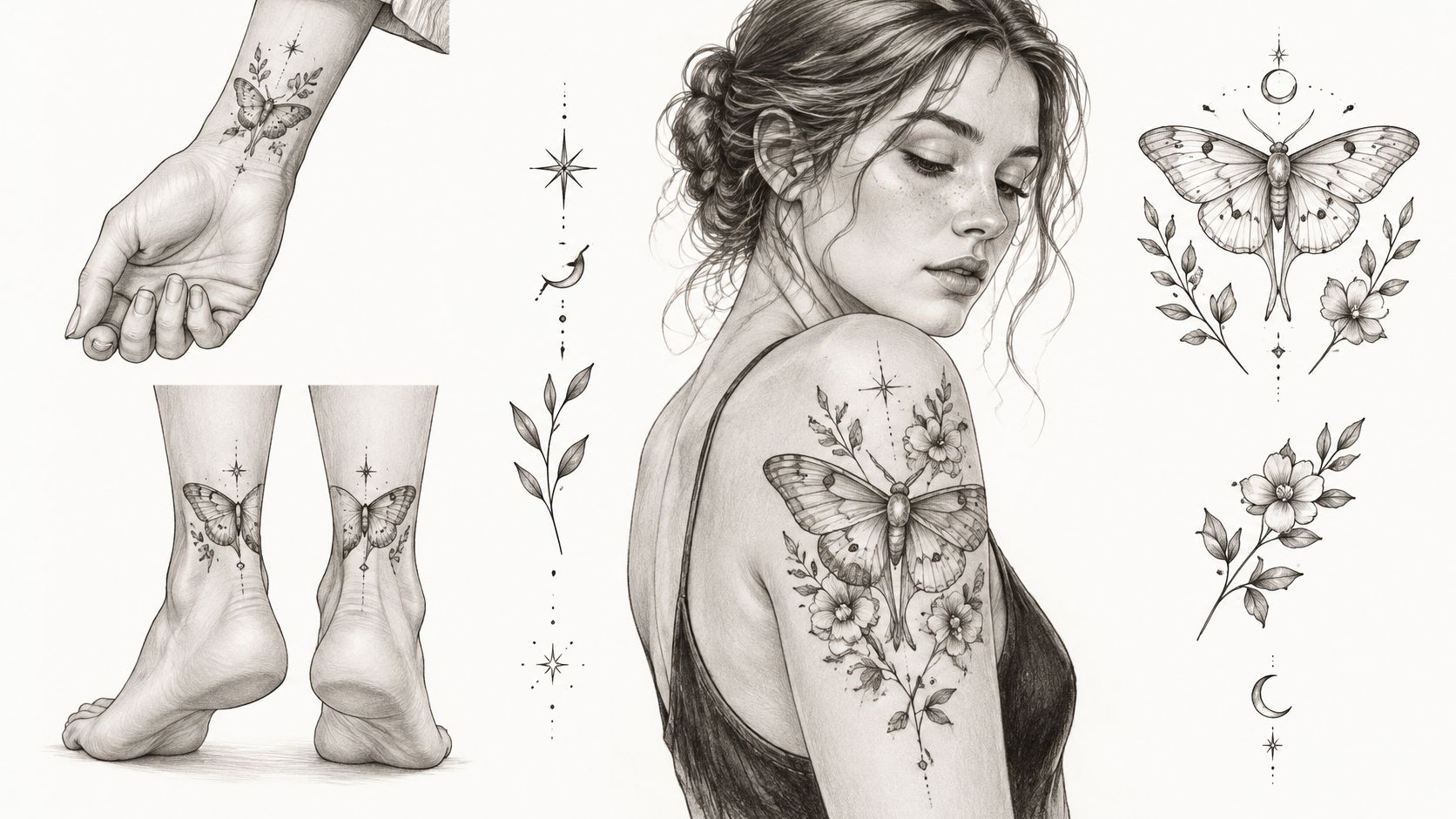
Placement affects how often you and other people see the design. A moth on the chest can feel private, while a skull-marked moth on the hand becomes part of everyday introductions.
Choose the location alongside the artwork, rather than treating placement as an afterthought. A detailed scene needs enough space for viewers to distinguish its important cues.
Match the placement to the composition
| Placement | Design that suits it | Impression it can strengthen |
|---|---|---|
| Wrist or ankle | Small single moth | A subtle, frequently noticed personal reminder |
| Paired wrists or ankles | Coordinated moths | Balance and connection |
| Shoulder or upper arm | Larger moth with flowers | Growth expressed through an organic composition |
| Back or chest | Moth with moon imagery | A personal nighttime scene |
| Forearm or sleeve | Moth, flame, and supporting details | A more visible story about desire or risk |
Keep recognizable details away from areas where the composition constantly folds or wraps out of view. Our guide to placement spots for temporary tattoos can help you compare locations before applying a design.
Compare the styles
- Black-and-grey or blackwork can emphasize night, mystery, and mortality through contrast and heavier shapes.
- Color with botanical details can create a more lively impression, especially when leaves and flowers remain prominent.
- Fine-line work feels delicate and minimal, but small markings need enough space to stay recognizable.
For visual comparisons, explore our butterfly collection and the Whimsical Botanical Moth temporary tattoo. Consider both the overall silhouette and which details you notice first.
Choose a placement where you want the meaning to be seen, whether that's mostly by you or by the people you meet.
Try a Moth Design Before You Commit
A moth's silhouette can look different on skin than it does on a screen. A temporary design lets you check its size and placement in daily life before deciding whether to book a permanent tattoo.
Give the design an everyday test
Just Tattoos offers semi-permanent tattoos made with plant-based ink and applied without needles. The ink absorbs into the top layer of skin, develops over approximately 24 hours, and remains visible for 7–10 days depending on skin and placement.
Follow the step-by-step guide to applying a temporary tattoo. If your skin is sensitive, consider a patch test. Compare the Moth Dual Swords temporary tattoo with other designs in the Just Tattoos collection.
Wear the design through its full run. Notice whether its visibility, size, and meaning still feel right in everyday settings.
Just Tattoos ships to all 50 United States. Shipping costs $4.99, with free shipping on orders of $35 or more.
A short-term design can help you test a sleeve idea for a weekend, coordinate with a friend for a trip, or change your look without a permanent commitment. Wear the moth for a weekend and note whether its details still convey the meaning you intended.