
An angel tattoo doesn't have to represent religion, and a protective-looking figure can also express grief. Angel tattoo meaning usually centers on protection, guidance, faith, or remembrance, but the figure's pose, wings, and accompanying details shape what people see. The wearer's personal meaning and a stranger's first impression won't always match.
Table of Contents
- What Does an Angel Tattoo Usually Mean?
- Where Does Angel Symbolism Come From?
- How Do Details and Setting Change the Reading?
- Could an Angel Design Carry Someone Else's Meaning?
- Which Angel Styles Change the Message?
- Where Should an Angel Tattoo Go?
- Try it before you commit
What Does an Angel Tattoo Usually Mean?
An angel can represent someone watching over you, a belief that helps you through uncertainty, or a person you want to remember. It can also express resilience without making a specific religious statement. The whole design matters more than the presence of wings alone.
Use this comparison to separate related motifs before choosing your artwork.
Common angel tattoo designs and their meanings
| Design type | Key visual | Usual meaning | Often paired with |
|---|---|---|---|
| Guardian angel | Outstretched arms, wings lifted | Protection, watchfulness, guidance | A name, a date or a small heart |
| Archangel warrior | Sword or shield held upright | Courage, defense, spiritual strength | A banner or scroll |
| Fallen angel | Dark or drooping wings, downward gaze | Rebellion, independence, loss | Chains or broken feathers |
| Kneeling angel | Head bowed, hands together | Reverence, prayer, mourning | Dates or a cross |
| Memorial angelito | Small child figure with wings | Remembrance of a child who died | A name and dates |
| Minimal halo or wing | Single wing or halo line art | Faith, grace or a fashion-led look | Small floral or star accents |
| Messenger angel | Trumpet, scroll or raised hand | Message, revelation, communication | A verse or a date |
Which meaning fits your intention?
Start with the feeling you want to carry rather than the most dramatic drawing. For a guardian-inspired direction, browse celestial styles with protection or guidance in mind, then examine whether the individual artwork supports that intention. A celestial theme alone doesn't make a design a guardian angel.
The table describes common readings, not a universal code. A dark-winged figure might express grief for one wearer and independence for another. Neither interpretation automatically cancels the other, but surrounding details can make one reading more likely.
Practical rule: Choose the message first, then choose the angel that expresses it.
You also don't need to assign a dramatic life event to a design you enjoy. Aesthetic preference is a valid reason to choose body art, provided you understand any recognizable sacred or memorial references.
A useful distinction is between personal meaning and recognizable symbolism. You control the story you attach to an image, but you can't fully control what other people associate with it. Angels carry this range of associations because their imagery developed within overlapping religious and artistic traditions.
Where Does Angel Symbolism Come From?
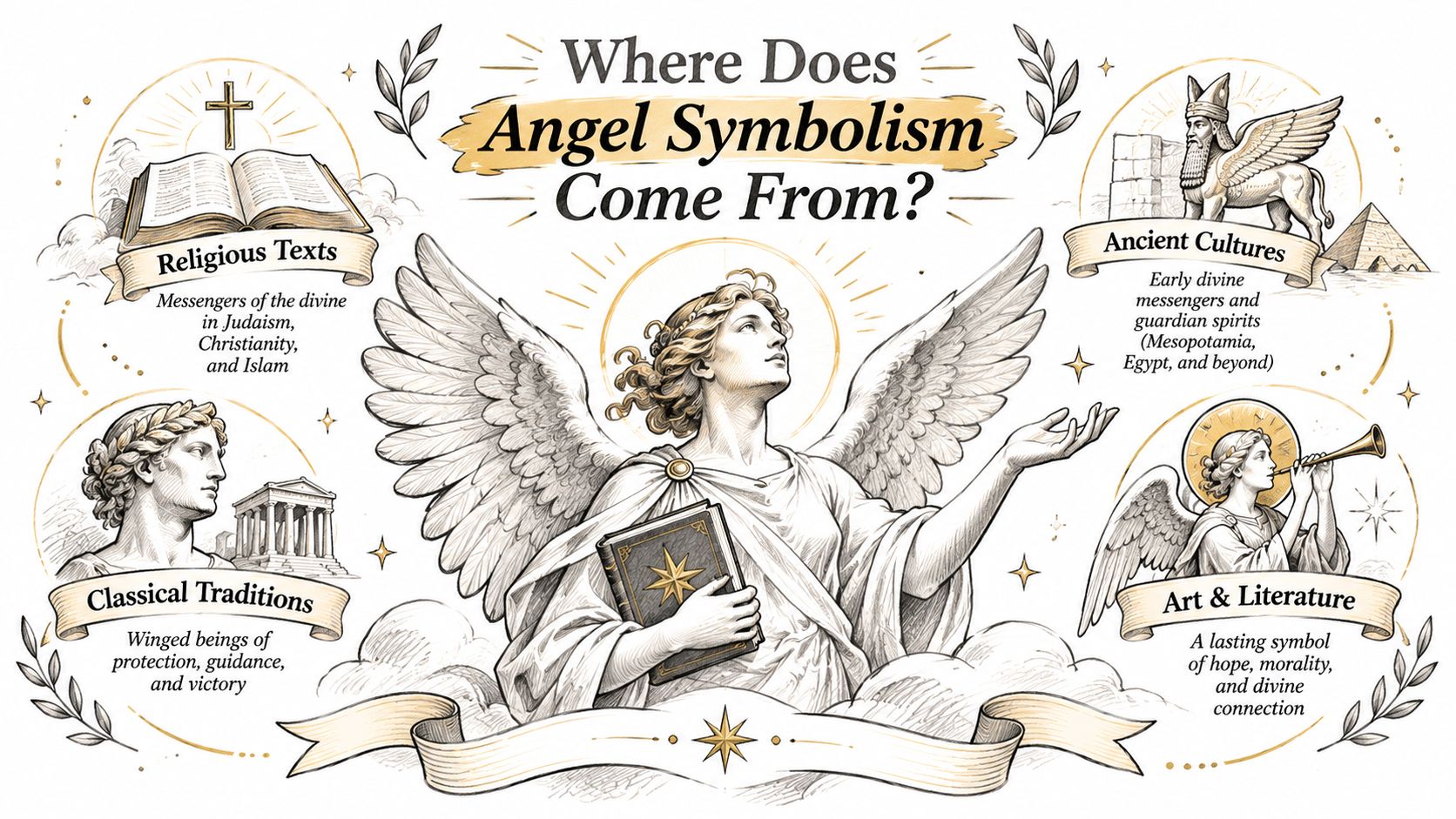
The story begins with a role, not a pair of wings. The Rijksmuseum's guide to angels traces the word to the Greek angelos, meaning “messenger,” and describes angels within Judaism, Christianity, and Islam. That background helps explain why an angel can suggest communication with the divine rather than mere goodness or beauty.
Think of an artist trying to show a messenger whose origin isn't earthly. Clothing, gesture, light, and eventually wings give viewers clues about the figure's identity. Over time, those clues become familiar enough that someone can recognize an angel without seeing the event the figure originally belonged to.
From divine messenger to personal guardian
Theologians also organized angels into a heavenly hierarchy, placing seraphim at the top and guardian angels at the bottom. That ordering concerns religious roles, not how valuable a tattoo should feel to its wearer. A guardian design can emphasize personal care and protection, while imagery associated with higher angelic ranks can suggest divine power or closeness to heaven.
Angels weren't always depicted with wings. Their familiar appearance developed gradually, so a wingless figure isn't necessarily disconnected from angelic history. Equally, a modern winged outline doesn't reproduce every belief attached to older religious artwork.
For choosing a design, these roots offer practical distinctions:
- Messenger: Emphasize communication, revelation, or an important personal reminder.
- Guardian: Focus on companionship, vigilance, or the feeling of being watched over.
- Heaven and earth: Use the figure to express spiritual connection or movement beyond ordinary limits.
A star beside an angel can introduce another layer of personal symbolism. If you're considering that combination, explore star tattoo meaning before treating the accent as decoration alone.
These histories aren't interchangeable religious instructions. They explain why the same broad image can hold faith, comfort, aspiration, and remembrance at once, while still carrying different significance in different communities.
How Do Details and Setting Change the Reading?
A halo, a weapon, and a date aren't minor finishing touches. Each helps viewers decide whether they're looking at a comforting guardian, a sacred figure, or a memorial. Details can change the message even when the angel's basic outline stays the same.
The Uffizi Galleries' exhibition on angel imagery explains the visual tradition behind these distinctions: wings connect heavenly and earthly realms, halos indicate sanctity, and white or golden garments suggest purity. It also places the emergence of winged Christian angels in the fourth century, with fifth-century mosaics helping establish the familiar form.

Read the attributes before the expression
Halos and rays of light strengthen a devotional reading. Combined with a cross or scripture, they make an explicitly Christian interpretation more likely. A plain figure without those attributes leaves more room for a personal guardian interpretation, although simplicity doesn't erase the symbol's religious roots.
A sword or spear points toward the warrior-angel tradition associated with Saint Michael. Instead of gentle reassurance, the image may communicate defense, judgment, or resistance. A trumpet suggests proclamation, while a scroll or inscription directs attention toward a message.
Feathers deserve a separate look, too. An intact wing and a detached feather don't necessarily tell the same story, so consider feather tattoo meaning if your design isolates that detail.
Separate your intention from a viewer's assumption
Say you choose a large kneeling angel with dates because it represents surviving a difficult period. A stranger may reasonably assume it commemorates someone who died. Your meaning remains valid, but the dates and mourning posture make bereavement a plausible reading.
A warrior angel holding a sword may mean courage to you, while another viewer sees combat, spiritual defense, or religious allegiance. A minimalist single wing may feel spiritual to its wearer but look primarily decorative to someone else.
Setting changes the conversation. A visible wrist or neck design at work may invite casual questions; the same image at a religious gathering may prompt a more specific discussion about belief. A design covered by a sleeve gives you more control over when that discussion happens.
You don't owe everyone your story, but it helps to know which story they may assume.
Before choosing, use this checklist:
- Name the figure. Is it a generic guardian, a recognizable archangel, or a memorial child?
- List every element. Include the halo, weapon, clothing, expression, text, dates, and background.
- Check the combined reading. What does each element add, what might a stranger assume, and where will people see it?
Aim for details that support a clear message rather than competing emotional cues. Write your intended meaning in a sentence before choosing the artwork, such as wanting a quiet reminder of guidance rather than an image of battle or loss.
Could an Angel Design Carry Someone Else's Meaning?
Yes, particularly when a design comes from a recognizable family, memorial, or religious tradition. Appreciating an image doesn't automatically mean you understand its context. Researching that context is a form of respect, not a test you have to pass before enjoying art.
A generic adult angel, a cherub-like child, and an angelito memorial image shouldn't automatically be treated as interchangeable. In Mexican-American and Chicano traditions, an angelito can commemorate a child who died young and carry specific Catholic and family meanings. Using that image only because it looks sweet could be painful for someone who recognizes a connection to child loss.
Look beyond the label
A seller's broad description of angel artwork may not identify every reference within it. Check the figure's attributes and any accompanying words, especially if the image resembles devotional art. A saint's name, a recognizable attribute, or a scripture verse can communicate a religious commitment you didn't intend.
This doesn't mean every childlike winged figure is a memorial or that every winged warrior is identifiable as a particular sacred figure. It means appearance alone isn't always enough to establish context. When a motif seems culturally specific, investigate its origin rather than assuming that all angel imagery means protection.
Ask yourself:
- Personal connection: Does this image come from my own family or faith, or am I borrowing it mainly for its appearance?
- Understanding: Can I explain the tradition accurately without reducing it to a decorative theme?
- Respect: Would someone connected to that tradition likely understand my use as thoughtful?
These questions help identify cultural-appropriation concerns without treating every cross-cultural influence as identical. Intent matters, but so does the significance an image already has for other people.
If you're unsure, choose a related non-sacred motif rather than copying a particular memorial figure or devotional composition. An abstract wing, a simple celestial accent, or an original design can express your intention without borrowing someone else's family story. You can keep the feeling you love while changing the visual reference.
Which Angel Styles Change the Message?
Style changes the emotional tone, even when the figure stays in the same pose. Think of these as visual tendencies, not rules about what a tattoo must mean.
| Style | How it can feel | Meanings it may support |
|---|---|---|
| Fine-line | Light, restrained, intimate | Quiet guidance, a minimal halo, personal remembrance |
| Realistic shading | Detailed, substantial, sculptural | Devotion, mourning, a strong sense of presence |
| Blackwork or bold silhouette | Graphic, forceful, high-contrast | Defiance, strength, warrior or fallen-angel themes |
| Watercolor-style | Soft-edged, fluid, expressive | Hope, grace, emotional openness |
A fine-line guardian can feel like a private reminder rather than a public declaration. Realistic shading gives more attention to the face, hands, and folds of clothing, which can make a kneeling figure feel solemn. Neither approach guarantees a religious or memorial interpretation.
Compare the same design in different styles
Sketch the same pose as a delicate outline and as a solid, dark silhouette. Keep the wings, expression, and surrounding symbols unchanged, then ask which version better matches your intended message. This isolates the effect of style rather than comparing unrelated drawings.
A useful test: Choose the version that feels right without needing an explanation to soften it.
A dark, bold angel may prompt a different reaction than a delicate outline in the same setting. If you prefer a less figure-focused direction, celestial tattoo ideas can help you consider a broader visual language.
Treat styles as options to explore, not promises about how every viewer will respond. Your own associations still matter.
Where Should an Angel Tattoo Go?
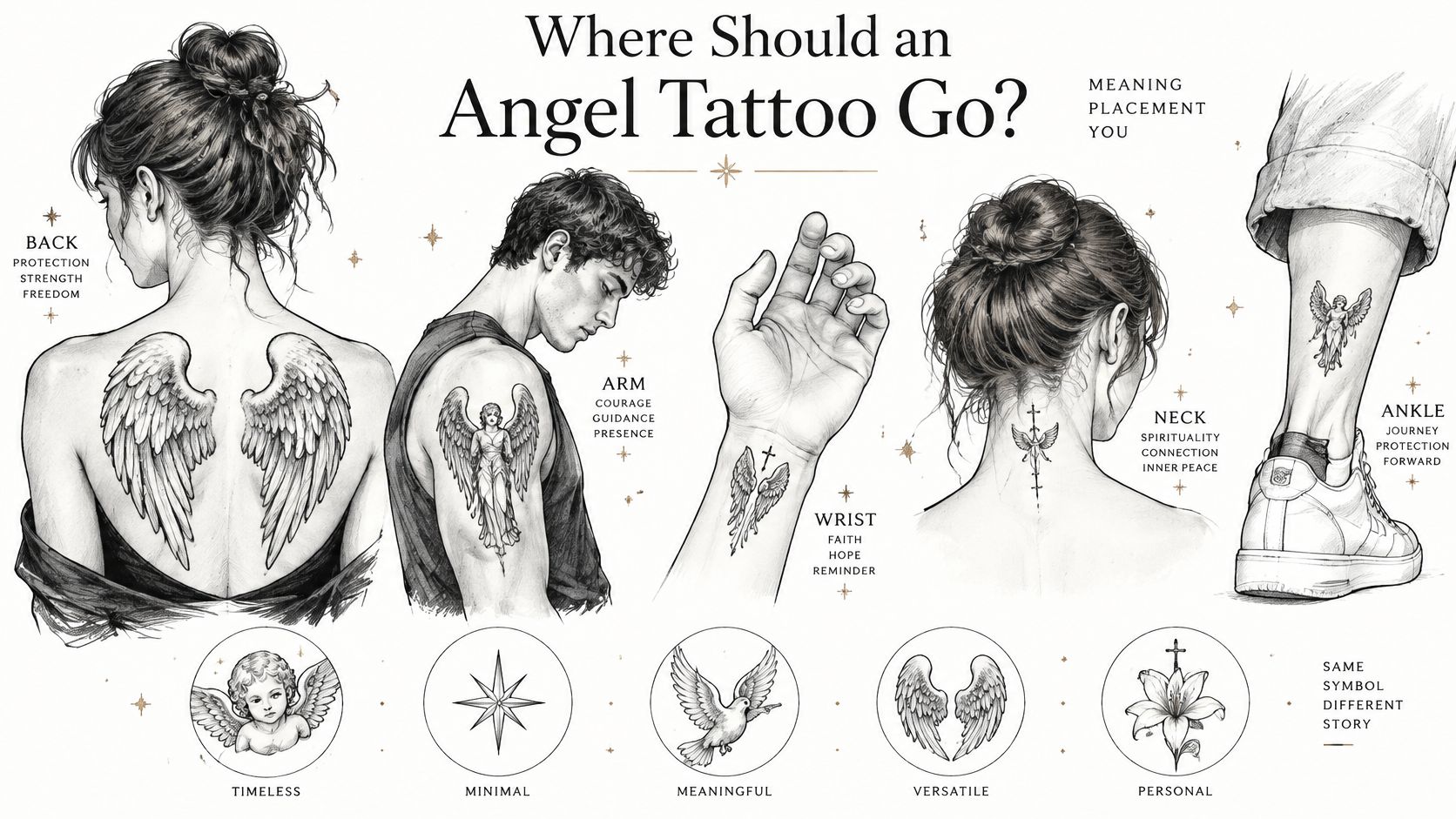
Match the available space to the shape of the artwork, then decide how visible you want it to be. Small guardians and minimal halos can suit the wrist, ankle, or inner forearm. These areas make a design easy for you to see, but whether it stays low-key at work depends on clothing and workplace expectations.
Larger kneeling or warrior figures need room for the wings, hands, and attributes to remain distinct. The upper back, upper arm, thigh, or shoulder blade can give a full composition more breathing room than a narrow wrist.
Check the proportions on your body
Our Angel & Devil Hearts tattoo consists of two hearts, each measuring 1.5 x 1.5 inches, for paired placements such as one per wrist, one per ankle, or both sides of the collarbone. For the options you're comparing, check the dimensions on this angel-themed product page and this alternative product page, rather than judging scale from a close-up photograph.
- Mark the outline: Use a skin-suitable cosmetic pencil or marker to indicate the listed height and width.
- Step back: Check the proportions in a mirror with your arm relaxed.
- Try everyday clothing: See what remains visible and whether sleeves or necklines interrupt the composition.
An inner-arm memorial can feel private when covered. A neck design is harder to conceal, while chest visibility depends on the neckline. Choose a placement that suits both the image and your willingness to answer questions about it.
Try it before you commit
Testing the design can clarify both placement and meaning. Scientific literature available through NIH's PubMed Central describes permanent tattooing as inserting pigment into the dermis with needles, creating a lasting mark. A needle-free semi-permanent design lets you assess the appearance without immediately choosing that permanence.
Our application process happens at home, and the design develops in about 24 hours. Most designs last 7–10 days, depending on skin and placement. If you have sensitive skin, consider a patch test before applying the full design; that isn't a guarantee against a reaction.
Make the trial useful
- Choose for meaning. Pick artwork that matches your intention, not just an appealing photograph.
- Use the intended placement. Wear it where you'd consider permanent ink, so you can judge scale and visibility.
- Notice your response. Live with it for a few days and ask someone you trust what they think it communicates.
Our guide to trying a tattoo before getting it can help you plan that preview. Testing can also serve a simpler purpose, such as matching with a friend for a trip or changing your look without booking an artist.
Browse the full design catalog to compare celestial imagery with floral, animal, Japanese, tribal, and color directions. If the motif still feels personally accurate after a week of wear, it may be worth discussing with a permanent tattoo artist. There's no need to rush that decision.
Just Tattoos offers realistic-looking, semi-permanent tattoos made with plant-based ink for at-home application without needles, available in the US. Visit Just Tattoos to choose an angel-inspired look and test whether its symbolism and placement feel right for you.
Part of our Tattoo Symbols and Meanings guide, which groups every symbol by theme, from animals and flowers to sun, moon and stars.