
A tattoo can look almost invisible when you apply it and still develop into convincing body art. Our plant-based ink starts faint and develops over about 24 hours. The practical answer to semi permanent tattoo vs temporary is simple: choose absorbed ink for a realistic, matte look, a printed decal for immediate color and easier removal, or henna for a paste-applied skin stain.
Table of Contents
- How Do Semi Permanent and Temporary Tattoos Compare?
- What Does Each Type Look Like on Skin?
- How Do You Apply Each Type Without Mistakes?
- Why Does Semi Permanent Ink Take About 24 Hours to Develop?
- How Long Do Designs Last in Daily Life?
- What Should You Check Before Trying Henna?
- Which Option Fits What You Are Testing?
How Do Semi Permanent and Temporary Tattoos Compare?
A temporary decal transfers a printed film onto the skin's surface. A semi permanent tattoo uses plant-based ink that absorbs into the outer skin layer, while henna uses a paste to leave a stain. Those differences matter more than the word temporary on the package.
Semi permanent, decal and henna compared
| Feature | Semi permanent | Temporary decal | Henna |
|---|---|---|---|
| Application | Press on with a damp cloth and peel the backing, no needles | Press face down with a wet cloth and slide the paper off | Paste painted on skin freehand or through a stencil |
| First appearance | Faint at first, develops over about 24 hours | Full color immediately after transfer | Orange stain that deepens as it oxidizes |
| Finish | Matte ink in the outer skin layer, nothing to peel | Printed film that can look glossy and crack at creases | Stained skin with no film |
| Wear time | Most designs last 7–10 days, depending on skin and placement | About a day to a week or longer | About three days to several weeks |
| Water | Water-resistant once developed, suitable for showers and gym activity | A quick shower may leave it intact, but edges can soften | Washing and scrubbing speed fading |
| Removal | Fades on its own as skin renews | Oil or an appropriate alcohol-based remover can lift the film | Fades naturally rather than washing off on demand |
The decal and henna wear windows are described in the FDA's temporary tattoo guidance. They're category estimates, not promises for every application.
Why the labels cause confusion
Temporary is an umbrella term, not a description of how a product works. Advice to remove a tattoo with oil makes sense for a printed film. It doesn't mean you can wipe away ink that has already stained the outer skin.
Permanent tattooing is a separate category again. The FDA's tattoo-safety update reports that about 30% of Americans have at least one permanent tattoo, rising to 40% among adults aged 18–34. A trial design can help someone considering that commitment judge placement and scale, but it isn't a preview of the tattooing procedure itself.
At Just Tattoos, we sell semi-permanent designs for adults made with plant-based ink, applied at home without needles. You can browse the full design collection by the artwork you want to test, rather than choosing on duration alone. We serve US customers only.
Start with your non-negotiable: If you need the design gone tonight, easy removal matters more than realism. If you want to live with the placement, the finish and everyday wear matter more.
Read the comparison by priority. Immediate appearance points toward a decal; a matte finish points toward absorbed ink; paste application and traditional artwork point toward henna.
What Does Each Type Look Like on Skin?
Texture and edges matter more than the artwork alone when judging how a temporary tattoo looks. Printed decals, absorbed ink, and henna give different results, even when the outlines are similar. Choose the finish that suits the look you want to wear.
Look closely at the border
Check how the outline sits across your chosen placement. On a forearm, you can judge the whole shape easily; across a knuckle, look at whether the edges and fine details still read clearly as the hand bends. A design that looks balanced on a flat area can look different over a joint.
Decals suit bright costume artwork and graphics you want to wear immediately. Judge them on the strength of that printed design: its color, outline, and scale. Expecting a decal to look like a skin stain sets the wrong standard.
At Just Tattoos, our black semi-permanent designs develop from faint marks into deep blue-black ink. The plant-based ink absorbs into the outer skin layer, leaving no shiny film or die-cut border. Assess the finished outline once the color has developed, rather than judging the faint initial transfer.
Henna has a distinct visual identity: a warm orange-to-brown stain. Choose it for that color and the artwork it suits, rather than as a stand-in for blue-black ink.
Judge the design as it wears
Wear changes the outline as well as the color. Missing patches or lifting edges interrupt a decal's shape. An absorbed stain gradually loses intensity and definition, and friction can leave some areas lighter than others. Look at whether the design remains readable as those changes appear.
For colored designs, assess the shade on your skin rather than expecting an exact match to a screen image.
Use daylight to judge color, then look from your usual viewing distance. Close-up details deserve less weight if they disappear when you're dressed and moving. Check scale: smaller fine artwork and broad solid areas create different visual effects. Check your skin tone: contrast affects how clearly fine lines and lighter colors show.
Prioritize liking the result on your own body, including its placement, color, and appearance as it fades.
How Do You Apply Each Type Without Mistakes?
Preparation matters more than pressing harder. Clean, dry skin gives both transfer methods a better starting point, while lotion, body oil, and an awkward crease can spoil an otherwise good application.
Keep the procedures separate. Similar-looking backing paper doesn't mean every product uses the same transfer process.
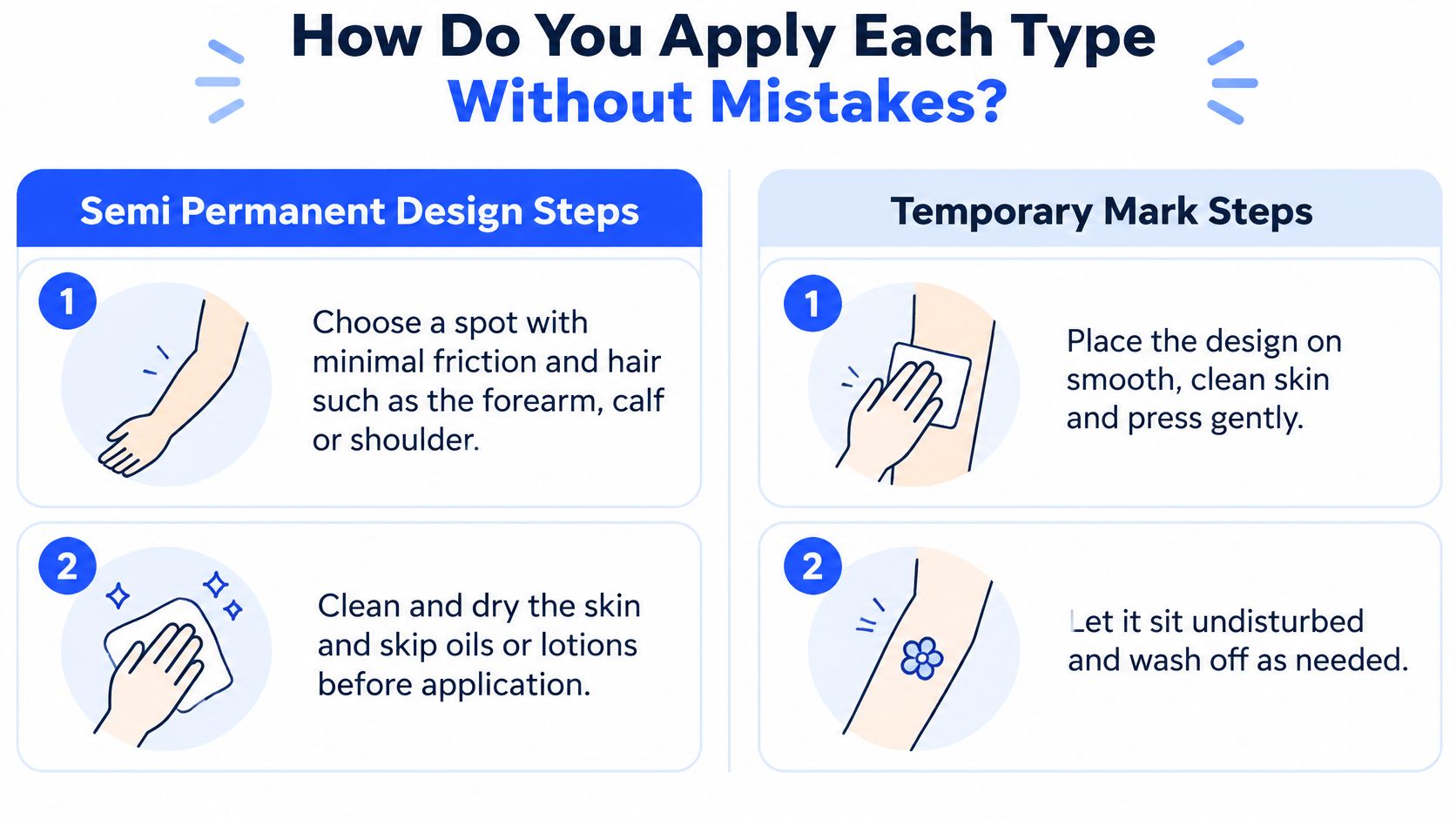
Applying a semi permanent design
- Choose a low-friction spot, such as the forearm, calf, or shoulder, so movement and rubbing won't work against the fresh design.
- Clean the skin, removing lotion and oil that could interfere with contact.
- Dry the area completely, so you're starting with a controlled surface rather than leftover wash water.
- Place the design face down, checking its direction before it touches your skin.
- Press with a damp cloth for 30–60 seconds, maintaining even contact across the artwork.
- Peel the backing away slowly, so a rushed pull doesn't disturb the transfer.
- Leave the faint design alone, rather than rubbing it to see whether it has worked.
- Keep lotions, sunscreen, and heavy oils off the area for at least 24 hours, as we recommend during development.
Avoiding sunscreen on the fresh design isn't a reason to leave your skin exposed. Choose a placement you can cover with loose clothing or keep the area out of the sun during that initial period.
Applying a printed decal
- Cut around the artwork, so excess paper doesn't make positioning awkward.
- Remove the clear protective film, allowing the printed side to contact your skin.
- Position it face down on clean, dry skin, keeping it clear of a deep fold.
- Wet the backing thoroughly, so the image can release instead of tearing during removal.
- Hold the paper still for the package's stated transfer time, rather than sliding it around to check underneath.
- Slide the backing away gently, leaving the transferred film undisturbed.
- Let the surface dry without clothing rubbing it, so a sleeve doesn't catch the new edges.
Henna needs a different procedure because the paste must stay in place before it's removed. Follow the specific paste instructions or the artist's aftercare guidance; don't borrow decal instructions for it.
Application rule: Don't compensate for poor contact by repeatedly lifting and replacing the design. Position it carefully, wet it evenly, and remove the backing slowly.
The repeat offenders are moisturizer underneath, too little water, constant bending, and rushed backing removal. Open our step-by-step tattoo application guide before starting, especially if you're positioning a larger piece where correcting the angle will be difficult.
Why Does Semi Permanent Ink Take About 24 Hours to Develop?
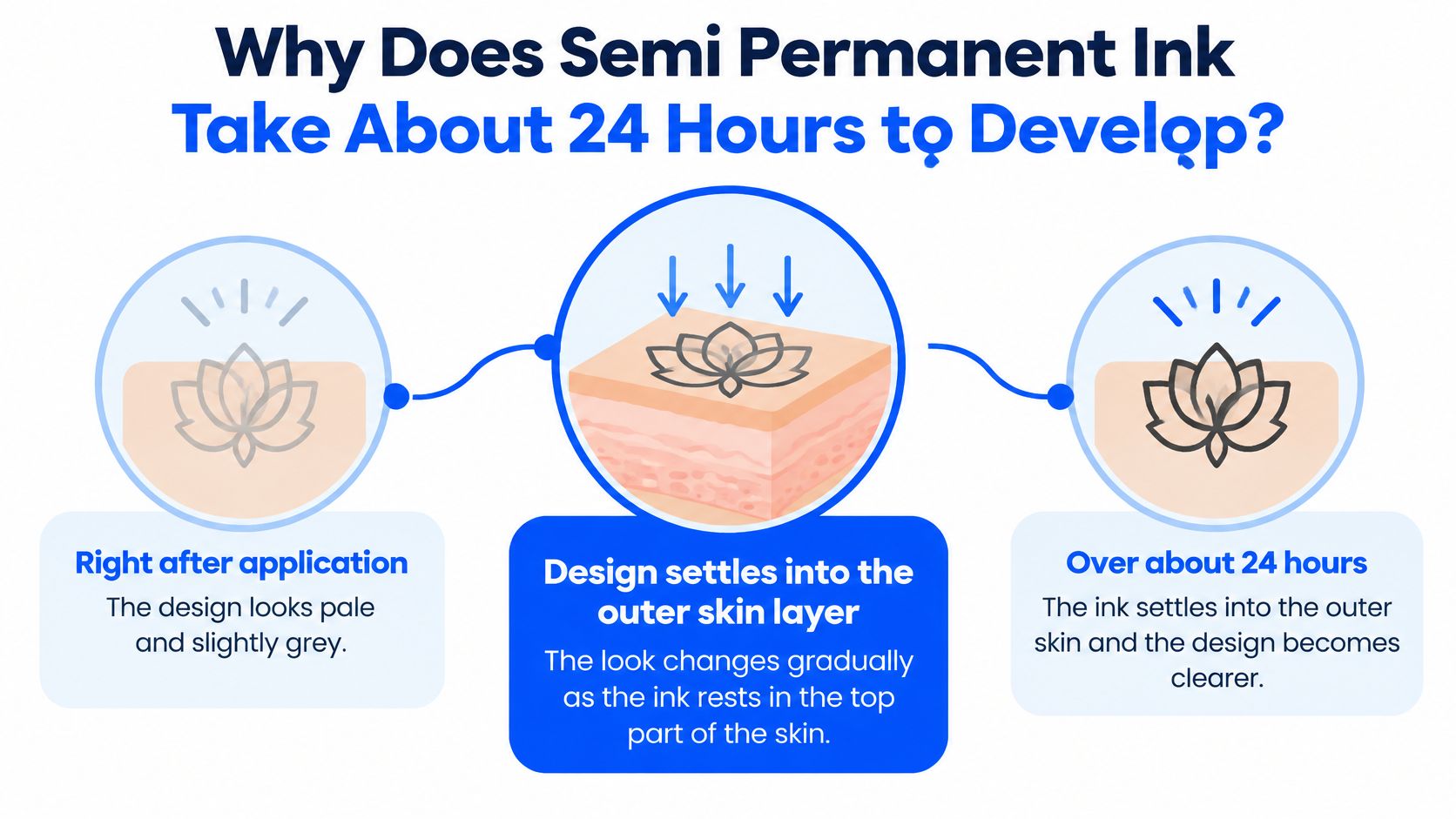
The wait is the point. Just Tattoos semi-permanent ink starts faint, then develops over 24 hours from a pale transfer into a deep blue-black that reads like a real tattoo. The change is gradual, so the color you see right after application is only the beginning.
There is no exact minute when the finish appears. The ink absorbs into the outer layer of skin and develops there, which is why the design shifts in depth and tone across the first day. Read how semi-permanent tattoos work for the closer science behind that process.
Where the color sits matters
A printed decal shows its finished image as soon as it transfers because the artwork sits on the skin's surface. Semi-permanent ink goes into the outer skin layer instead, so the visible color needs time to develop. That difference is the whole reason the two products behave so differently in the mirror.
Permanent tattooing places pigment deeper in the skin. Semi-permanent designs do not do that, and they do not wash off like a sticker either. The ink absorbs into the outer layer, so there is no shiny film to peel and no raised printed edge to catch on clothing.
Skin tone, placement, preparation, and early sweating can all affect the finished appearance. A clean forearm and a frequently rubbed wrist are not identical canvases, even with the same artwork and the same application method.
What to expect during the development window
Judge the shade after development, not right after removing the backing. The early pale look is part of the process, and the design continues to deepen as the ink develops.
- Assess it after development: Give the color the full 24 hours before deciding how it looks.
- Expect a deeper finish: The developed shade reaches a deep blue-black that reads like a real tattoo.
- Plan around the delay: Apply the design ahead of the occasion, especially if you want the finished look for photos or a full day out.
Henna also changes after application, beginning with an orange stain that deepens as it oxidizes. That is another reason a fresh mark tells you very little about the final look. The practical call is simple: treat the first day as development time and choose semi-permanent ink when you want absorbed color, not an instant surface transfer.
How Long Do Designs Last in Daily Life?
Most designs last 7–10 days, depending on skin and placement, then fade on their own as skin renews. Treat that as a realistic styling window, not a deadline you can schedule to the hour.
Placement is the most useful variable you control. Choose an area because it suits both the artwork and your routine, not just because it looks good in a close-up photo.
Which placements hold a design longest?
| Placement | Friction and washing | What it means for wear |
|---|---|---|
| Forearm | Low, easy to keep dry | Best chance of a full wear period |
| Upper arm | Low, covered by sleeves | Holds well under loose clothing |
| Shoulder | Low | Good for larger designs, away from straps |
| Calf | Low, easy to keep dry | Holds well through ordinary daily activity |
| Back and chest | Low to moderate, sweat under clothing | Large designs work; rubbing can cause local fading |
| Wrist | Moderate, watches and bracelets rub | Edges can fade first |
| Hand | High, washing and sanitizer | Shorter wear than the arm |
| Fingers | High, constant bending | Among the quickest placements to lose definition |
| Feet and ankles | High, socks and shoes | Friction concentrates at the shoe line |
| Neck and collarbone | Moderate to high, exposure and collars | Clothing friction can speed fading |
A shoulder placement isn't automatically low-friction if your bag strap crosses it all day. A calf design may face little rubbing in shorts but much more under tight boots. Map the artwork against the things that touch your skin.
Hair, dry or flaky skin, fitted sportswear, and frequent sweaty workouts can also affect the result. For narrow spaces, small designs are easier to position on wrists, fingers, and ankles, but a smaller size doesn't cancel out the wear those areas receive.
Water isn't the same as abrasion
Once developed, our designs are water-resistant and suitable for showers and gym activity. Ordinary soap doesn't wash away the absorbed ink.
Scrubbing is a different matter. Loofahs, body scrubs, exfoliating acids, and repeated towel friction work against the outer skin layer where the design sits. Long hot soaks can also make a careful wear routine harder to maintain.
Keep the routine simple:
- Pat dry: Press a towel against the area instead of dragging it across the lines.
- Skip exfoliation on the artwork: Keep scrubs and exfoliating products away while you want the design visible.
- Avoid tight contact on a fresh design: Choose loose clothing rather than a snug cuff or strap.
- Keep normal hygiene: Don't skip handwashing to preserve a hand tattoo.
A decal's vulnerable points are its film and edges, so soaking and rubbing can lift it. Henna behaves as a stain, making repeated washing and exfoliation more relevant than a peelable border.
You can't control how quickly your skin renews. You can choose whether your design sits beneath a watchband, sock cuff, or bag strap.
Our guide to how long semi-permanent tattoos last offers more placement detail. For a first trial, I'd choose the forearm, calf, or shoulder rather than a finger: you'll learn more about whether you like the design and less about how often you wash your hands.
What Should You Check Before Trying Henna?
Plant-based doesn't mean interchangeable, and temporary doesn't mean reaction-free. Henna paste, a printed decal, and absorbed semi-permanent ink have different ingredients and application methods. Read what you're putting on your skin, not just the category printed on the front.
Traditional henna leaves a warm-colored stain. Products sold as black henna are a different concern because they often contain p-phenylenediamine, or PPD, a hair-dye ingredient that can cause dangerous skin reactions.
Check ingredients before color
The FDA's tattoos and permanent makeup fact sheet warns about reactions involving temporary products, including henna and hair-dye ingredients, and notes that some have caused scarring. The agency also states that henna is approved in the US as a hair dye, not for direct application to skin.
Don't interpret a familiar tradition as proof that every commercial paste has the same composition. Ask the artist or seller for the complete ingredients, and avoid anything sold as black henna.
- Read the ingredient list: Don't accept natural as a substitute for disclosure.
- Confirm the intended use: Hair color isn't automatically suitable for body art.
- Avoid black henna: Don't use a patch test as a workaround for the PPD concern.
- Consider a patch test for sensitive skin: Follow the product's directions, without treating a clear result as a guarantee.
A good first day proves little
Reactions don't always appear immediately. The Minnesota Department of Health reports that most black-henna reactions occur 4–10 days after application, although they can appear as late as 3 weeks afterward.
That delay matters when someone says a product must be suitable because it looked fine when applied. If you develop itching, redness, swelling, or blistering, stop using the product and seek medical advice rather than trying to scrub the design away.
Our jagua and henna comparison can help you distinguish stain categories. The buying rule stays the same: choose disclosed ingredients and a clearly stated application method over reassuring marketing language.
Which Option Fits What You Are Testing?
Two placements are better than one. If you are deciding between the forearm and shoulder, or between a small back-of-hand piece and a finger design, test them in the same week. Skin moves, stretches, sweats, and meets clothing differently in each spot. A design you love on a flat photo can feel completely wrong under a sleeve or beside a watch strap.
Which product fits which situation
| Situation | Best fit | Why |
|---|---|---|
| Testing a design before booking a permanent artist | Semi permanent | Lets you assess the placement through showers, workdays, and real clothing |
| You need a design for tonight | Decal | Full color immediately and removable with a suitable remover |
| A sleeve look for a weekend trip | Semi permanent sleeve | Gives you a larger composition without needles |
| Matching designs for a group trip | Semi permanent multipacks | Lets friends coordinate artwork for the trip |
| A one-day costume or kids' party | Age-appropriate decal | Quick application and easier planned removal |
| A bridal or festival henna tradition | Henna from a trained artist with disclosed ingredients | The paste application and stain are part of the tradition |
| Seeing how color reads on your skin tone | Semi permanent colored designs | Lets you inspect the developed shade in daylight |
Make a placement trial useful
Choose the exact body area you're considering, not an easier spot nearby. A design above your wrist tells you something different from the same design beneath a sleeve.
Use the same design in two locations if sizing allows. That gives you a cleaner answer than testing two different artworks at once. Wear each one with your normal clothes and pay attention during ordinary activities. Does the artwork disappear under your usual neckline? Does it feel too prominent when you're working, or too small when you see your whole arm in a mirror?
Photograph both placements in daylight, close up and with the surrounding body area visible. Revisit those pictures after the novelty has worn off. For a larger composition, compare sleeve designs and check how the artwork wraps around the arm, not just how it looks from the front.
Our Try On AR feature can help you preview positioning before applying. Use it to narrow your choice, then use actual wear to judge the placement in daily life.
A decal works when the deadline is today and removal is part of the plan. Henna works when the application ritual matters. Semi permanent ink works when you want a placement to behave like body art through normal days, with no needles and no sticker film. Just Tattoos designs use plant-based ink, develop over about 24 hours, and fade on their own after 7 to 10 days.
For a second trial, pick a low-friction area such as the forearm, calf, or shoulder. Those spots make it easier to judge the design itself instead of fighting rubbing fabric, heavy sweat, or repeated washing.
Just Tattoos offers plant-based, needle-free designs you can apply at home to test a placement or change your look. Visit Just Tattoos to choose your design; US shipping is $4.99 flat and free on orders of $35 or more.